If your telemarketing program targets Canadian consumers, the National Do Not Call List, commonly called the DNCL, is not optional background reading. It is a legal requirement enforced by the CRTC, and the rules around it are more nuanced than “don’t call anyone on the list.” This guide focuses specifically on consumer telemarketing, the exemptions that actually apply, and how to keep a calling program compliant without losing the leads that are still fair game.
This is a different question from business-to-business outbound compliance. B2B telemarketing operates under a separate set of considerations involving CASL and implied consent between organizations. Consumer telemarketing, by contrast, runs through the DNCL framework directly, and the rules for who you can and cannot call are specific enough that it is worth walking through them carefully.
What the National DNCL Actually Covers
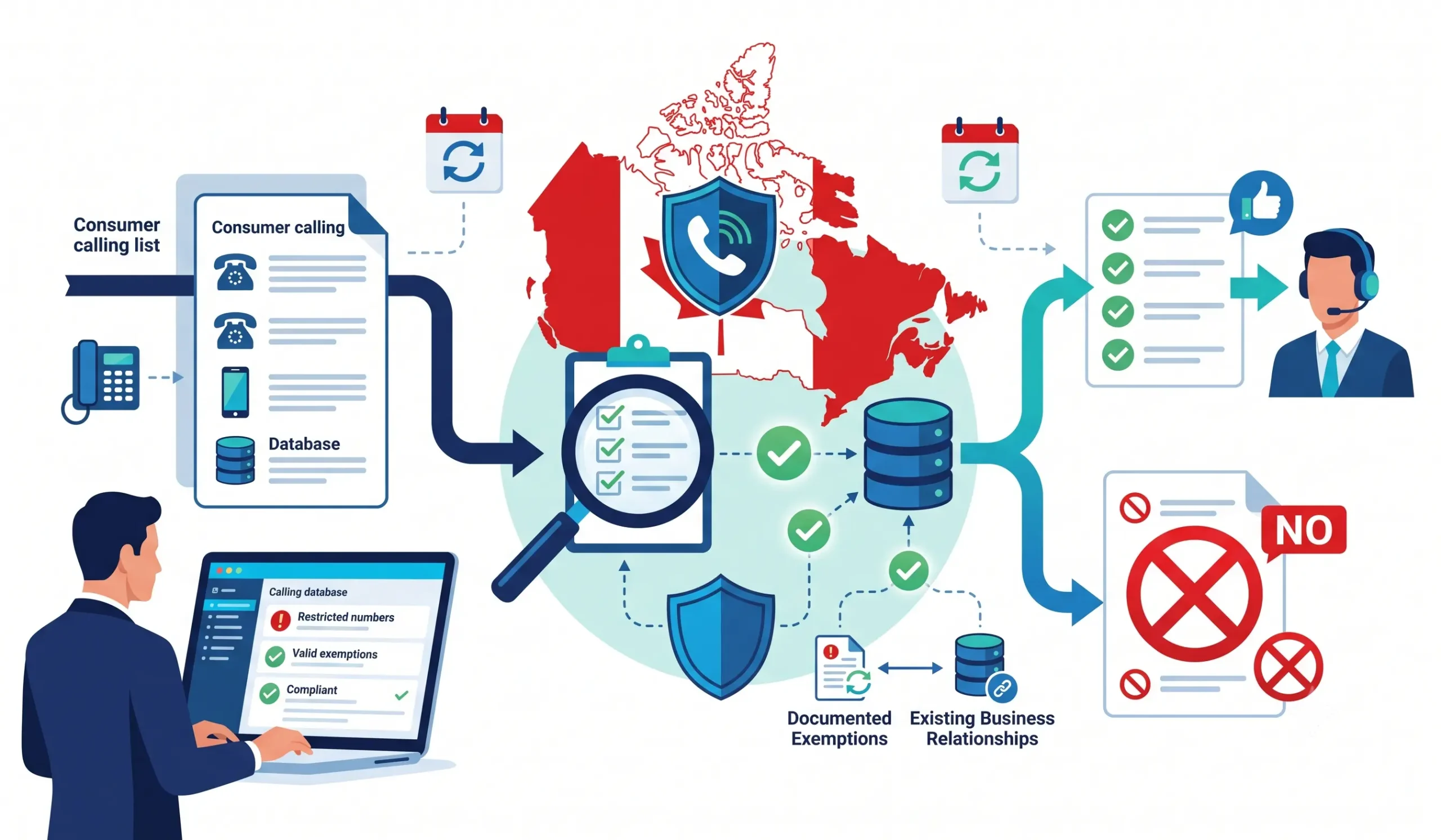
The National Do Not Call List lets Canadian consumers register their residential and wireless phone numbers to reduce unsolicited telemarketing calls and faxes. Any organization that engages in telemarketing to Canadian consumers, or that hires a third party to make those calls on its behalf, is required to subscribe to the DNCL and to regularly scrub its calling lists against the registry.
That subscription requirement has been mandatory since September 30, 2008, and it applies regardless of whether the calls are made in-house or outsourced to a call center. If your organization directs the calling campaign, the compliance obligation is yours, even if someone else is dialing. For a broader overview of the rules governing outbound channels in Canada and the US, see our direct marketing regulations resource.
The Exemptions That Actually Matter
Registration on the DNCL reduces telemarketing calls, it does not eliminate every category of outbound call. A handful of exemptions determine what a consumer telemarketing program can still legally do.
Existing business relationship
You may call a consumer registered on the DNCL if you have an existing business relationship with them. That relationship exists when the consumer has purchased, leased, or rented a product or service from your organization within the past eighteen months, has made a written inquiry about your products or services within the past six months, or currently has, or had within the past eighteen months, a contract with your organization. This exemption is the one most consumer marketers rely on for reactivation and retention campaigns, and it is also the one most often misapplied when the relationship window has quietly expired.
Registered charities
Registered charities are permitted to call consumers to solicit donations even if those consumers are on the National DNCL. This exemption is specific to charitable solicitation and does not extend to a charity’s commercial partners running co-branded campaigns unless the call itself is a donation solicitation. Organizations running donation campaigns typically pair this exemption with a properly segmented donor list built for charitable outreach.
Other narrow exemptions
Political parties and candidates, newspapers soliciting subscriptions, and businesses calling in response to a consumer’s own request for a call are also treated differently under the framework. Each of these carries its own conditions, and the safest approach is to confirm which exemption applies before relying on it, rather than assuming a general “we have a reason to call” standard will hold up.
What Happens When You Get It Wrong
The CRTC investigates complaints and can penalize violations of the Unsolicited Telecommunications Rules, with penalties reaching up to $1,500 for an individual and up to $15,000 per violation for a corporation. Because penalties apply per violation, a calling list that was not properly scrubbed against the registry can generate exposure that scales with the size of the campaign, not just a single flat fine.
Consumers who receive unwanted calls do file complaints regularly, and the DNCL framework was built specifically because unsolicited telemarketing calls remained a persistent source of consumer frustration. A calling program that treats list scrubbing as a one-time setup task rather than an ongoing process is the most common way organizations end up on the wrong side of this.
Building a Compliant Consumer Telemarketing List in Practice
Scrubbing a calling list against the DNCL registry is the baseline requirement, but a well-built consumer telemarketing list goes further than the minimum legal standard.
Start with a list that is already segmented with compliance in mind, meaning the provider can tell you which records reflect an active or recent business relationship versus which are cold prospect records requiring a fresh DNCL scrub before use. Maintain a documented process for when the scrub was last run relative to your campaign date, since the registry itself updates continuously and a scrub performed weeks before a campaign launch is not the same as one performed immediately before dialing begins. And keep a clear record of which exemption applies to which segment of your calling list, so that if a complaint is filed, you can point to the specific basis for the call rather than reconstructing your reasoning after the fact.
Where This Fits Alongside Your Broader Compliance Program
Consumer telemarketing compliance under the DNCL framework sits alongside, but separately from, your organization’s broader marketing compliance obligations. A business running both consumer telemarketing and business-to-business outbound calling needs to treat these as two distinct compliance tracks: one governed by DNCL registration and scrubbing, the other by CASL and implied consent standards for business contacts. Treating them as a single unified process is a common source of confusion, since the exemptions, registration requirements, and penalty structures differ between the two. For the email side of that second track, our guide to CASL in 2026 covers what Canadian businesses need to confirm before sending a single commercial email.
How Long an Exemption Actually Lasts
One of the more common compliance mistakes is treating an exemption as permanent once it applies, rather than tracking its actual expiration. The existing business relationship exemption is explicitly time-bound: eighteen months from a purchase, lease, or rental, or eighteen months from the end of a contract, and only six months from a written inquiry. A consumer who qualified for outreach under this exemption a year and a half ago may no longer qualify today, even though nothing about your organization’s records has changed in the meantime.
This means a consumer telemarketing list is not a static asset that stays compliant indefinitely once built. It needs to be reviewed on a schedule that reflects these expiration windows, with contacts moved out of the callable segment as their relationship window lapses, rather than assuming a contact who was compliant to call last year is still compliant to call today.
Documenting Your Compliance Basis
Beyond scrubbing against the registry itself, maintaining a clear internal record of why each segment of your calling list is exempt, or confirming it has been properly registered against the DNCL, matters more than many organizations initially assume. If a complaint is filed, being able to point to a specific, documented basis for the call, this consumer had an active purchase within the past eighteen months, for example, is a materially stronger position than reconstructing the justification after the fact. This documentation does not need to be complicated, but it does need to exist and be current at the time the call was made, not assembled retroactively.
How This Affects Wireless Versus Residential Numbers
The National DNCL covers both residential landlines and wireless numbers, and consumer telemarketing programs that historically focused on landlines need to apply the same scrubbing discipline to mobile numbers used in text-based or voice campaigns. As more households rely exclusively on wireless service, a compliance program still built primarily around residential landline habits risks missing a growing share of the registered numbers it needs to check against. Treating wireless and residential numbers as a single combined scrub, rather than assuming mobile numbers fall outside the registry’s scope, is a detail that is easy to overlook and costly to get wrong.
What a Reasonable Internal Review Cadence Looks Like
Because the DNCL registry updates continuously as consumers register and deregister numbers, a scrub performed at the start of a long campaign gradually loses accuracy the further the campaign runs past that initial check. For calling programs that extend beyond a few weeks, building in a re-scrub at reasonable intervals, rather than relying entirely on the pre-campaign check, keeps the list compliant throughout the full run rather than only at the outset. This is a small operational addition that meaningfully reduces exposure on longer campaigns without adding significant cost or complexity to the overall program.
Getting Your Calling Lists Right From the Start
A consumer telemarketing list that is properly scrubbed, segmented by relationship status, and refreshed on a predictable cycle removes most of the compliance risk before a single call is made. Building that kind of list internally, especially alongside DNCL registry checks that need to happen close to the campaign date, is a meaningful operational lift for most marketing teams. This is one of the core reasons marketers work with a list broker rather than managing sourcing and compliance segmentation in-house.
Prospects Influential prepares consumer telemarketing lists built to your specific campaign criteria, with attention to the compliance segmentation that a DNCL-aware calling program actually needs. Lists are typically ready within one to two business days of confirming your requirements, and once delivered, they can be used across your full campaign without a cap on usage. If your program spans multiple channels, the same criteria can extend to consumer direct mailing lists and consumer opt-in email lists alongside your calling file.
To discuss a compliant consumer telemarketing list for your next campaign, visit our consumer telemarketing lists page, explore the full range of consumer lists available, or get in touch directly to talk through your specific compliance requirements.