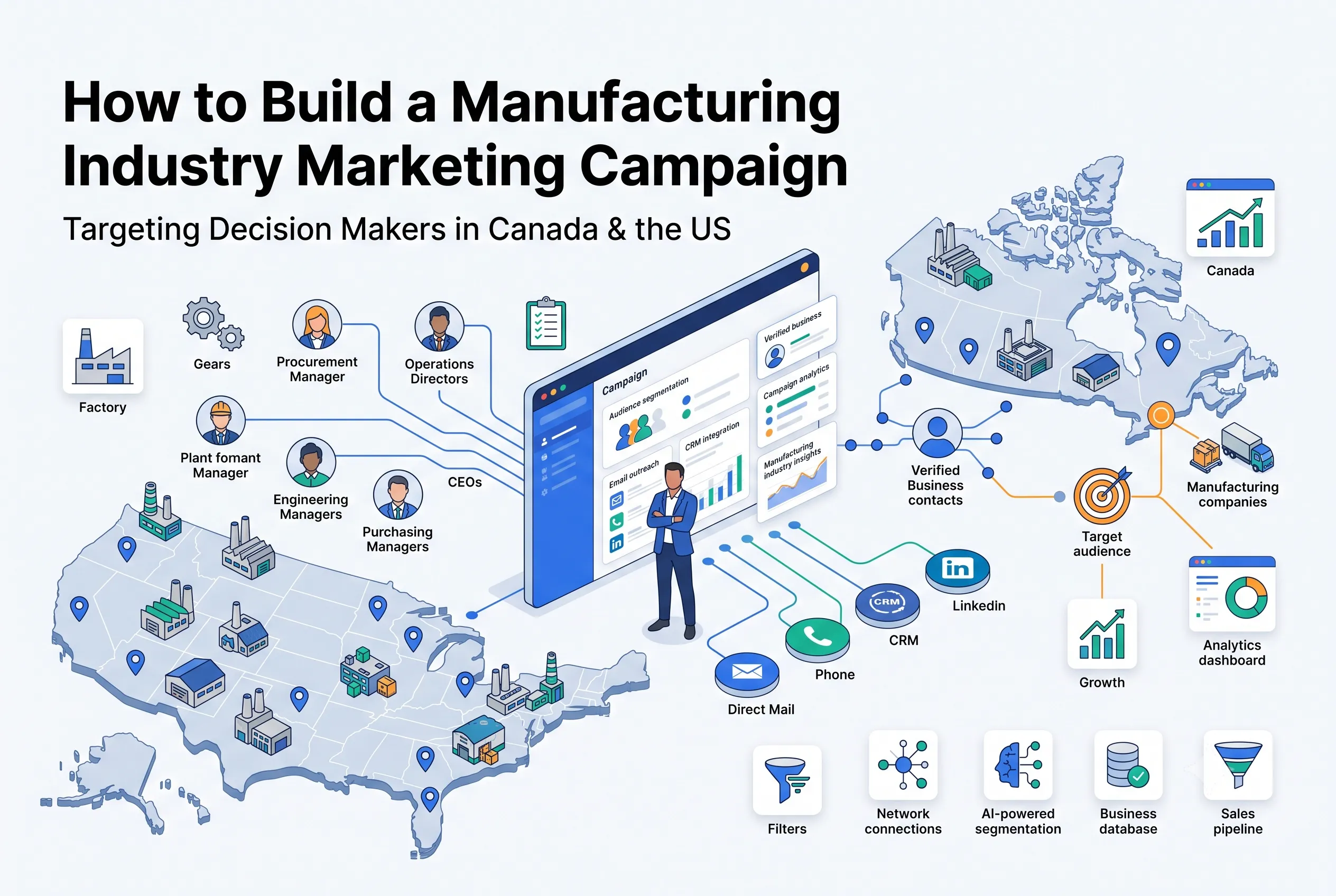
Manufacturing is one of the most valuable and most underserved sectors in B2B marketing.
Valuable because manufacturing companies buy enormous volumes of goods and services: equipment, software, raw materials, staffing, logistics, safety products, financial services, insurance, maintenance, and much more. A single manufacturing plant can be a significant customer for a wide range of suppliers.
Underserved because manufacturing companies are notoriously hard to reach through the digital channels that dominate modern B2B marketing. Senior decision makers at factories and industrial facilities are rarely active on LinkedIn. They don’t respond to cold email at the rates that office-based professionals do. Their buying decisions often happen through relationships built over time, not through inbound content marketing funnels.
This means that businesses targeting the manufacturing sector need to think differently about how they reach and engage their prospects. This guide covers who the real decision makers are in manufacturing, what channels work best, and how to build a marketing list that gives you a realistic shot at reaching them.
Who Actually Makes Buying Decisions in Manufacturing
One of the most common mistakes in manufacturing marketing is targeting the wrong person. Manufacturing organisations have distinct roles, and buying authority varies significantly depending on what you’re selling.
Plant Manager / Operations Manager. For anything that affects production, equipment, or plant operations directly, the plant manager or operations manager is typically a key decision maker or at minimum a key influencer. They own the budget for operational spending and have strong influence over what gets approved.
Procurement Manager / Purchasing Manager. For regular supply purchases, components, raw materials, and recurring vendor relationships, the purchasing function is the right point of contact. In larger manufacturing organisations, procurement teams have significant autonomy and specific vendor approval processes.
Maintenance Manager / Facilities Manager. For equipment maintenance, replacement parts, maintenance services, and facilities-related products, the maintenance or facilities manager is the relevant decision maker. They often have their own budgets and supplier relationships separate from general procurement.
Engineering or Technical Director. For technical equipment, specialised tooling, engineering services, or anything that requires technical specification and approval, the engineering function needs to be in the room. In many manufacturing companies, the engineering team effectively controls what technology and equipment gets purchased, even if procurement handles the actual vendor relationship.
CFO / Finance Director. For significant capital expenditures or financial products (equipment financing, insurance, banking), the CFO or finance director will be involved in approval. For smaller operational purchases, they’re typically less involved in day-to-day decisions.
CEO / Owner. In smaller manufacturing companies (under 50 employees), the owner or CEO is often directly involved in supplier selection across most categories. In larger facilities, the CEO is relevant mainly for significant strategic or capital decisions.
The implication for list building: the right contact title on your list depends entirely on what you’re selling. A list of plant managers is the right starting point for operational products and services. A list of procurement managers is the right starting point for supply chain and vendor relationships. Matching the contact to the category is as important as matching the company type.
Why Standard Digital Channels Underperform in Manufacturing
Most B2B marketing playbooks are built around the assumption that your prospects spend significant time on LinkedIn, respond to targeted email sequences, and find vendors through content marketing and SEO.
Manufacturing decision makers often don’t fit this profile. Plant managers and operations directors are typically on the floor, not in front of a screen. Their inboxes are functional, not marketing channels they engage with proactively. They’re often deeply relationship-driven buyers who extend trust to new vendors based on referrals from peers or on direct outreach that demonstrates genuine understanding of their context.
This doesn’t mean digital channels don’t work at all in manufacturing. It means they work differently. LinkedIn advertising can reach manufacturing executives during the windows when they are online. Targeted content that addresses specific operational challenges can generate inbound inquiries from technical decision makers who are actively researching solutions. Email can work when it’s personalised and relevant.
But the channels that consistently work best in manufacturing direct marketing are the same ones that have always worked: phone, physical mail, and in-person engagement (trade shows, sales visits).
Direct Mail in Manufacturing Marketing
Physical mail remains highly effective for reaching manufacturing decision makers, precisely because it’s uncommon enough to stand out. A well-designed piece of mail addressed to the plant manager by name, arriving at the facility, gets handled and often gets passed to the relevant person even when the initial recipient wasn’t the right contact.
For direct mail to manufacturing companies, the list needs to include the physical address of the facility (not just the corporate headquarters, which may be in a different location entirely), the correct contact name and title where possible, and accurate industry classification so you’re reaching the right type of manufacturing operation.
Direct mail for manufacturing campaigns works best when it’s specific: referencing the industry the recipient operates in, the challenges typical to that type of operation, and a clear reason to respond. Generic business mail that could apply to any industry tends to perform poorly.
Telemarketing and Manufacturing
Outbound calling remains viable in manufacturing B2B marketing, but it requires patience and persistence. Decision makers in manufacturing facilities are not at their desks in the way that office-based professionals are. Reaching the right person on the first call is the exception, not the rule.
What works:
- Calling the facility directly and asking by name for the appropriate contact is more effective than calling a general number and asking for “whoever handles purchasing.”
- Calling at the right time of day. Early morning (before the operational day gets fully underway) and late afternoon tend to produce higher connection rates for manufacturing contacts than mid-day.
- Being specific about why you’re calling. Decision makers in manufacturing respond better to calls that demonstrate knowledge of their industry or operation than to generic sales openers.
- Having a direct line where possible. A direct dial number for the specific contact, rather than the main switchboard, significantly improves connection rates.
A well-built telemarketing list for manufacturing campaigns includes direct numbers where available and company main lines as a fallback, along with the correct contact name and title for your product or service category.
Building a Manufacturing Marketing List
A targeted manufacturing marketing list is built around several key dimensions:
Industry type. Manufacturing is an enormous sector. Food and beverage manufacturing, automotive parts, plastics, fabricated metal products, industrial machinery, electronics, textile products: each of these is a distinct market with distinct buying needs and decision-making structures. Your list should filter to the specific manufacturing sub-sectors you serve, using SIC codes to achieve the right level of precision.
Geography. Manufacturing is highly geographic. Industrial zones in southern Ontario, the automotive corridor in Michigan and Ohio, the food processing concentration in the Fraser Valley, the aerospace cluster around Montreal: knowing where your target companies are concentrated helps you build a geographically efficient list.
Company size. A plant with 20 employees is a very different prospect from one with 500. Filtering by employee count ensures your list reflects companies of the right scale for your product or service.
Contact title. As described above, the right title depends on what you’re selling. Multi-title lists (targeting both the plant manager and the procurement manager at the same facility, for example) can be useful for complex sales where multiple stakeholders are involved.
Channel. Manufacturing lists need to be channel-appropriate. A direct mail campaign needs facility addresses, not corporate addresses. A telemarketing campaign needs facility phone numbers and direct dials. An email campaign needs verified professional email addresses for the relevant contacts.
Getting a Manufacturing Marketing List
If you’re planning a campaign targeting manufacturing companies in Canada or the US, we can build a list to your exact specifications.
Explore our Manufacturing Companies Lists page for an overview of what’s available, or browse our Business Lists hub for the full range of business list options.
When you’re ready to build, get in touch with us. Tell us which manufacturing sub-sectors you’re targeting, your geographic coverage, your preferred contact titles, and the channel you’re running. We’ll prepare a list built to those criteria, typically within one to two business days.