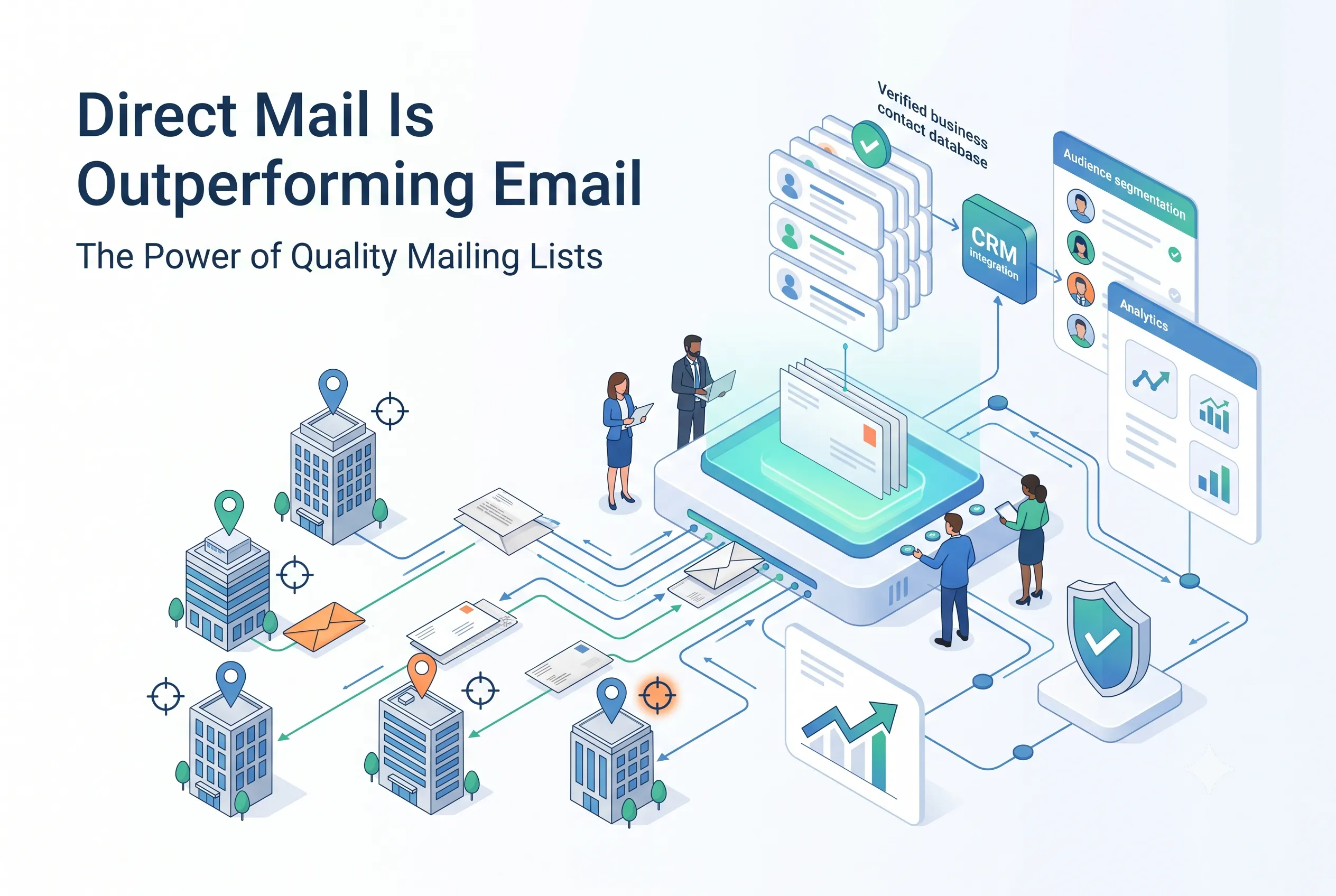
Something counterintuitive is happening in marketing right now. At a time when digital tools are more powerful, more targeted, and more measurable than ever, physical mail is quietly outperforming email across nearly every key metric.
Response rates. Open rates. ROI. Brand recall. In category after category, direct mail is beating email in 2026. And the reason matters for anyone planning a marketing campaign.
The Numbers That Changed the Conversation
The marketing industry spent years treating direct mail as a relic. Expensive to produce, slow to deliver, impossible to track in real time. Meanwhile, email was free, instant, and measurable to the click.
What happened next was predictable in hindsight. Email inboxes became overwhelmed. Open rates fell. Spam filters got smarter and more aggressive. Digital advertising platforms became crowded and expensive. And somewhere in the middle of all this digital noise, physical mail became something unexpected: rare enough to be noticed.
The data from 2025 and into 2026 reflects this shift clearly.
Direct mail response rates average around 4.4 percent, compared to roughly 0.12 percent for email. That’s not a small gap. Direct mail open rates run between 80 and 90 percent, against email’s 20 to 30 percent. ROI figures consistently come in at 29 percent for direct mail, higher than both online display (16 percent) and paid search (23 percent). In higher-value categories like home services, automotive, and financial products, direct mail campaigns using data-driven targeting have reported ROI figures many times that.
The majority of marketers who track channel performance now report that direct mail delivers their highest return. Budget allocations are shifting accordingly.
Why Physical Mail Works Better Right Now
The effectiveness of direct mail in 2026 is directly tied to the failure of digital channels to stand out.
When every business sends emails, no individual email stands out. When every platform runs ads, no individual ad gets attention. When a physical piece of mail arrives in a letterbox, it’s one of a handful of items competing for attention in a low-noise environment. It gets picked up. It gets handled. Often it gets kept.
Physical mail also engages differently. Studies on mail response consistently show that physical items activate more areas of the brain associated with memory and emotional engagement than digital content. The tactile experience of handling a well-designed piece of mail creates a different type of impression than scrolling past an ad.
There’s also a trust dimension. Consumers have become increasingly suspicious of digital communications, particularly email. Phishing, scams, and impersonation have made many people reluctant to engage with unsolicited digital messages. A physical piece of mail from a business they don’t yet know carries different connotations. It’s a real address, a real organisation, a real commitment of budget. That signals legitimacy in a way that a cold email can’t always match.
The Role of the Mailing List
None of the above matters without the right list. A direct mail campaign’s effectiveness is determined primarily by two factors: the quality of the creative and the quality of the mailing list. Creative gets more attention. Lists are more important.
Here’s why.
A strong piece of mail sent to the wrong people produces very little. A straightforward piece of mail sent to the right people, people who match your target profile, live in your service area, and are likely to want what you’re offering, will consistently outperform it.
The mailing list determines who opens your piece. It determines the ratio of genuine prospects to irrelevant contacts. It determines your response rate ceiling, because no amount of creative quality can convert someone who was never a plausible prospect.
In direct mail, the list typically accounts for around 40 percent of campaign success. The offer accounts for around 40 percent. The creative accounts for around 20 percent. Yet most businesses spend the majority of their planning time on creative and very little on list quality.
Consumer Mailing Lists vs. Business Mailing Lists
The type of mailing list you need depends on who you’re trying to reach.
Consumer mailing lists include individuals at residential addresses. They can be filtered by geography, age, household income, homeowner vs. renter status, presence of children, and other demographic and lifestyle variables. These are used for campaigns in sectors like retail, home services, financial products, healthcare, food and beverage, and lifestyle brands.
Business mailing lists include companies at their registered or operational address. They can be filtered by industry (SIC code), company size, geography, and contact name or title. These are used for B2B campaigns targeting specific types of organisations.
A well-built mailing list for either category goes beyond a basic address file. The best lists include the right contact name (so your piece is addressed to a specific person, not just “the homeowner” or “the business owner”), are checked for address accuracy to minimise undeliverable pieces, and are filtered to the demographic or firmographic profile that matches your target audience.
Programmatic and Data-Driven Direct Mail in 2026
One of the more significant developments in direct mail over the past few years is the integration of data targeting with physical mail production. What used to require large minimum quantities and long lead times can now be done at smaller volumes with more precise targeting.
Trigger-based direct mail (sending a piece when a specific event occurs, such as a prospect visiting your website, a customer lapsing, or a home being listed for sale) has become practical for businesses that couldn’t previously justify it. Personalised variable printing, where each piece includes recipient-specific content, is more accessible than it was.
The common thread in all of this is the mailing list. Whether you’re running a broad awareness campaign to a defined geographic area or a targeted trigger campaign to a narrow segment, the list is what makes the targeting possible.
Making the Most of Your Direct Mail Budget
A few principles that hold consistently across effective direct mail campaigns:
Match your list to your offer. If you’re offering a service only available to homeowners, your list should filter to homeowners. If you’re offering a B2B product for companies with more than 20 employees, your list should filter to that threshold. Every mismatch between the offer and the recipient reduces your response rate.
Use geographic targeting deliberately. Physical mail is a channel where geography matters practically, not just strategically. If you can only serve customers within a certain radius, your mailing footprint should reflect that exactly. Mailing outside your service area is pure waste.
Test before you scale. A smaller initial mailing to a test segment lets you validate your offer and creative before committing to a full-scale campaign. The list should be structured to allow this kind of segmentation.
Follow up through other channels. Direct mail works well as part of a multi-channel campaign. A mailing piece followed by a phone call or email to the same contacts consistently outperforms either channel alone.
Getting a Mailing List for Your Campaign
If you’re planning a direct mail campaign and need a list built to your target audience specifications, get in touch with us. We build both consumer mailing lists and business mailing lists matched to your geographic, demographic, and firmographic criteria.
Tell us who you need to reach and where, and we’ll prepare a list built around those requirements. Lists are typically ready within one to two business days, and once you receive yours, it’s yours to use across as many mailings as your campaign requires.
In a channel that’s producing some of the strongest response rates in direct marketing, the quality of your list is the most important variable you control.