Most B2B marketing claims about open rates are exaggerated. The near 100 percent open rate claim for dimensional mail is not.
It is explained by a physical reality that no other marketing channel can replicate. When a three-dimensional package arrives at an office, it gets opened. Not because of clever copywriting. Not because of a strong subject line. Because it is a box.
This guide explains what dimensional mail actually is, why the open rate claim holds up, when it makes financial sense for B2B campaigns, and how to execute one properly.
What Dimensional Mail Is
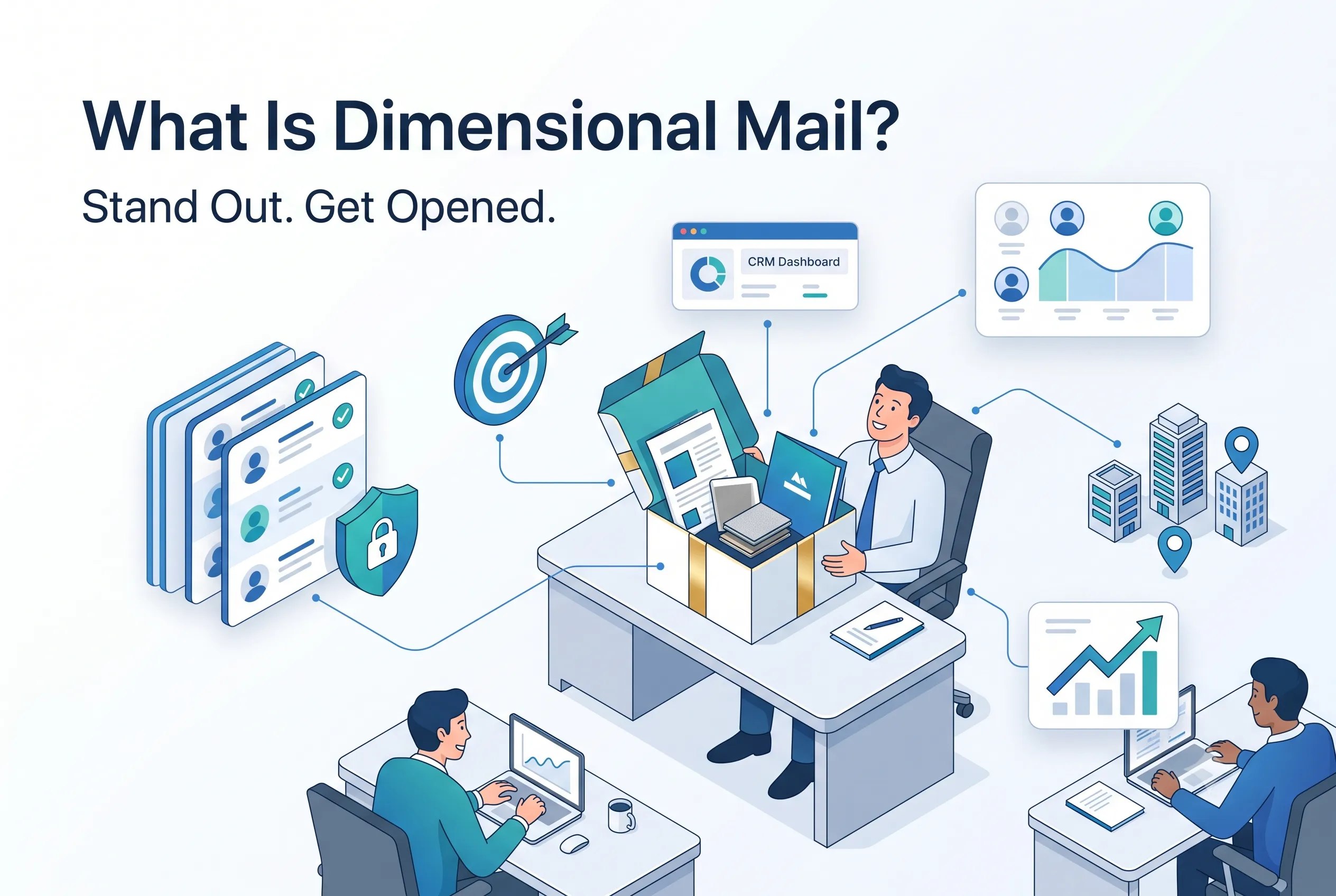
Dimensional mail is any direct mail piece that has physical depth. It is not a flat letter or a postcard.
The most common formats are small boxes, padded envelopes, tubes, and packages that contain an object alongside your marketing message. That object can be a branded item, a product sample, a book, a small gift, or anything relevant to the message you are delivering.
The defining characteristic is that the piece cannot be filed away or skimmed in three seconds. It requires a physical action to open and engage with. That action changes everything about how the recipient processes what is inside.
The Two Reasons the Open Rate Is Real
There are two distinct mechanisms behind the near 100 percent open rate. Both matter and they work together.
The first is psychological.
Human beings are wired to open packages. It is not a decision. It is a reflex. When something arrives that has physical depth and weight, curiosity triggers before any rational filtering process kicks in. This is true regardless of whether the recipient is a consumer or a senior executive. The instinct to open a package is universal.
Research on tactile engagement confirms that three-dimensional objects receive longer attention and create stronger memory formation than flat printed materials. The physical act of opening something and holding an object creates a different neurological imprint than reading an email or looking at an ad.
The second is logistical.
Office mailrooms and reception staff sort incoming mail by type. Letters and flat envelopes get sorted into mail trays that may sit for days or be pre-screened. Packages and dimensional items get routed directly to the named recipient because they look like deliveries, not marketing.
The same gatekeeper who throws away 80 percent of unsolicited envelopes without forwarding them will personally deliver a box to the executive it is addressed to. They do not screen packages. They deliver them.
This means dimensional mail bypasses the single biggest obstacle in B2B outreach at the executive level. It reaches the decision-maker directly without being filtered, screened, or discarded before it reaches their hands.
The Numbers Behind the Format
Dimensional mailers cost more per piece than flat mail. The question is whether the cost is justified by the results. For B2B campaigns targeting high-value accounts, the data consistently says yes.
The ANA/DMA Response Rate Report 2025 shows that dimensional mailers achieve response rates between 5 and 15 percent when sent to targeted ABM lists. Flat postcards average around 2 to 3 percent on the same cold prospect lists. The response rate lift from dimensional formats is roughly 337 percent above flat mail on average.
A $15 box sent to 200 target accounts costs $3,000 in printing, production, and postage. Reaching those same 200 specific named decision-makers through LinkedIn advertising requires far more spend, and LinkedIn does not guarantee that your ad reaches each person even once, let alone generates a response.
The math works when deal values justify the per-piece investment. A company selling a product or service worth $50,000 per customer does not need a high response rate from 200 pieces to generate strong ROI. One closed deal from a $3,000 dimensional campaign is a 1,567 percent return.
What Goes Inside a Dimensional Mailer
The physical object inside the package is not decoration. It is the mechanism that earns the attention the open rate creates.
The object needs to connect to the message. A random branded pen does not create a strong recall connection. An object that makes the recipient think of the specific problem you solve does.
Some examples of objects that have worked well in B2B dimensional campaigns:
A book on a topic directly relevant to the recipient’s role, with a handwritten note inside referencing a specific challenge they face in their industry.
A product sample that lets the decision-maker experience the quality of what you are selling before any conversation happens.
A useful desk item that stays visible after the campaign is over, keeping your brand in their line of sight during the weeks following delivery.
A creative object that directly illustrates the campaign message. A company selling security software sending a locked box that opens only when the recipient visits a personalized URL. A logistics company sending a small scale to represent precision. The object becomes memorable because it makes the abstract concrete.
The message inside should be short. The object has already done the attention work. A long sales letter inside a dimensional mailer wastes the advantage the format created. A single clear point, a specific offer, and one call to action are enough.
When Dimensional Mail Makes Sense and When It Does Not
Dimensional mail is not appropriate for every campaign. The per-piece cost makes it the wrong format for large-volume, low-value prospect lists.
It makes sense in four specific situations.
ABM targeting of named accounts. When your campaign has a defined list of 50 to 500 high-value target accounts and you need to break through at the executive level, dimensional mail is often the most efficient attention-getting investment available. The cost per piece is high but the audience is small and the deal values justify it.
Unsticking stalled pipeline deals. When a deal has gone quiet and follow-up emails are being ignored, a dimensional package sent to the decision-maker restarts the conversation in a way no digital touchpoint can replicate. It signals investment and seriousness without the desperation a tenth email implies.
Pre-event outreach for executive meetings. Conference season and trade shows create opportunities to secure meetings before the event. A dimensional package sent to a target executive two weeks before an industry event, requesting a specific meeting time, produces meeting acceptance rates significantly higher than email-only pre-event outreach.
Welcoming high-value new customers. The first physical impression after a deal closes sets the tone for the entire relationship. A well-designed dimensional welcome package communicates that the customer made the right decision in a way no onboarding email sequence replicates.
For campaigns targeting hundreds or thousands of prospects, standard direct mail formats produce better economics. Dimensional mail earns its cost only when the audience is tightly defined and the deal value is large enough to justify per-piece investment.
The List Behind the Campaign
A dimensional mailer sent to the wrong address is a complete waste. A dimensional mailer opened by the wrong person inside the right company is nearly as bad.
Executive-level dimensional campaigns require verified direct contact data for the named decision-maker, including their physical business address confirmed as current. Remote and hybrid work arrangements have made this more complicated since 2020. A meaningful percentage of executives now split time between home and office, and sending a package to a mostly-empty office reduces the gatekeeper-bypass advantage dimensional mail creates.
Before any dimensional campaign launches, the physical address for each named contact needs to be verified as current and active. This is a different verification requirement from standard direct mail campaigns. It requires checking not just whether the address exists but whether the specific person is regularly present at that location.
Prospects Influential’s executive mailing list provides verified contacts at the decision-maker level with current address data, segmented by industry, company size, and role for dimensional ABM campaigns.
The B2B direct mailing lists page covers the full range of business contact options for campaigns where verified physical address data is the primary requirement.
Frequently Asked Questions
What is dimensional mail? Dimensional mail is a direct mail format that has physical depth rather than lying flat. It includes boxes, tubes, padded packages, and any format that contains a three-dimensional object alongside a marketing message. It is used in B2B campaigns to capture attention from executive-level decision-makers who receive high volumes of standard flat mail.
Why does dimensional mail get a near 100 percent open rate? Two mechanisms drive the open rate. First, humans instinctively open three-dimensional packages before any rational filtering occurs. Second, office mailrooms route packages directly to the named recipient rather than screening them with flat mail. This bypasses the gatekeeper filtering that prevents most flat mail from reaching executives at all.
How much does a dimensional mail campaign cost? Per-piece costs for dimensional mailers range from $5 to $25 depending on the object inside, packaging, printing, and postage. This is 10 to 30 times more than a standard flat mail piece. The higher cost is justified when deal values are large enough that one or two conversions from a small target list produce strong ROI.
What response rates does dimensional mail produce? Research from ANA/DMA shows dimensional mailers sent to targeted B2B ABM lists produce response rates of 5 to 15 percent. This compares to 2 to 3 percent for flat direct mail to cold prospect lists and under 1 percent for cold email. Dimensional mail outperforms flat mail by approximately 337 percent on average.
When should B2B companies use dimensional mail? Dimensional mail is most effective for ABM campaigns targeting 50 to 500 high-value named accounts, for re-engaging stalled pipeline deals, for pre-event outreach requesting executive meetings, and for welcoming high-value new customers. It is not cost-effective for high-volume campaigns where per-piece investment cannot be justified by deal value.
What should go inside a dimensional mailer? The object inside should connect directly to the campaign message. Effective choices include relevant books with personal notes, product samples, creative objects that illustrate the value proposition, or branded items that stay visible on a desk long after delivery. The message inside should be short: one clear point, a specific offer, and one call to action.
Send the Package That Gets Opened Every Time
Standard flat mail gets filtered, stacked, and often discarded before it reaches a decision-maker’s hands. A dimensional package goes directly to the person it is addressed to, gets opened immediately, and creates a physical memory that no digital touchpoint produces.
For B2B campaigns targeting high-value accounts, the combination of near 100 percent open rates and 5 to 15 percent response rates makes dimensional mail one of the highest-ROI formats available when the audience is correctly defined.
Prospects Influential’s executive mailing list provides verified decision-maker contacts with current physical address data for dimensional ABM campaigns. For broader direct mail campaign databases, the B2B direct mailing list covers the full range of business audiences.
Call 800 352 2282 to speak with a list specialist about building a verified executive contact list for your next dimensional mail campaign.