Here is something that changes how you should think about hospital B2B marketing completely.
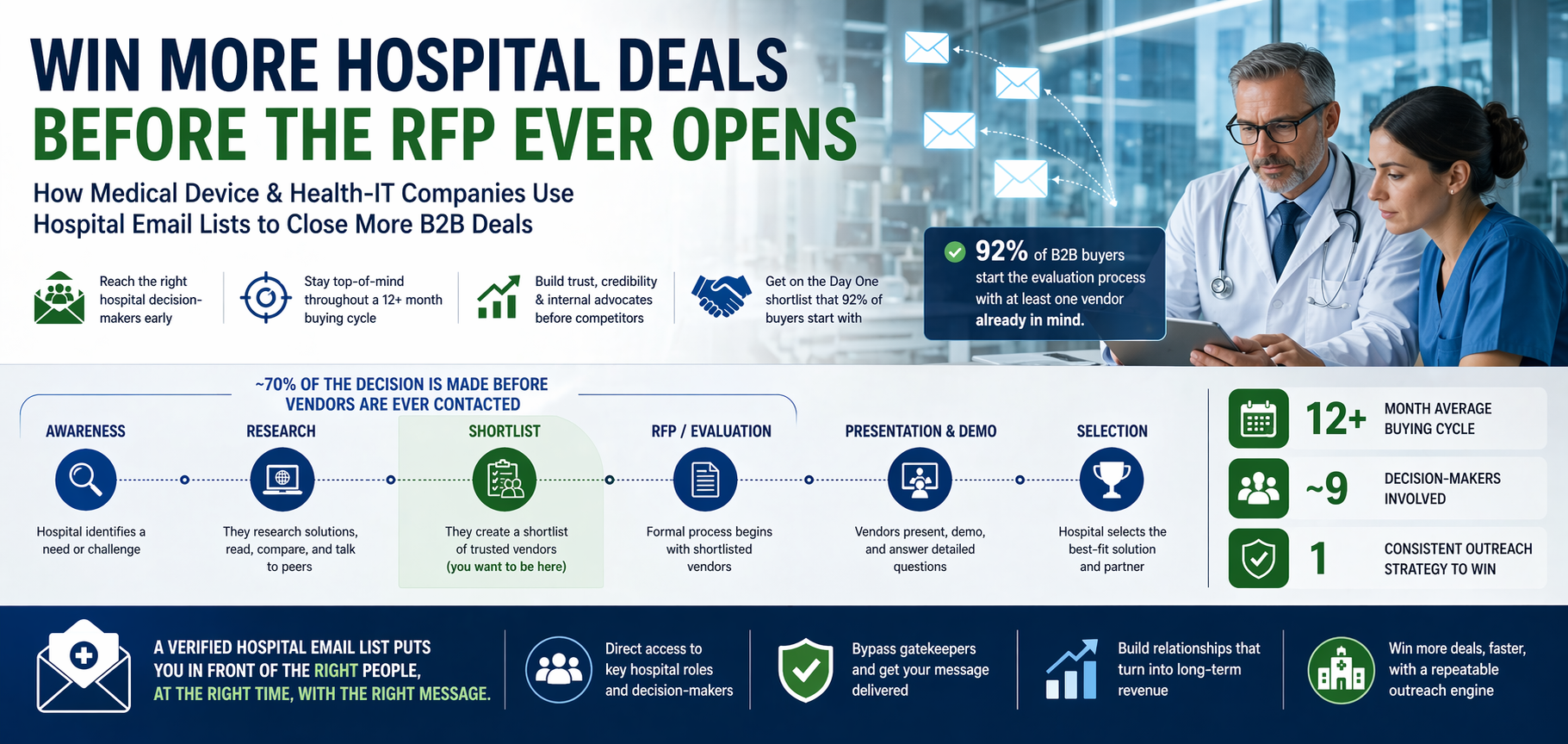
By the time a hospital officially reaches out to a vendor, they have already completed roughly 70% of their decision-making process. They have done the research. They have compared options. They have had internal discussions. In many cases, they already have a shortlist in mind before they ever respond to anyone’s outreach. In fact, 92% of B2B buyers start the formal evaluation process with at least one vendor already in mind.
That means the companies winning hospital accounts in 2026 are not winning them at the demo stage. They are winning them weeks and months before the formal evaluation even begins, by being present, credible, and relevant to the right people long before anyone has officially opened an RFP.
A hospital email list is how you get there. But it is not a magic button. It is a contact layer that gives your outreach access to the people who matter, provided you know what to send, who to send it to, and when to send it across a buying cycle that averages 12 months and involves roughly 9 decision-makers.
This guide breaks down exactly how medical device companies and Health-IT vendors use hospital email lists to build that kind of presence and turn it into pipeline.
Why do medical device companies need hospital email lists?
Medical device companies need hospital email lists because their buyers are inside hospitals and are nearly impossible to reach through any other scalable channel. Hospital executives do not respond to cold LinkedIn messages from unknown vendors. Physicians do not answer unsolicited calls from sales reps. The average hospital has dozens of gatekeepers between a vendor and the procurement director, CMO, or surgeon who would actually evaluate the product.
A verified hospital email list gives a medical device company direct access to those contacts, bypassing the gatekeeping layer entirely. It is the difference between waiting for inbound interest and building pipeline proactively.
Why do Health-IT companies need hospital email lists?
Health-IT companies face a slightly different version of the same problem. Their buyers are CIOs, IT directors, CMOs, and operations executives who are evaluating multiple software solutions simultaneously and are deeply skeptical of generic vendor outreach. Health-IT buying cycles are long, compliance-sensitive, and committee-driven. A hospital email list lets a Health-IT company reach the right technical and clinical stakeholders simultaneously, with role-specific messaging, rather than hoping a single contact forwards their email to the right person internally.
The Core Problem Hospital Email Lists Solve
Before getting into how each industry uses lists differently, it helps to understand the shared problem they both face.
Hospital B2B deals are not lost at the close. They are lost at the beginning when a vendor fails to get on the shortlist before the formal process starts. The average hospital buying cycle runs 12 months, with complex technology and equipment deals extending to 3 years or more. During that period, the hospital is doing independent research, consulting peers, attending conferences, and forming opinions about which vendors are credible.
A company that only shows up when a deal is formally in play is already behind. The ones that show up consistently in the inboxes of the right people, with content and offers relevant to that person’s specific role, are the ones that get on the Day One shortlist that 92% of buyers bring into formal evaluation.
A hospital email list is the mechanism for that consistent presence. It gives you the contact data to reach the right roles at the right institutions before the formal process locks the field.
How Medical Device Companies Use Hospital Email Lists
Medical device sales carry a specific constraint that shapes how the entire outreach strategy must be built: FDA regulations govern what promotional claims can be made about a cleared device. Every email sent to a hospital clinical contact must stay within the bounds of the device’s cleared indications for use. This is not optional. A poorly worded promotional email can trigger a regulatory response before a single deal is even in discussion.
Within those constraints, here is how medical device companies use hospital email lists effectively.
Reaching Clinical Champions Before Procurement
For most medical devices, the internal champion is a clinical professional, not a procurement officer. A surgeon who sees value in a new instrument, an OR director who wants to evaluate a new monitoring system, or a department head who wants to pilot a new diagnostic tool initiates the internal conversation that eventually becomes a procurement process.
Medical device companies use role-segmented hospital email lists to reach these clinical contacts before procurement ever gets involved. The goal at this stage is not to close a deal. It is to create the internal demand that drives a formal evaluation.
Messaging at this stage leads with clinical outcomes: procedure success rates, peer-reviewed data from comparable institutions, patient safety improvements. For surgical and implantable devices, clinical evidence and comparative outcomes are the only currency that matters with this audience.
Access verified healthcare professional contacts for clinical outreach here.
Mapping the Buying Committee by Role
Once a medical device company has identified a target account, the hospital email list becomes a buying committee map. A single hospital account may require simultaneous or sequential outreach to the CMO, the procurement director, the relevant department head, and the CFO.
Each of these contacts gets a different message about the same product:
The CMO gets clinical validation data, patient outcome evidence, and strategic alignment with the hospital’s quality improvement goals.
The procurement director gets vendor compliance documentation, pricing structure, reference accounts, and contract flexibility information.
The CFO gets an ROI analysis: total cost of ownership, clinical efficiency gains expressed in financial terms, and comparison against the cost of the problem the device solves.
The department head or clinical champion gets the operational story: how the device fits into existing workflows, what the implementation process looks like, and what comparable departments at peer institutions have experienced.
Running these conversations in parallel, timed to intersect at the evaluation stage, is what accelerates the buying cycle. Medical device companies that only email one contact at a target institution are leaving the buying committee uninformed and giving competing vendors time to fill that space.
Reach hospital procurement contacts for vendor evaluation conversations here.
The Pilot and Proof of Concept Offer
Medical device companies have a structural advantage over most B2B categories: many products can be piloted in a limited clinical setting before a full contract commitment. A hospital administrator or clinical director willing to run a 60-day pilot in one department is a very different ask than a full procurement approval.
The pilot or proof-of-concept offer is one of the most effective conversion tools in medical device email outreach precisely because it lowers the commitment threshold for a skeptical buying committee. The email sequence for this offer works differently than a standard demo request sequence:
The first message introduces the clinical problem and positions the device against it without making any direct pitch. The second message shares a clinical case study from a comparable institution. The third message introduces the pilot offer: a defined scope, a limited timeframe, a specific department, and a clear success metric. The fourth message is a follow-up addressing the most common objection, typically implementation complexity or staff training time.
This structure moves the contact from awareness to a low-risk first step, which is far more achievable inside a 12-month hospital buying cycle than jumping straight to a procurement request.
Reaching Medical Device Distributors Alongside Hospital Contacts
Medical device companies often sell through distributors as well as directly to hospitals. Using a hospital email list alongside a distributor contact database creates a dual-channel outreach strategy: direct outreach to hospital clinical and procurement contacts builds end-user demand, while distributor outreach builds the channel partnerships needed to fulfill it.
Access medical device distributor contacts here.
Access medical device manufacturer contacts for partnership outreach here.
How Health-IT Companies Use Hospital Email Lists
Health-IT companies face a different version of the hospital selling challenge. Their products are not evaluated by surgeons in operating rooms. They are evaluated by committees that include CIOs, CMOs, compliance officers, department heads, and procurement teams, all of whom have different priorities and different objections to the same platform.
Health-IT deals are also significantly longer on average. An EHR implementation or enterprise clinical platform sale can run 2 years or more. A single bad email to the wrong contact at a target institution can poison the relationship before it begins. And hospital IT environments run aggressive spam filters that will block outreach from unauthenticated or low-reputation sending domains.
Here is how Health-IT companies use hospital email lists effectively within these constraints.
Targeting IT Directors and CIOs for Technology Outreach
For Health-IT vendors, the CIO and IT director are primary decision-makers for infrastructure, security, and integration decisions. These contacts evaluate products on a completely different axis than clinical or procurement contacts: data security, EHR compatibility, implementation timeline, staff adoption, and compliance with HIPAA and relevant state privacy regulations.
Messaging that works for CIOs and IT directors does not lead with clinical outcomes. It leads with integration simplicity, security architecture, and the elimination of IT risk. An email to a hospital CIO should answer the question they are already asking internally: “How much disruption will this create for my team, and does it integrate with our existing systems without creating a new compliance exposure?”
Specificity matters. A Health-IT vendor who can name the EHR systems their platform integrates with, cite the security standards they comply with, and reference a comparable hospital’s implementation experience will generate replies that a generic platform overview email will not.
Targeting CMOs for Clinical Software Adoption
For clinical software platforms, the CMO is often the key internal champion. They evaluate technology through a combined clinical and operational lens. They care about whether the platform improves clinical decision-making, reduces adverse events, and aligns with the hospital’s quality improvement metrics. They also care about physician adoption because a platform that clinical staff resist using provides no value regardless of its technical quality.
Health-IT email outreach to CMOs works best when it leads with a clinical outcome the platform measurably improves, backed by data from institutions with comparable patient populations or quality challenges. The message should be brief, data-grounded, and framed around the CMO’s existing priorities rather than the platform’s feature list.
Connect with hospital CMO contacts through the healthcare professionals list here.
Using Hospital Email Lists for ABM in Healthcare
Account-based marketing is the natural strategic framework for Health-IT companies selling into large hospital systems. ABM flips the standard outreach model. Instead of sending a broad campaign to a large list and waiting for responses, ABM identifies a defined set of high-value target accounts and coordinates personalized, multi-touch outreach to multiple contacts within each account simultaneously.
A 120-day ABM pilot using this approach produced 31 meetings, 17 qualified opportunities, and $2.7 million in closed revenue. That outcome is not achievable with a single-contact blast campaign. It requires reaching the CIO, the CMO, the procurement director, and the relevant department heads at each target institution, with role-specific messaging timed to build internal awareness across the buying committee at the same time.
Hospital email lists are the contact layer that makes ABM operational. Without verified, role-segmented contact data for each target account, ABM in healthcare is a strategy without an execution path. The list is what puts the right message in front of the right person inside the right institution.
For enterprise Health-IT deals targeting health system CEOs and executive sponsors, the hospital CEO email list covers the executive tier needed for board-level awareness campaigns.
How Health-IT Startups Use Hospital Email Lists to Land Flagship Accounts
Early-stage Health-IT companies face a specific challenge: they need a credible flagship account to close the next deal, but they cannot close a flagship account without credibility. Hospital email lists break this cycle by giving startups direct access to the decision-makers at target accounts, bypassing the brand recognition barrier that blocks cold inbound attempts.
The approach that works for early-stage companies is a narrow, high-quality list combined with a highly specific offer. Rather than trying to sell the full platform in an initial outreach, the email sequence focuses on a single use case with strong clinical evidence, a risk-free pilot structure, and references from any early adopters, even if those adopters are smaller institutions than the flagship target.
Healthcare B2B email open rates average 25 to 30% with well-targeted, relevant campaigns. At that engagement rate, a list of 500 precisely targeted hospital contacts at 25 target accounts generates meaningful pipeline visibility within the first 90 days of a structured outreach campaign.
How to Structure a Hospital Email Sequence
Hospital decision-makers do not convert from a single email. The benchmark for cold B2B outreach to senior healthcare executives is 6 to 8 touches before a meaningful response rate is achieved. Healthcare industry best practice suggests 2 to 4 emails per month per segment, spaced to provide new information with each touch rather than simply following up on the previous message.
Here is a practical sequence structure for both medical device and Health-IT outreach:
Touch 1: The problem frame. A short email that identifies a specific clinical or operational challenge relevant to the contact’s role without mentioning your product. The goal is to establish that you understand their world.
Touch 2: The peer evidence. A case study or clinical data point from a comparable institution. Not a product brochure. A concrete outcome achieved by someone with the same job title at a hospital of similar size and type.
Touch 3: The specific offer. A low-commitment next step: a 20-minute call, a pilot proposal, a custom ROI analysis for their institution type. The ask should require minimal time and carry no purchase obligation.
Touch 4: The objection address. A follow-up that proactively handles the most common reason contacts at this role delay engagement: implementation complexity, budget cycle timing, or internal stakeholder alignment.
Touch 5 onward: Value-add touches. Industry data, relevant regulatory updates, clinical research, or a relevant webinar invitation. Each touch adds something new rather than restating the original pitch.
LinkedIn outreach running parallel to the email sequence significantly improves response rates. Research shows that referencing a LinkedIn connection in a follow-up email, or reaching out via LinkedIn two days after an email open, produces meaningfully higher engagement than email alone.
Segmenting Hospital Email Lists for Medical Device and Health-IT Campaigns
The segmentation decisions you make before a campaign launches determine most of the campaign’s outcome. Broad lists with generic messages consistently underperform narrow lists with specific messages in hospital B2B marketing.
By role: CMO, CIO, procurement director, procurement manager, department head, CFO. Each role gets a different message about the same product.
By hospital type: Academic medical centers, community hospitals, rural and critical access hospitals, private health systems. Hospital type determines budget scale, procurement cycle length, and the complexity of the buying committee.
By bed count and revenue: A 500-bed hospital and a 50-bed hospital are not the same buying conversation. Bed count and revenue data in a quality hospital email list let you separate enterprise health system targets from community hospital targets with a single filter.
By specialty for medical devices: A cardiac device company should not send the same email to a radiology department head and a cardiology department head. Specialty-level segmentation ensures clinical messaging is relevant to the contact’s actual clinical domain.
By geography for regional campaigns: Territory-aligned segmentation ensures your outreach maps to your sales team’s coverage areas, which is essential for deals that require on-site demonstrations or local sales rep follow-up.
Access the hospital procurement managers email list for supply chain segmentation here.
Compliance: What Medical Device and Health-IT Companies Need to Know
HIPAA: Does not apply to B2B marketing outreach to hospital professionals. HIPAA governs protected health information about patients. A vendor emailing a hospital CIO about a software platform or a surgeon about a medical device is not handling patient data. HIPAA becomes relevant only if your email content references identifiable patient information, which it should never do.
CAN-SPAM: Applies to all commercial emails sent to US-based hospital contacts. Requires honest sender identification, no misleading subject lines, a physical postal address in every email, a working one-click unsubscribe, and opt-out requests honored within 10 business days. The FTC’s civil penalty is $53,088 per violation as of January 2025.
GDPR: Applies to EU-based contacts. Permits B2B outreach under the legitimate interests basis when the message is professionally relevant and includes a clear opt-out. For global campaigns, EU contacts require more careful documentation than US contacts.
FDA promotional claims: Specific to medical device companies. Every email making claims about a cleared device must stay within its cleared indications for use. Subject lines and email body copy that make efficacy claims beyond the cleared indication are a regulatory violation regardless of how strong the clinical evidence is. Medical device marketing teams should ensure every email template has cleared legal and regulatory review before campaign launch.
A practical note on hospital spam filters: hospital IT environments run some of the most aggressive filtering of any industry. Authenticate your sending domain with SPF, DKIM, and DMARC before any campaign. Warm up new sending domains gradually before scaling volume. Never send from generic role-based inboxes. Work from a verified list to keep bounce rates under 4%.
Frequently Asked Questions
Why do medical device companies need hospital email lists? They need direct access to the clinical and procurement contacts who evaluate medical devices without going through gatekeepers. Hospital email lists are the contact layer that makes proactive outreach to surgeons, department heads, procurement directors, and CMOs operationally possible at scale.
Why do Health-IT companies need hospital email lists? Health-IT buying committees involve multiple roles across clinical, IT, operations, and finance. A hospital email list segmented by role allows a Health-IT vendor to run coordinated outreach to the CIO, CMO, and procurement director at the same target account simultaneously, which is required for ABM campaigns in healthcare.
How do hospital email lists shorten the sales cycle? By getting vendors onto the shortlist before formal evaluation begins. 70% of hospital buying decisions are made before vendors are contacted. Companies present in the right inboxes with relevant content before the evaluation period are already ahead of competitors who first appear in the formal RFP queue.
What open and reply rates are realistic when emailing hospital decision-makers? Healthcare B2B email open rates average 25 to 30% with well-targeted campaigns. Reply rates on cold outreach to senior hospital executives typically range from 1 to 5% per individual email, with cumulative response rates across a 6 to 8 touch sequence running meaningfully higher. Response rates for personalized ABM campaigns targeting a narrow list of high-fit accounts consistently outperform broad campaign averages.
Are hospital email lists HIPAA-compliant for B2B marketing? Yes. Hospital email lists for B2B marketing contain professional contact data, not patient health information. HIPAA applies to covered entities handling patient data. A vendor conducting B2B outreach to hospital professionals is not a covered entity and is not subject to HIPAA. CAN-SPAM and GDPR are the relevant compliance frameworks.
What type of email content works best for medical device companies? Clinical case studies from comparable institutions, procedure-level outcome data, peer-reviewed evidence, and pilot or proof-of-concept offers. Avoid feature lists. Lead with the clinical problem and the measurable outcome your device achieves. Keep FDA promotional claim boundaries in mind for every message.
What content works best for Health-IT vendors emailing hospital CIOs? Integration specifics, security architecture, EHR compatibility details, implementation timeline, and references from comparable hospital IT environments. CIOs evaluate technology on risk reduction and operational fit, not clinical outcomes. Frame your platform around the problems it eliminates for the IT team, not the features it adds.
How do you follow up after a hospital demo? Send a summary email within 24 hours that recaps the key points discussed, identifies the next step agreed in the meeting, and includes one additional resource relevant to the contact’s primary concern. For multi-stakeholder deals, send role-specific follow-up emails to each committee member who attended, not a single generic recap. Procurement gets contract and compliance information. The CMO gets clinical evidence. The CIO gets technical documentation.
Building Your Hospital B2B Pipeline With the Right Contacts
Medical device and Health-IT companies that close more hospital deals share one consistent characteristic: they reach the right people inside their target accounts before the formal evaluation process begins, with messages built for each person’s specific role in the buying committee.
A hospital email list is the foundation of that strategy. It is the contact layer that makes proactive, role-specific, multi-touch outreach to 9 decision-makers across a 12-month buying cycle operationally possible.
Prospects Influential builds hospital contact lists from verified, sourced data with over 30 years of healthcare list brokering experience across US and Canadian markets. Whether you need clinical contacts for medical device outreach, IT and administrative contacts for Health-IT campaigns, procurement coverage for vendor evaluation conversations, or executive-level contacts for ABM strategies, the right list starts with the right conversation about your target.
The hospital procurement email list covers the vendor evaluation layer. The healthcare professionals list covers clinical and operational decision-makers including CMOs and department heads. The hospital CEO email list covers executive-level awareness for high-value enterprise deals. The health and cancer research contacts list serves medical device and pharmaceutical companies targeting research-focused hospital departments.
You can also read how similar precision targeting strategies apply in other B2B contexts in our guide on how to buy a pharmacists email list without compliance risk and our guide to hospital decision-maker targeting by role.
Get in touch with Prospects Influential to discuss which list combination fits your campaign and your target account strategy.