You found a pharmacists email list provider. The database looks solid. The price seems reasonable. And then the doubt creeps in.
What if this gets me fined? What if this violates GDPR? What if my domain gets blacklisted before the first campaign even launches?
These are legitimate concerns. They are also largely avoidable once you understand where the actual legal risk lives, because it is not where most people think it is.
This guide answers every real question marketers ask before buying a pharmacists email list, including the ones nobody posts publicly because they are too worried about looking uninformed.
The short answer before anything else:
Buying a pharmacists email list is legal in the United States. CAN-SPAM does not ban purchased lists. GDPR does not ban B2B outreach to healthcare professionals. The legal risk activates when you use the list incorrectly, not when you buy it. What matters is the quality of the data, where it came from, and how your emails are sent.
Is Buying a Pharmacists Email List Actually Legal?
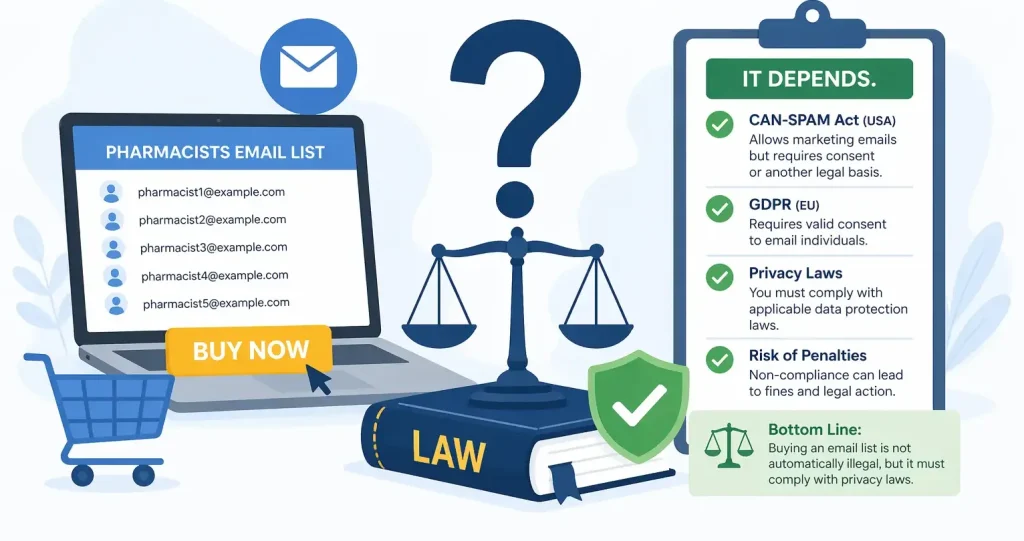
Yes. Under US federal law, purchasing a pharmacists email list is a standard and legal business practice. The CAN-SPAM Act of 2003 places no restriction on buying or owning contact data. It only governs how commercial emails are sent.
GDPR, which applies to contacts located in the European Union, does not prohibit B2B outreach either. It raises the bar for how that outreach is conducted and documented.
What makes a list purchase legally sound comes down to three factors: the data was collected ethically, the contacts have some form of opt-in or legitimate interest, and you follow the sending rules for every jurisdiction your campaign touches.
A pharmacist mailing list built from state licensing boards, professional associations, and healthcare directories is a fundamentally different product from a scraped database assembled without consent. The source determines the risk.
Where Does the Real Legal Risk Actually Sit?
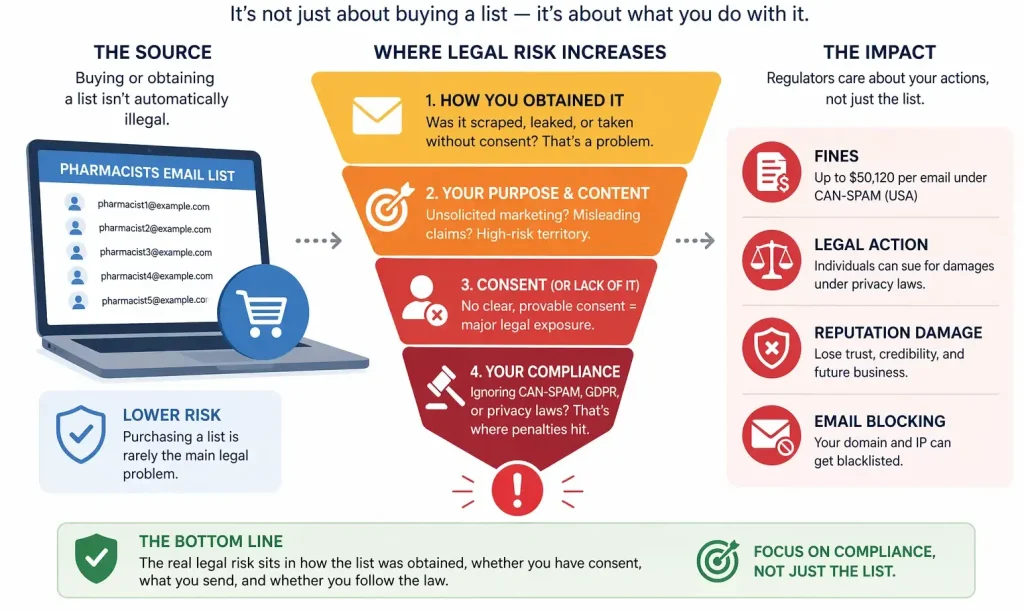
This is what Quora threads and forum discussions consistently get wrong. People ask whether buying the list is legal. The better question is whether how you use it is legal.
Here is where violations actually happen:
At the send. Misleading subject lines, no physical address in the email footer, and broken unsubscribe links are CAN-SPAM violations regardless of where your list came from.
At the bounce. A list with 15% bounce rate signals to Gmail, Outlook, and Yahoo that you are a bad sender. Your domain gets flagged. Future campaigns, including to your own subscribers, land in spam.
At the data request. Under GDPR, any EU-based pharmacist can ask you to confirm what data you hold about them and request deletion. If you cannot respond within 30 days, you face regulatory exposure.
At the opt-out. You have 10 business days under CAN-SPAM to remove someone from your list after they unsubscribe. Mailing them again after that is a direct violation.
None of these risks come from buying. They come from buying without asking the right questions and sending without the right setup.
What CAN-SPAM Actually Requires From You
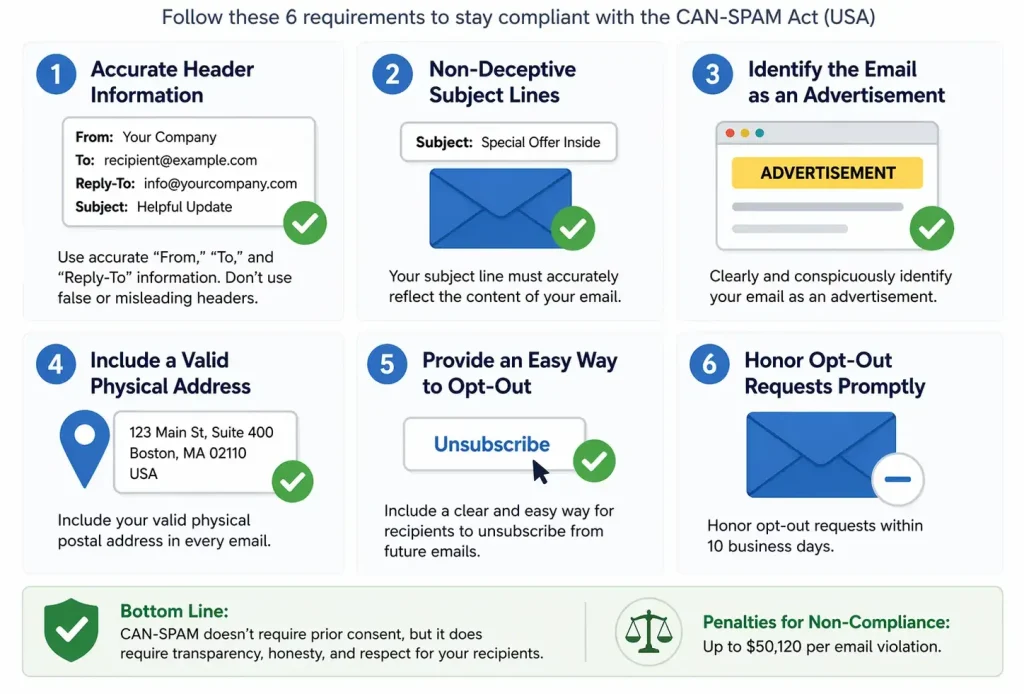
CAN-SPAM is a conduct law, not a consent law. It tells you how to send, not who you can contact. Every commercial email you send to US-based pharmacists must meet these requirements:
Accurate sender identity. Your “From” name, reply-to address, and routing headers must reflect who is actually sending the email. Disguising your identity is a direct violation.
Honest subject lines. The subject line cannot misrepresent what is inside the email. A subject line designed to trick the recipient into opening is a violation, regardless of how clever it is.
A physical postal address. Every email needs a valid physical address in the footer. A P.O. box or a registered private mailbox is acceptable.
A working unsubscribe mechanism. Recipients must be able to opt out with a single action. That mechanism must remain active for at least 30 days after the email is sent.
Prompt opt-out processing. Once someone unsubscribes, you have 10 business days to stop sending. You cannot require them to log in, pay a fee, or take more than one step to unsubscribe.
The FTC increased its civil penalty cap to $53,088 per violation in January 2025. With volume campaigns, non-compliance compounds quickly.
What GDPR Says About B2B Healthcare Outreach
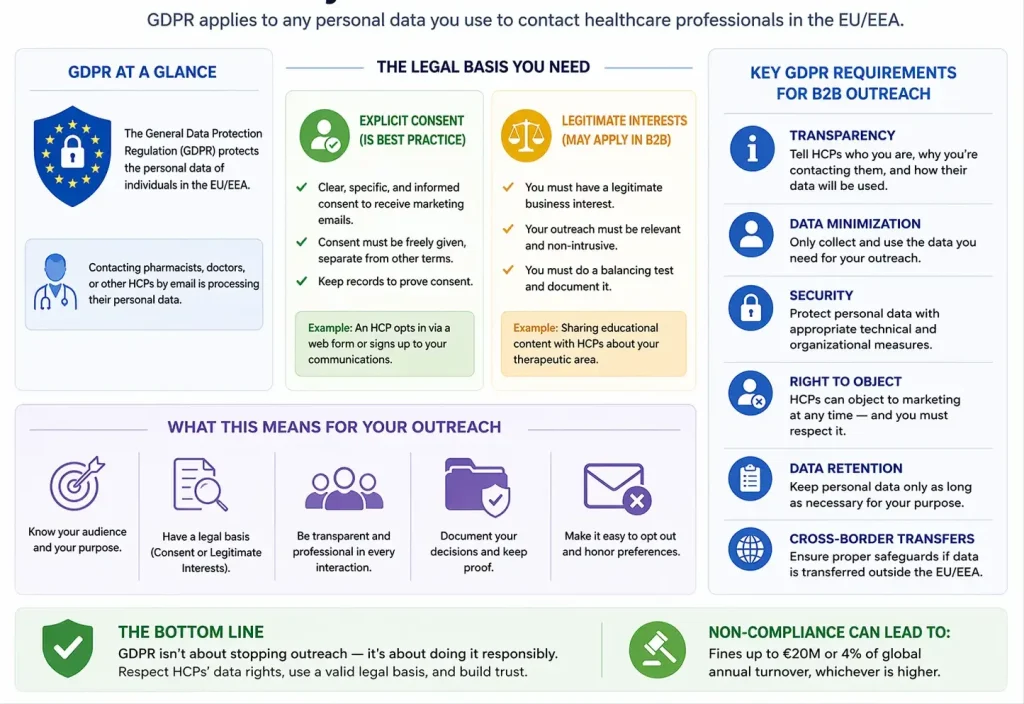
GDPR applies whenever you contact someone located in the European Union. If your pharmacists email list includes EU-based contacts, GDPR governs those contacts regardless of where your business is located.
For B2B outreach to healthcare professionals, GDPR does not require opt-in consent in every case. You can use legitimate interests as your lawful basis, provided:
- Your outreach is genuinely relevant to the pharmacist’s professional role
- You can document why your legitimate interest outweighs their privacy rights
- You identify yourself clearly in the first contact
- You include a simple opt-out in every message
Where GDPR goes further than CAN-SPAM:
Data subject rights. Any EU contact can request access to their data, correction of inaccuracies, or full deletion. You must respond within 30 days.
No pre-ticked consent boxes. If you collect EU contact data through any form or landing page, consent must be an active, affirmative action. A pre-checked box does not count.
Accountability. GDPR requires you to be able to demonstrate compliance, not just claim it. Keep records of your lawful basis, your data sources, and how you handle requests.
GDPR fines reach up to 20 million euros or 4% of global annual turnover, whichever is higher. Even for small B2B operations, a documented violation in the healthcare space carries serious reputational weight alongside the financial penalty.
Does HIPAA Apply When You Market to Pharmacists?
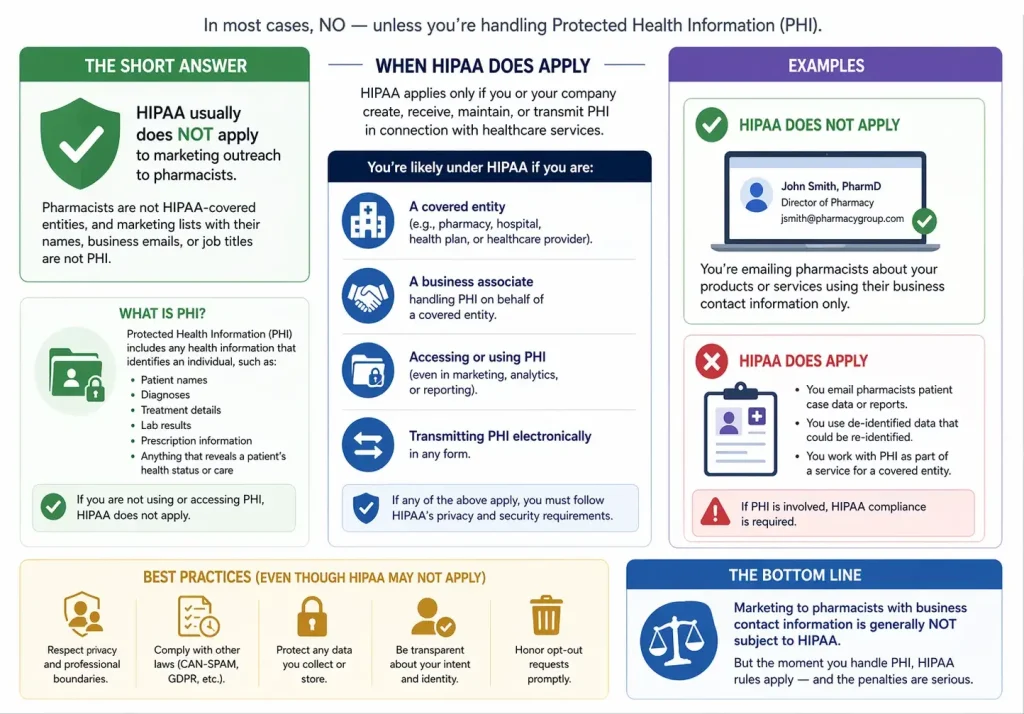
This question comes up in almost every healthcare marketing conversation and the answer is straightforward.
HIPAA does not apply to you as a list buyer and email marketer.
HIPAA governs covered entities: healthcare providers, health plans, and healthcare clearinghouses, along with their business associates. A pharmaceutical company, software vendor, or medical device manufacturer that markets to pharmacists is not a covered entity simply because its audience works in healthcare.
HIPAA becomes relevant only if you enter a data-sharing relationship with a covered entity or if your emails contain protected health information about patients. Keep your outreach focused on your product or service and what it does for the pharmacist professionally. HIPAA will not be a factor
What Is an Opt-In Pharmacist Email List and Why Does It Matter?
An opt-in pharmacist email list contains contacts who have, at some point, actively agreed to receive professional communications. This agreement typically happens through conference registrations, professional association memberships, journal subscriptions, or voluntary directory listings.
This matters for two reasons.
First, it dramatically improves your campaign performance. Pharmacists who have opted into professional communications open emails at higher rates, respond more frequently, and are less likely to mark your message as spam.
Second, it reduces your legal exposure. Opt-in data gives you a defensible paper trail. If a contact challenges how you obtained their information, your provider can point to a documented consent event. A scraped list has no equivalent defense.
When a provider says their list is “100% opt-in,” ask them to clarify when that opt-in occurred, through what channel, and how it is documented. Vague answers about “publicly available sources” without a consent record are a red flag.
What Data Does a Good Pharmacist Email List Contain?
A quality pharmacists email list goes well beyond a name and email address. When you buy a verified list, each contact record should include:
- Full name and professional credentials (PharmD, RPh)
- Primary business email address
- Direct phone number where available
- Job title and seniority level
- Pharmacy name and type (retail, hospital, clinical, compounding)
- Mailing address including ZIP code
- State licensing information and NPI number
- Years of experience
- Practice setting and specialty area
The depth of this data determines your segmentation capability. If you want to reach only hospital pharmacists in the Midwest with 10 or more years of experience, a list that only contains name and email cannot support that targeting. A properly built pharmacist database can.
How Often Should a Pharmacist Email Database Be Updated?
Pharmacists change employers, retire, transition between practice settings, and update their contact information constantly. A list that was accurate 18 months ago may carry a 20 to 30% error rate today.
Industry standard for a quality pharmacists email database:
- Email verification: at minimum every 90 days
- Employment and practice setting: quarterly
- Phone number validation: monthly
- Full database audit: annually
A bounce rate above 4% on a cold campaign signals that your list is outdated. Email service providers like Mailchimp, HubSpot, and Klaviyo monitor bounce rates closely. Sustained high bounce rates trigger domain-level filtering that affects all your outbound email, not just the campaign that caused the problem.
Ask any provider directly: when was this data last verified, what method did you use, and what is your guaranteed bounce rate? If the answer is vague, the data quality probably is too
What Questions Should You Ask Before Buying a Pharmacists Email List?
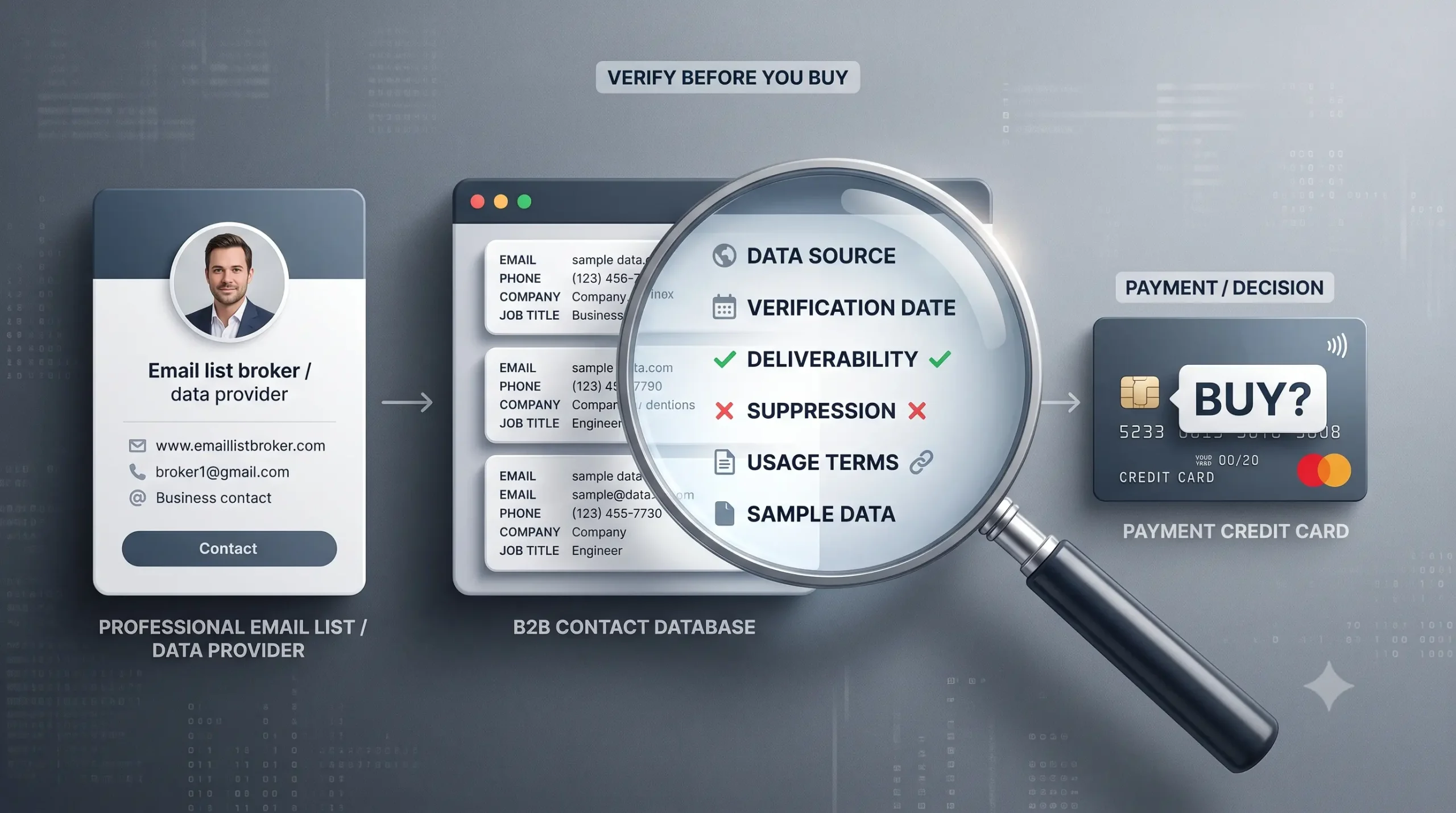
This is what experienced healthcare marketers actually want to know before they hand over a budget. Ask these before you commit:
Where did this data come from? Licensing boards, association directories, conference registrations, and professional publications are credible sources. “Various online sources” is not an acceptable answer.
Is this opt-in data? And if so, when was consent collected and through what channel? Ask for documentation if needed.
What is your guaranteed deliverability rate? Reputable providers guarantee 90 to 96% email deliverability and offer a replacement policy for contacts that bounce within 30 to 90 days of purchase.
Do you provide documentation of GDPR and CAN-SPAM compliance? This should be available immediately. Hesitation or vague reassurances suggest the compliance claim is marketing language rather than operational reality.
What segmentation options are available? If you cannot filter by practice setting, geography, specialty, or job title, the list is a generic database dressed up as a targeted one.
Prospects Influential has operated as an independent list broker for over 30 years with no allegiance to a single data provider. That independence means every pharmacists mailing list is assembled from the sources that best match your specific campaign criteria rather than defaulting to a single proprietary database.
Can You Use a Purchased Pharmacist List for Cold Email Outreach?
Yes, with the right setup.
CAN-SPAM permits cold email outreach to purchased contacts as long as your emails meet the conduct requirements above. You are not legally required to have a prior relationship with a US-based recipient before sending a commercial email.
For EU contacts under GDPR, cold outreach is permitted under legitimate interests, provided your message is professionally relevant and includes a clear opt-out. A pharmaceutical company emailing a clinical pharmacist about a new drug interaction tool has a legitimate interest case. A company emailing the same pharmacist about unrelated consumer products does not.
Before you send any cold campaign to a purchased list, do three things:
Set up proper domain authentication using SPF, DKIM, and DMARC records. This tells inbox providers your domain is legitimate and dramatically improves deliverability.
Warm up your sending domain over two to four weeks before full-volume sending. Never blast a cold list from a domain with no prior sending history.
Start with a small test segment of 200 to 300 contacts before scaling. Monitor open rates, bounce rates, and spam complaint rates before expanding.
How to Avoid Spam Traps and High Bounce Rates
Spam traps are email addresses that have no real user. They exist specifically to catch senders who are using unverified or scraped data. Hitting one flags your domain with inbox providers.
The best protection against spam traps is simple: only buy from providers who verify contacts using real-time SMTP validation, not just syntax checking. SMTP validation actually pings the receiving server to confirm the address is active before it lands in your list.
Beyond spam traps:
Segment before you send. Irrelevant emails generate spam complaints. A hospital pharmacist receiving a message about retail dispensing software is a likely “mark as spam” click. Relevance is your first deliverability tool.
Suppress unsubscribes immediately. Sync your email platform with your list and remove opt-outs before every send. Many deliverability issues trace back to repeatedly mailing people who already unsubscribed.
Monitor your complaint rate. Gmail considers a complaint rate above 0.1% a warning threshold. Above 0.3% triggers active filtering. With a purchased list, the first few campaigns require close monitoring before you scale.
Clean your list between campaigns. Remove hard bounces after every send. Hard bounces left on a list accumulate and damage your sender score over time.
What About CASL If You Are Targeting Canadian Pharmacists?
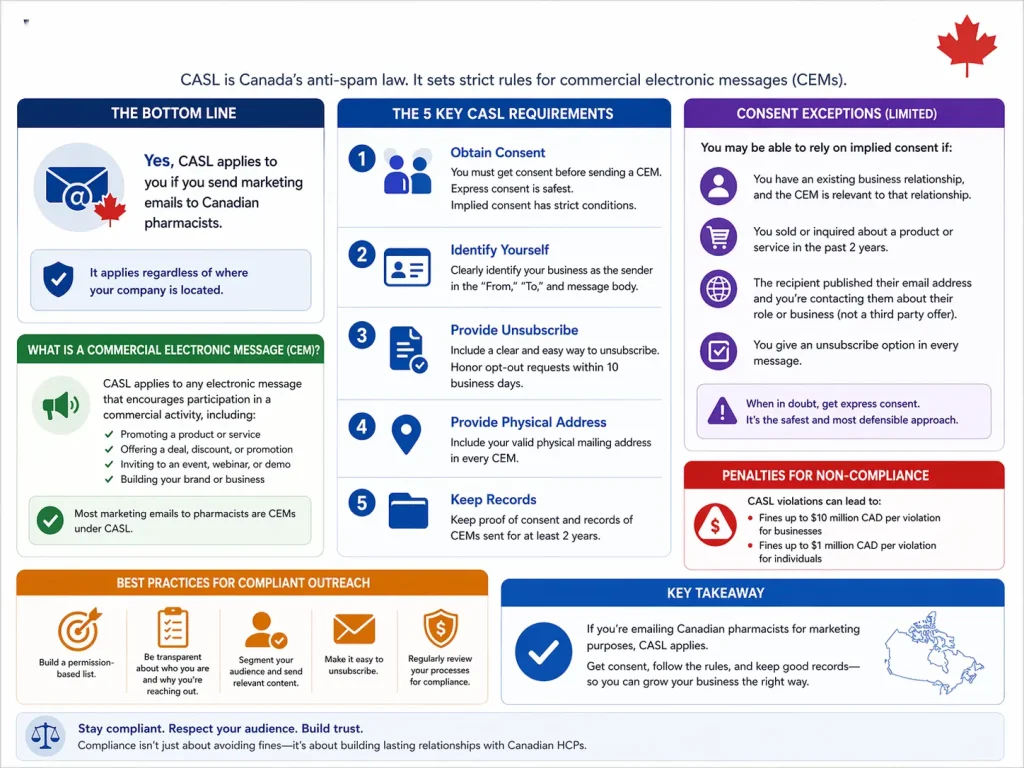
If your list includes pharmacists located in Canada, the Canadian Anti-Spam Legislation applies. CASL is stricter than CAN-SPAM and requires either express or implied consent before you send a commercial electronic message.
Express consent is a clear, affirmative opt-in. The contact specifically agreed to receive communications from you or from commercial senders in your category.
Implied consent exists when there is an existing business relationship, such as a prior purchase or a recent inquiry. It does not exist simply because the pharmacist’s contact information appears in a public directory.
The practical implication: before running a campaign to Canadian pharmacists, confirm with your list provider whether those contacts carry documented consent under CASL. Prospects Influential operates from offices in both West Vancouver, BC, and Bellingham, WA, and maintains separate compliance protocols for Canadian contacts specifically. If your campaign targets pharmacists in both the US and Canada, that dual-jurisdiction expertise matters.
You can explore broader healthcare professional lists that include contacts across both markets, built with jurisdiction-specific compliance built in.
CAN-SPAM vs. GDPR vs. CASL at a Glance
| Requirement | CAN-SPAM (US) | GDPR (EU) | CASL (Canada) |
| Consent required before sending | No | Legitimate interest or consent | Yes (express or implied) |
| Honest subject lines | Required | Required | Required |
| Physical address in email | Required | Required | Required |
| Unsubscribe mechanism | Required | Required | Required |
| Honor opt-outs within | 10 business days | Without undue delay | 10 business days |
| Right to data access | Not required | Required within 30 days | Not required |
| Right to erasure | Not required | Required | Not required |
| Maximum penalty | $53,088 per violation | 20M euros or 4% global turnover | $10M CAD per violation |
Frequently Asked Questions
Is buying a pharmacists email list illegal?
No. Buying a pharmacists email list is legal in the United States under the CAN-SPAM Act. The law regulates how you send emails, not the act of purchasing contact data. GDPR and CASL impose stricter conditions for EU and Canadian contacts but do not prohibit B2B outreach when conducted correctly.
Does a pharmacists email list violate GDPR?
Not automatically. GDPR permits B2B outreach to healthcare professionals under the legitimate interests basis, provided your message is professionally relevant, you identify yourself clearly, and you include a working opt-out. EU contacts from reputable providers include compliance documentation covering lawful basis and consent events.
What is the penalty for violating CAN-SPAM?
As of January 2025, the FTC’s civil penalty is capped at $53,088 per individual email in violation. For high-volume campaigns, violations compound rapidly across every non-compliant message sent.
Does HIPAA apply to marketers buying pharmacist contact data?
No. HIPAA applies to covered entities and their business associates. A business marketing products or services to pharmacists is not a covered entity. HIPAA becomes relevant only if your campaign involves protected health information about patients.
What should an opt-in pharmacists email list include?
A properly opt-in list includes contacts who actively agreed to receive professional communications through verifiable channels: conference registrations, association memberships, journal subscriptions, or voluntary directory listings. The provider should be able to document when and how each consent was collected.
How do I know if a list provider is compliant?
Ask for written confirmation that the data meets CAN-SPAM, GDPR, and CCPA requirements. Ask for the data sources by name. Ask for a sample before purchase. Ask for their bounce rate guarantee and replacement policy. A compliant provider answers all of these without hesitation.
Can I email pharmacists in Canada using a purchased list?
Yes, if those contacts carry express or implied consent under CASL. Implied consent exists through prior business relationships. Express consent requires a documented opt-in. Canadian contacts without documented consent should not be included in a cold email campaign.
How often should I update my pharmacist email list?
At minimum every 90 days for email verification. Quarterly for employment and practice setting data. Any list older than six months without reverification carries a materially higher bounce risk.
Ready to Reach Verified Pharmacists?
The fear around buying a pharmacists email list almost always comes from the same place: uncertainty about what the rules actually are. Now you have the rules.
The pharmacists who influence procurement decisions, formulary choices, and product adoption are reachable. The compliance framework to reach them legally is straightforward. What separates a successful campaign from an expensive mistake is the quality of the data and the expertise of the provider you work with.
Prospects Influential builds pharmacist contact lists from verified, sourced data with compliance documentation included. Their team has 30 years of experience in healthcare list brokering, covering both US and Canadian markets.
If your campaign targets pharmacy leadership specifically, the pharmacy directors mailing list gives you direct access to the decision-makers who hold purchasing authority at both chain and independent pharmacy operations.
Get in touch with Prospects Influential to discuss a pharmacists mailing list built to your campaign’s specific targeting and compliance requirements.