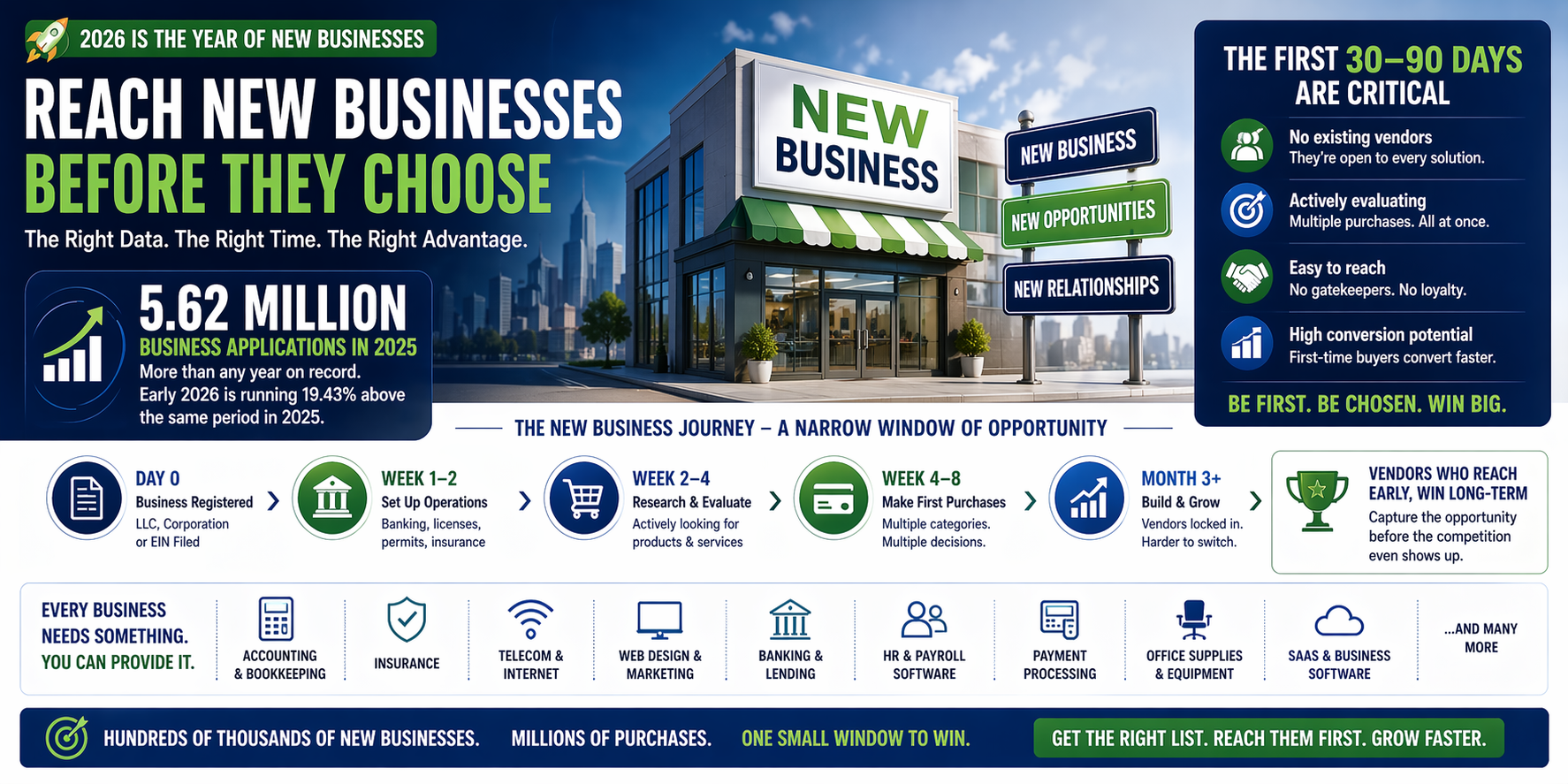
The United States Census Bureau reported 5.62 million business applications in 2025. That is more than any year on record. Business applications in early 2026 are running 19.43% above the same period in 2025.
What that means practically is simple. Every month in 2026, hundreds of thousands of new businesses are registering, hiring their first employees, signing their first leases, buying their first equipment, and looking for every service they need to get operational. They need accountants, insurance, telecom, web design, payment processing, HR software, banking, office supplies, and dozens of other things. And they need all of it at roughly the same moment.
For B2B vendors who target these new businesses, the commercial opportunity is enormous and the window is narrow. New business owners are not loyal to any vendor yet. They are actively deciding. They are making first-time purchases across multiple categories simultaneously. They are in market right now.
A new businesses list gives you direct access to those owners at that exact moment. This guide covers the five types of new business contact lists that serve different commercial use cases, who each one is built for, and why timing is the entire game.
What is a new businesses list?
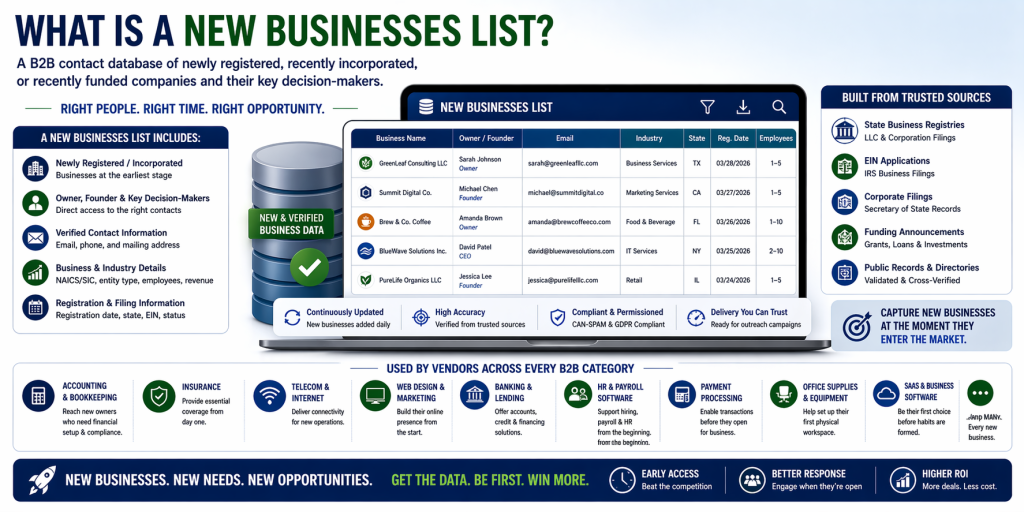
A new businesses list is a B2B contact database of recently registered, recently incorporated, or recently funded companies, along with the contact details of their owners, founders, and key decision-makers. It is used by vendors across virtually every B2B category to reach first-time buyers before they have committed to any supplier. Unlike general business lists, which include established companies with existing vendor relationships, new business lists specifically identify companies in their early formation stage, when purchasing decisions are open, urgent, and actively being made.
Why New Businesses Are the Most Commercially Valuable B2B Leads
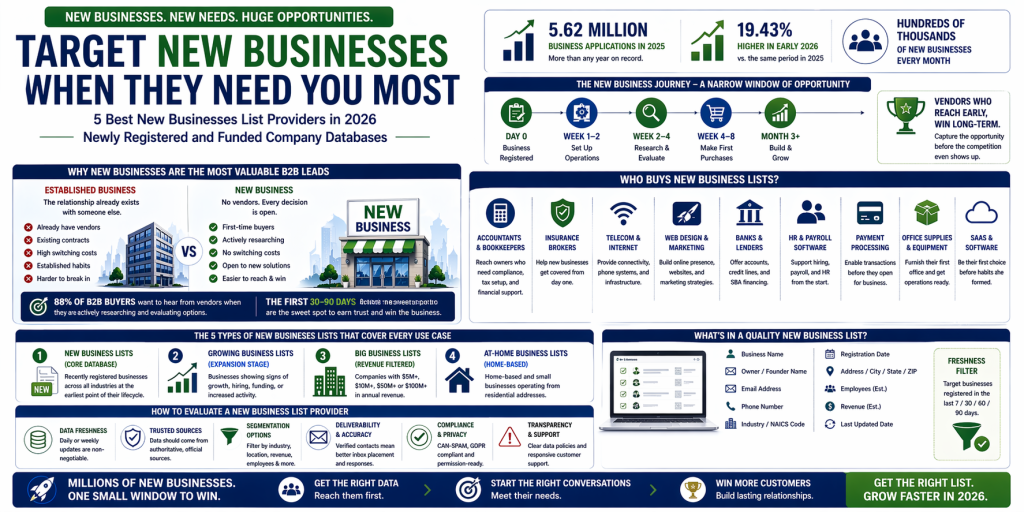
The logic behind targeting new businesses is different from targeting established ones.
When you email an established business about your accounting software, they probably already have accounting software. When you email them about insurance, they are already insured. When you reach out about web design, they have a website. The relationship with your category already exists with someone else, and displacing that relationship requires a compelling reason to switch.
When you email a new business, none of that is true. They need an accountant. They do not have insurance. They are building a website. They are choosing a payment processor. They are deciding on a phone system. Every one of those decisions is being made right now, often for the first time.
Research shows that 88% of B2B buyers want to hear from vendors when they are actively researching and evaluating options. New businesses are in that evaluation mode across almost every product category simultaneously. They are the most receptive B2B audience at the most commercially concentrated moment.
The timing advantage is the point. Vendors who reach new business owners in the first 30 to 90 days of registration are reaching them before loyalties, contracts, and relationships are established. That window does not stay open long.
Who Buys New Business Lists?
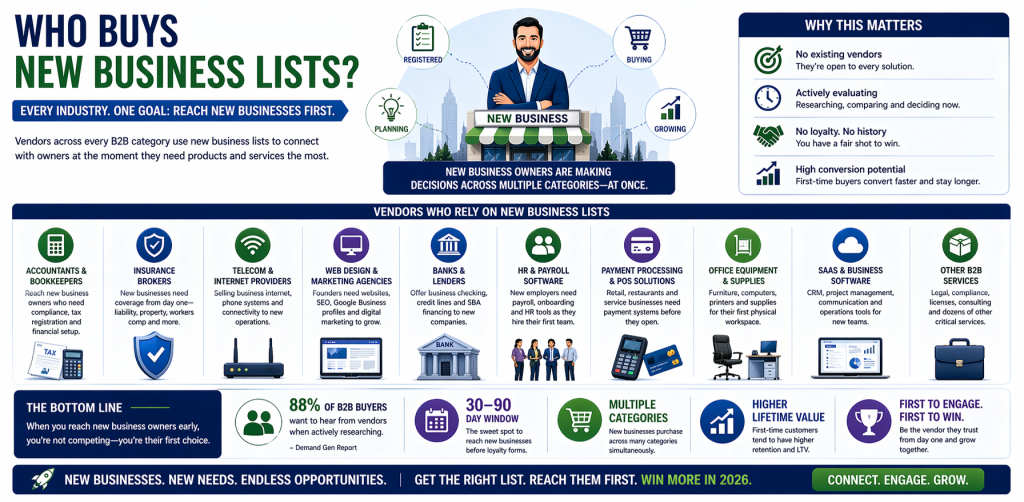
From accountants to SaaS platforms, B2B vendors across every category use new business lists to reach first-time buyers during the critical 30 to 90 day decision window.
The range of vendors who target newly registered businesses is broader than most B2B categories. New business lists serve:
Accountants and bookkeeping firms reaching owners who need compliance support, tax registration, and financial setup before their first quarter ends.
Business insurance brokers who know that a new LLC or corporation needs general liability, commercial property, and professional liability coverage from day one.
Telecom and internet service providers selling business broadband, phone systems, and connectivity packages to companies setting up their first operational infrastructure.
Web design and digital marketing agencies targeting founders who need an online presence, a Google Business profile, and a marketing strategy to generate their first customers.
Commercial banks and business lenders offering business checking accounts, commercial credit lines, and SBA-backed financing to new entities that need banking from day one.
HR and payroll software companies reaching new employers as they hire their first staff and face their first payroll obligations.
POS and payment processing vendors targeting retail, food service, and hospitality startups who need transaction infrastructure before they open.
Office equipment and supply vendors selling furniture, computers, printers, and consumables to new businesses furnishing their first physical space.
SaaS companies across categories including CRM, project management, operations, and communication tools whose ideal moment to acquire a customer is before they have built habits around a competing product.
What all of these vendors share is that their pitch is easiest at the beginning. The first-time buyer has no switching cost, no existing contract, and no preference to overcome.
The 5 Types of New Business Lists That Cover Every Use Case
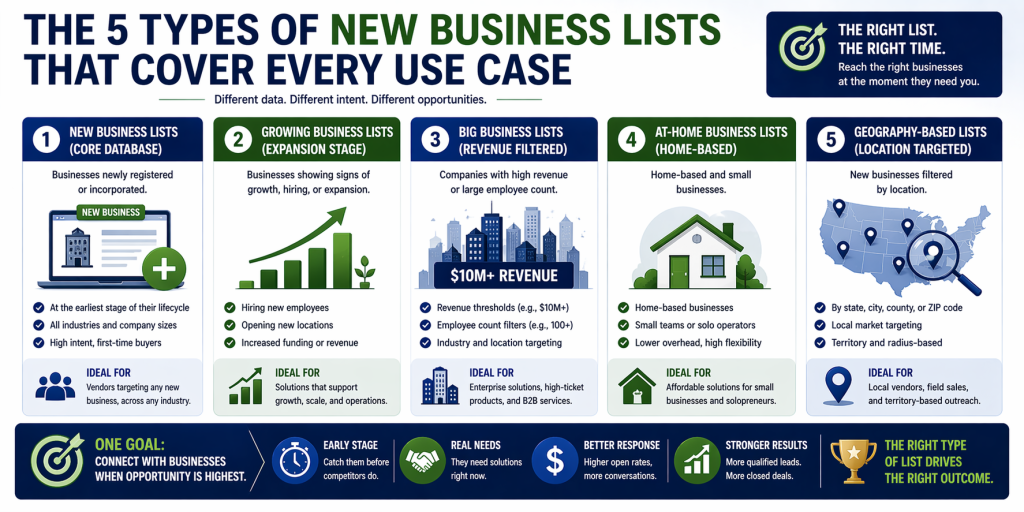
Not all new business lists work the same way. Choosing the right type based on your target audience, revenue threshold, or location can directly impact lead quality and conversion rates.
1. New Business Lists (Core Newly Registered Database)
Right for: Any vendor who wants to reach new business owners across all industries in the US at the point of registration.
The core new business list is built from recently filed business registrations, incorporating documents, and EIN applications. It captures businesses across every industry category at the earliest possible point in their commercial lifecycle.
In 2025, the US averaged 478,800 new business formations per month. That is a continuous, replenishing stream of new owners who are in active purchasing mode across every vendor category. A vendor with access to a regularly updated new business list has a standing pipeline of new-to-market prospects entering their territory every single month.
The commercial logic of this list type is timing. A business that registered six months ago has probably already made most of its foundational purchasing decisions. A business that registered 30 days ago has not. The freshness of the underlying registration data is what separates a list that generates first-call opportunities from one that generates responses like “we already have someone for that.”
Quality new business lists segment by industry, geography, business type, and estimated size. For vendors with territory-specific coverage, geographic segmentation by state, metro area, and ZIP code is essential for routing leads to the right sales team before the window closes.
Access the new businesses list here.
2. Growing Business Mailing List
Right for: Vendors selling solutions that serve businesses in their scale-up phase, where revenue is rising, headcount is increasing, and operational complexity is outgrowing their current tools.
There is an important commercial distinction between a newly registered business and a growing business. A new business needs first-time solutions. A growing business needs better solutions to replace the ones it outgrew.
A growing business that started on a basic payment processor two years ago is now processing significantly more volume and needs a more sophisticated platform. A growing business that was running payroll on a spreadsheet is now hiring enough people to need proper HR software. A growing business that handled its own bookkeeping is now generating enough revenue to need a proper accounting firm.
Growing businesses are in an active replacement cycle rather than a first-purchase cycle. The pitch is different from what works for brand new registrations. It centers on the cost of the current solution’s limitations rather than the absence of a solution entirely.
For SaaS companies, financial services vendors, operations software providers, and commercial real estate agents looking to place businesses in larger spaces, the growing business list targets the moment when the incumbent relationship is most vulnerable to displacement.
Access the growing business mailing list here.
3. Big Business Mailing List
Right for: Enterprise vendors, professional service firms, and high-value suppliers whose ideal customer is a large, established organization with significant budget authority.
Not every vendor benefits from targeting startups and new registrations. Enterprise software companies, commercial property developers, large-scale logistics providers, and corporate banking divisions need to reach decision-makers at established, revenue-generating organizations with procurement processes, defined budgets, and the organizational complexity to justify enterprise-level solutions.
The big business mailing list covers large organizations segmented by employee count, annual revenue, industry, and geography. For vendors whose deal size requires an established buyer, this list targets the accounts where budget authority and organizational maturity are already in place.
For campaigns that need to reach C-suite executives, procurement directors, or department heads at organizations large enough to have those roles formally defined, the big business list provides the contact layer to build enterprise ABM campaigns or high-value outreach programs.
Access the big business mailing list here.
4. At-Home Business Mailing List
Right for: Vendors selling products or services specifically relevant to home-based business operators, solopreneurs, and remote-first founders.
The at-home business category has grown significantly since 2020. Of the 5.62 million business applications filed in 2025, a meaningful share represents solopreneurs, consultants, freelancers, and home-based operators who work without a traditional commercial lease. The US Census Bureau counts over 29 million nonemployer businesses, which are businesses run by their owners without paid employees, a category that includes the majority of home-based operations.
At-home business owners have distinct purchasing needs from traditional office-based companies. They need home office equipment, virtual phone systems, remote work software, business insurance that covers home-based operations, separate business banking from personal accounts, and professional services like accounting and legal advice that understand sole proprietor and LLC structures.
For vendors whose product category specifically serves this segment, a general new business list mixed with commercial registrations is inefficient. The at-home business list targets this specific operational profile, where the owner is both the decision-maker and the end user of virtually every product they buy.
Access the at-home business mailing list here.
5. Geography-Specific New Business Lists
Right for: Vendors with defined geographic territory coverage, regional service businesses, and companies whose product or service requires physical proximity to the customer.
A national new business list is useful for SaaS companies and online service providers who can serve customers anywhere. It is less useful for a commercial insurance agent licensed only in three states, a local web design agency, a regional telecom provider, or a commercial landlord with properties in a specific market.
For these vendors, geographic segmentation is not a nice-to-have. It is the entire point. A new business in Seattle is not a lead for a commercial office provider in Philadelphia. Targeting it wastes budget and generates frustration on both ends.
Prospects Influential covers new business contact data across specific US cities, states, and metro areas, as well as international markets for vendors expanding their reach globally. Geographic list options include:
US Metro and State Lists: New businesses in specific markets including New York, Washington DC, and Philadelphia.
European Business Lists: Newly registered and active businesses in Germany, France, Sweden, and Switzerland.
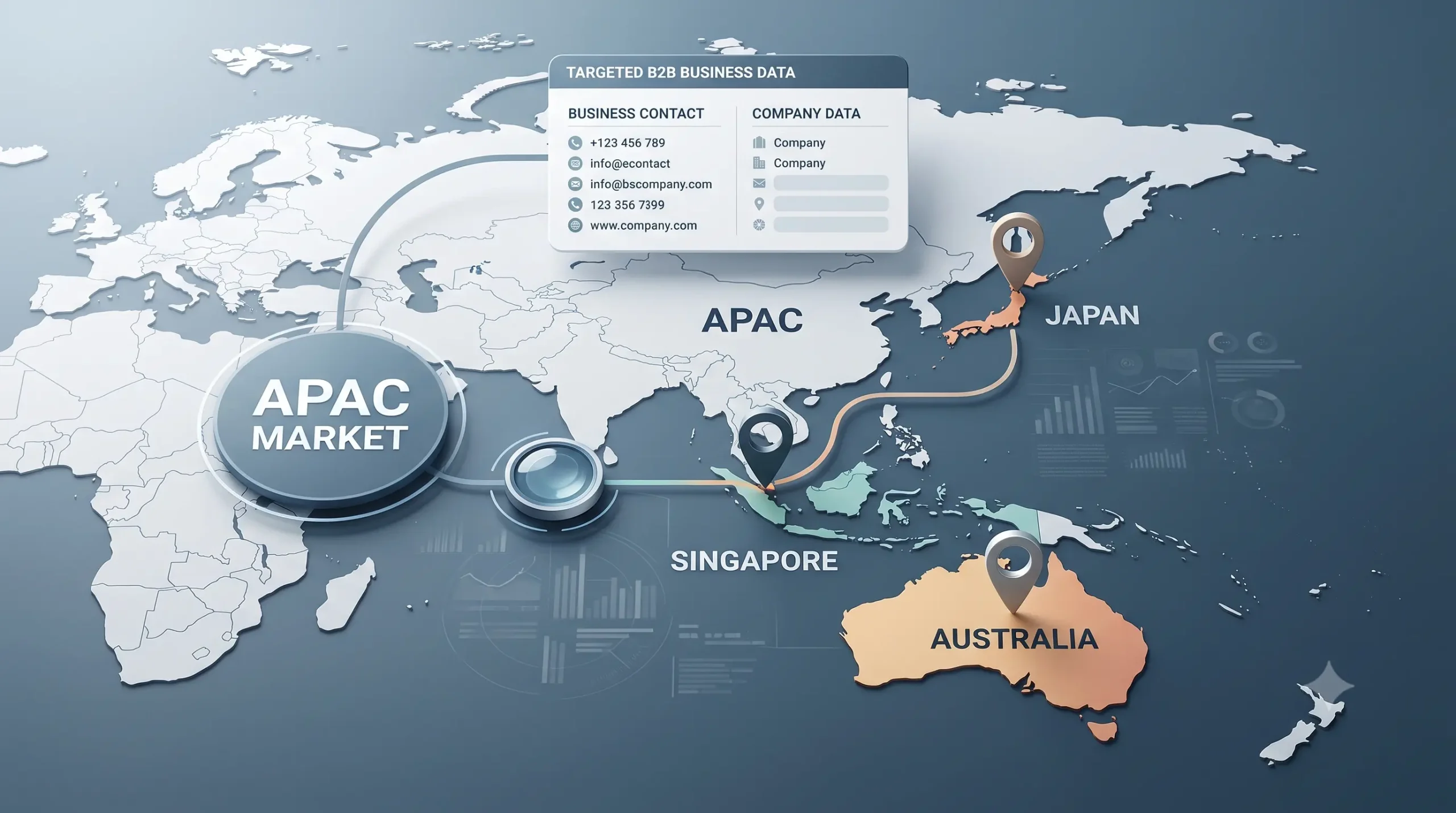
Asia-Pacific Business Lists: Active businesses across Japan, New Zealand, and the broader Asia-Pacific region.
For vendors whose sales territory has defined geographic boundaries, these segmented lists deliver prospects that are actually reachable, relevant, and within scope, rather than a national database that requires manual filtering to find the actionable subset.
How to Evaluate a New Business List Provider
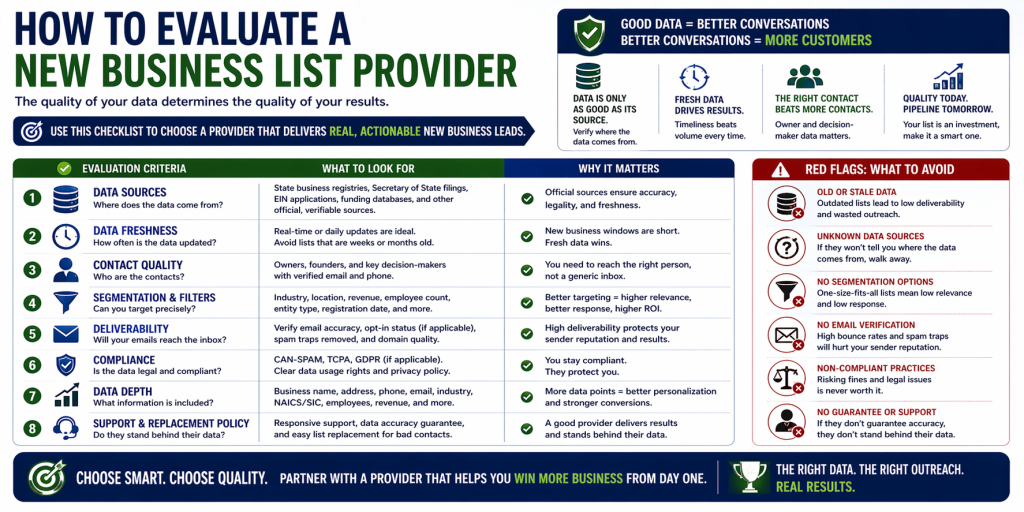
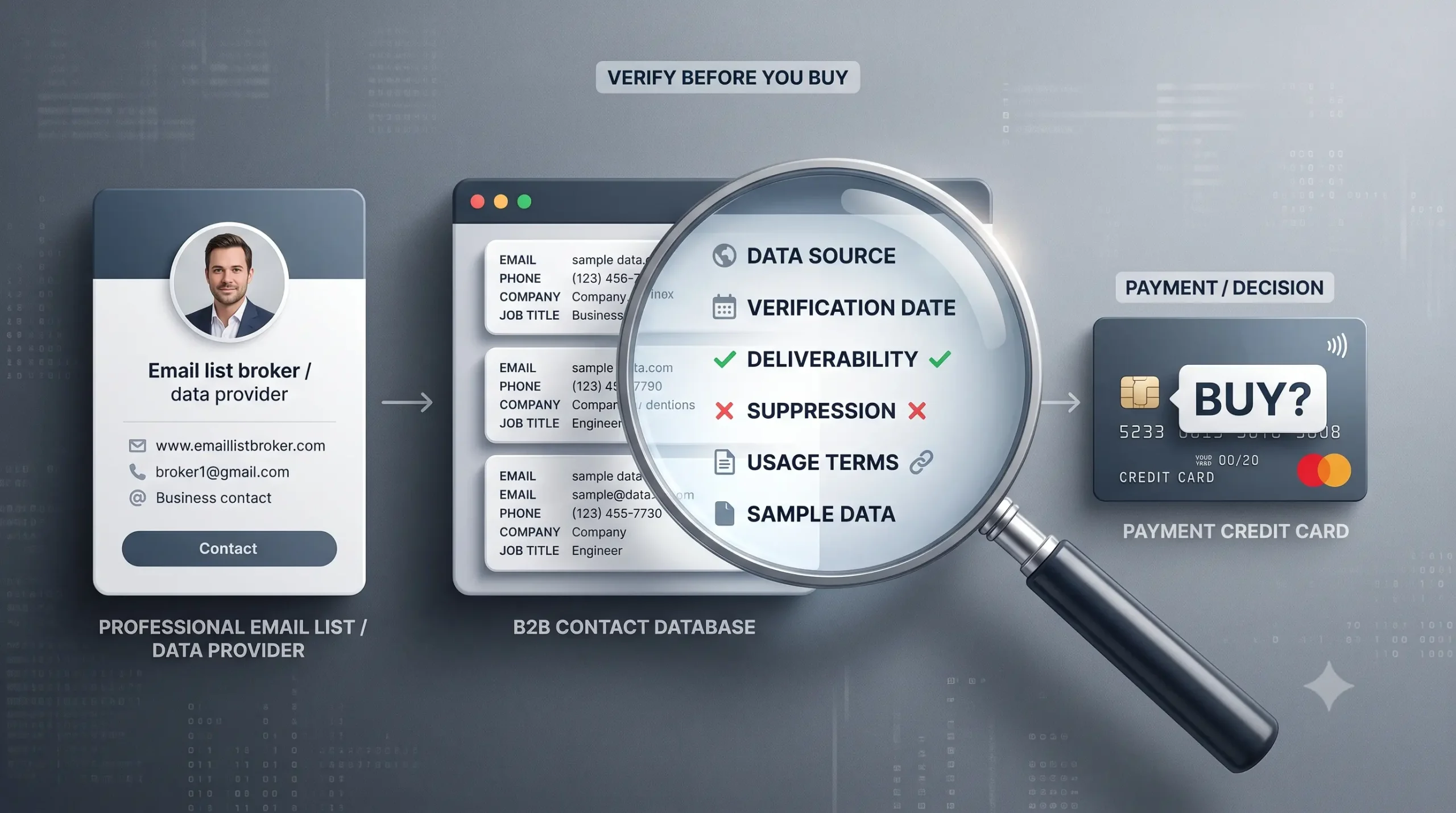
Before you buy any new business list, run it through these 8 evaluation criteria to make sure you are getting accurate, compliant, and deliverable B2B contact data.
The same evaluation questions apply to new business lists as to any B2B contact database, with one additional factor that matters more here than in most other categories: data freshness.
A new business list that is 12 months old is not a new business list. It is a slightly-more-established-than-average business list. The entire commercial value of this list type rests on reaching businesses while they are still in their early purchasing window. A list that was current in Q1 2025 has significantly less timing value in Q2 2026 than it did when it was compiled.
Ask any provider these questions before you commit:
How recently was this data compiled? Registration data should ideally be pulled within the past 30 to 90 days for maximum commercial relevance.
What is your update frequency? A new business list that is not continuously refreshed from registration sources becomes a general business list over time.
What sources does the data come from? Quality new business data is sourced from official registration filings, Secretary of State records, EIN applications, and incorporation databases, not from scraped web directories.
Can I segment by industry, geography, business type, and size? Without segmentation options, you cannot match the list to your ICP. A payment processor targeting retail businesses does not want to be paying for registered professional services firms.
What is your deliverability guarantee and replacement policy? New businesses frequently change addresses, email providers, and contact details in their first year. A provider who cannot guarantee deliverability or offer replacement contacts for bounces is selling you a risk you cannot manage.
What Data Fields Come with a Quality New Business List?
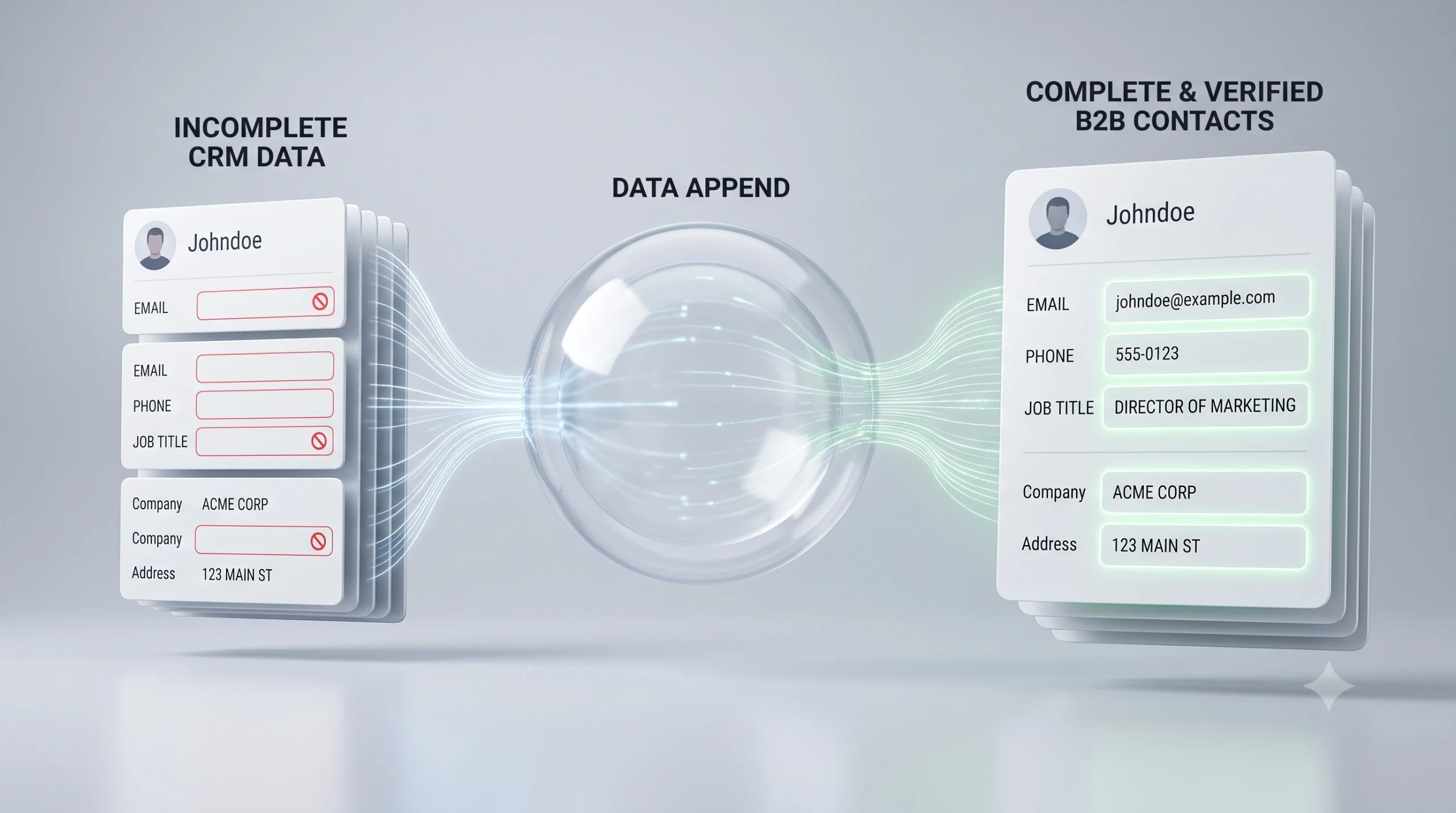
A well-built new business contact list includes more than a company name and a generic email. Look for:
- Business owner or founder full name
- Direct business email address
- Business phone number
- Business name and legal entity type (LLC, S-Corp, sole proprietorship, etc.)
- Industry classification by SIC or NAICS code
- Physical business address and ZIP code
- Registration date or incorporation date
- State and county of registration
- Estimated employee count where available
- Estimated annual revenue where available
The registration date is particularly important. It is what allows you to filter for truly new businesses, those registered within the past 30, 60, or 90 days, versus businesses that registered a year or more ago and have already made their foundational purchases.
Frequently Asked Questions
What is a new businesses list? A new businesses list is a B2B contact database of recently registered, recently incorporated, or recently funded companies and their owners or founders. It is used by vendors across every B2B category to reach first-time buyers before they have committed to any supplier.
What is the difference between a new businesses list and a growing businesses list? A new businesses list targets companies that have just registered or incorporated and are making first-time purchases across all categories. A growing businesses list targets companies that are scaling and are in an active replacement cycle for the tools and services they outgrew during their early stage.
Who buys new business lists? Accountants, insurance brokers, telecom providers, web design agencies, banks, HR and payroll software companies, POS and payment vendors, office equipment suppliers, and SaaS companies across categories. Any vendor whose ideal moment to acquire a new customer is before that customer has established a competing relationship.
How many new businesses are registered each year in the US? According to US Census Bureau Business Formation Statistics, 5.62 million business applications were submitted in 2025, the highest on record. Business applications through March 2026 are running 19.43% above the same period in 2025. Monthly new business formations have averaged over 478,800 per month in 2025.
How fresh should a new businesses list be? For maximum commercial relevance, registration data should be no older than 30 to 90 days. Businesses registered more than 6 months ago have typically already made most of their foundational purchasing decisions. Data freshness is the single most important quality differentiator for new business lists specifically.
Can I segment a new businesses list by industry and geography? Yes. Quality new business lists support segmentation by industry (SIC or NAICS code), geographic territory (state, metro, ZIP), business entity type, and estimated size. Geography segmentation is particularly important for regional vendors whose service area has defined boundaries.
Are new business lists available for international markets? Yes. Prospects Influential covers new and active business contact data across European markets including Germany, France, Sweden, and Switzerland, as well as Asia-Pacific markets including Japan, New Zealand, and the broader APAC region.
What makes Prospects Influential different for new business lists? Prospects Influential operates as an independent list broker with no allegiance to a single data source. That independence means your new business list is built from the sources that best match your campaign’s industry focus, geographic coverage, and data freshness requirements, rather than defaulting to one proprietary database. They have operated in this space for over 30 years across both US and Canadian markets.
Getting Started with a New Business List
The commercial opportunity in new business lists is straightforward: 5.62 million new businesses registered in the US in 2025 alone, every one of them needing the same categories of products and services at roughly the same moment, with no existing vendor relationships to compete against.
The vendors who capture that opportunity are not the ones with the biggest databases. They are the ones who reach the right new businesses at the right moment, with the right message, before the purchasing window closes.
Prospects Influential builds new business contact lists from verified, regularly updated registration data across US national, state, and metro markets as well as international regions. Whether you need a broad national new business list, a geography-specific segment, a growing business audience, or an enterprise-scale big business database, the right list starts with understanding your commercial timing and your customer acquisition window.
Access the new businesses list here or get in touch to discuss a custom segment built to your specific industry focus, geographic territory, and campaign timing.
You can also read how targeted list building applies to specific industries in our guide to building a targeted list of renewable energy consulting firms for B2B lead generation.