If you’ve ever tried to buy or build a business marketing list, you’ve almost certainly encountered the term SIC code. It might have appeared in a filter on a data platform, in a question from a list provider, or in a spreadsheet column you weren’t quite sure what to do with.
SIC codes are one of the most powerful tools available for B2B targeting. They’re also one of the most underused, largely because many marketers haven’t taken the time to understand how they work.
This guide explains what SIC codes are, how they organise the business world, and how to use them to make your business lists significantly more targeted and effective.
What Is a SIC Code?
SIC stands for Standard Industrial Classification. A SIC code is a four-digit number assigned to a business based on its primary industry or economic activity. The system was developed in the United States in the 1930s to provide a consistent way of categorising businesses for statistical and regulatory purposes. It has since been adopted and adapted in Canada, the United Kingdom, and many other countries.
Every SIC code represents a specific type of business activity. A few examples:
- 2099: Food preparations, not elsewhere classified
- 5065: Electronic parts and equipment, not elsewhere classified (wholesale)
- 7372: Prepackaged software
- 8742: Management consulting services
- 5511: Motor vehicle dealers (new and used)
The four digits are not random. They’re hierarchical. The first two digits indicate the major industry group. The first three indicate a sub-group. All four together identify a specific industry within that sub-group.
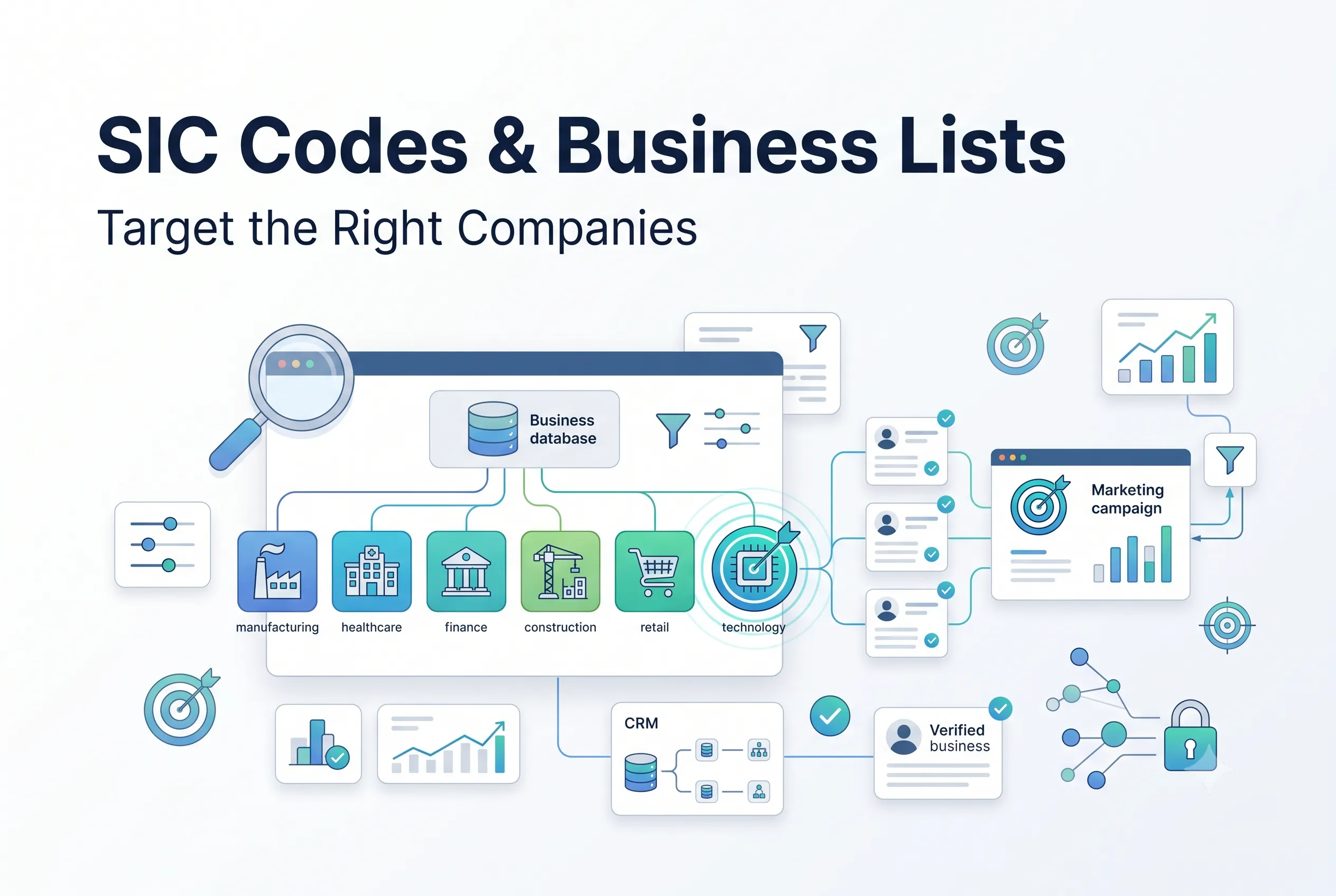
This structure is what makes SIC codes useful for marketing. You can target at the broad industry level (all manufacturing companies), at the sub-group level (all food manufacturers), or at the specific activity level (all fresh or frozen packaged fish manufacturers). The level of specificity you choose depends on how narrowly you want to define your target market.
How SIC Codes Organise the Business World
The SIC system divides all economic activity into ten major divisions, each covering a broad sector:
- Agriculture, Forestry, and Fishing (SIC codes 01-09)
- Mining (10-14)
- Construction (15-17)
- Manufacturing (20-39)
- Transportation, Communications, Electric, Gas, and Sanitary Services (40-49)
- Wholesale Trade (50-51)
- Retail Trade (52-59)
- Finance, Insurance, and Real Estate (60-67)
- Services (70-89)
- Public Administration (91-99)
Within each division, the numbering breaks down further into major groups, industry groups, and specific industries. Manufacturing alone spans SIC codes 2000 through 3999, covering everything from food and tobacco to industrial machinery and electronic equipment.
For marketers, the most immediately useful way to engage with SIC codes is through a lookup reference. You don’t need to memorise the structure. You need to be able to find the codes that correspond to the types of businesses you’re trying to reach.
Our Business List SIC Code directory lets you look up codes by industry category, making it straightforward to identify the right codes for your target market.
Why SIC Codes Matter for Business List Targeting
Without SIC codes (or a comparable classification system), describing a target business type to a list provider is imprecise. “Manufacturing companies” is a category with tens of thousands of companies spanning hundreds of sub-sectors. “Accounting firms” covers sole practitioners, small regional partnerships, and large national firms that serve very different markets.
SIC codes give both you and your list provider a precise shared language for describing what you want. Instead of “financial services companies,” you can specify SIC 6020 (state commercial banks), 6311 (life insurance), or 6411 (insurance agents, brokers, and service), depending on which part of the financial services sector you’re targeting.
This precision has several practical benefits.
Relevance. When your list is filtered to a specific SIC code or set of codes, every company on it is in the industry you’re targeting. You’re not paying for contacts at companies that are adjacent to your target but won’t actually buy what you sell.
Volume control. Because SIC codes vary enormously in how many companies they represent, filtering by code gives you control over list size. Broad codes produce large lists. Specific codes produce smaller, more targeted lists. You can adjust the level of specificity to match your campaign budget and approach.
Combination filtering. SIC codes work best in combination with other filters. A business list filtered to SIC 7372 (prepackaged software) companies with 50 to 250 employees in Ontario is a very precise target. The SIC code is the layer that ensures you’re reaching the right industry; the other filters ensure the right size, geography, and type of company within that industry.
How to Find the Right SIC Codes for Your Campaign
The process of identifying the right SIC codes for your target market doesn’t have to be complicated. A few approaches:
Start with your best customers. If you already have customers you’d like to replicate, look at what they do and find the SIC codes that match those activities. Businesses in the same SIC code tend to have similar needs, buying patterns, and decision-making structures.
Use a SIC code directory. A well-organised reference directory lets you browse by industry category and identify codes that match your target. This is faster than starting from a blank list of four-digit numbers and trying to work backwards.
Think about related codes. Your ideal customer might appear under multiple SIC codes depending on how they describe their primary activity. A company that manufactures and distributes its own products might appear under a manufacturing code or a wholesale trade code. Checking related codes ensures you’re not missing a significant portion of your target market.
Talk to your list provider. A good list provider will ask about your target market and help you identify the most appropriate SIC codes if you’re not sure. This is part of what the brief-taking process is for.
SIC Codes vs. NAICS Codes
You may also encounter NAICS codes (North American Industry Classification System), which were introduced in 1997 as a more detailed and up-to-date alternative to SIC codes. NAICS uses a six-digit code structure and covers new industries (particularly in technology and services) that didn’t exist when the SIC system was developed.
In practice, both systems are still widely used. Many data providers maintain SIC codes because of the long history of data classified under them. Others use NAICS. Some use both.
If you’re building a list and the provider uses NAICS rather than SIC, the process is the same: find the codes that match your target industry, apply them as a filter, and combine them with your other targeting criteria. The two systems cover the same ground; they just use different numbering structures and levels of granularity.
Putting It Into Practice
Here’s how a typical SIC-code-based list brief comes together:
Scenario: A commercial cleaning company wants to target office buildings, medical facilities, and manufacturing plants in the greater Vancouver area.
SIC codes:
- 6512 (operators of apartment buildings and office buildings)
- 8011 (offices and clinics of doctors of medicine)
- 8049 (offices and clinics of other health practitioners)
- 2000-3999 range (manufacturing, narrowed further by relevant sub-sectors)
Additional filters:
- Geography: Metro Vancouver FSAs
- Company size: 10 or more employees (to target businesses large enough to have a cleaning contract)
- Contact title: Office Manager, Facilities Manager, Operations Director
The result is a list of businesses in the right industries, the right size, and the right location, with contacts at the right level to make a buying decision about cleaning services. Every name on that list is a genuine prospect. None of them are there by accident.
This is what targeted list building looks like when SIC codes are used correctly. The difference between this and a generic “Vancouver business list” is the difference between a precision tool and a blunt instrument.
Ready to Build Your List?
If you know which types of businesses you want to reach but aren’t sure which SIC codes apply, our Business List SIC Code directory is a useful starting point for identifying the right codes.
When you’re ready to build a list, get in touch with us. Tell us which industries you’re targeting (by name or SIC code), your geographic requirements, any company size filters, and the type of contact you want to reach. We’ll prepare a business list built to those specifications, typically within one to two business days.