The renewable energy sector is exploding. With global investment in clean energy hitting record highs and governments worldwide pushing aggressive sustainability goals, renewable energy consulting firms are multiplying rapidly.
These consultants help businesses, municipalities, and developers navigate the complex world of solar, wind, geothermal, and other renewable technologies. They conduct feasibility studies, manage projects, ensure regulatory compliance, optimize energy systems, and guide clients through incentive programs and financing options.
And if you sell products or services that these consulting firms need software, equipment, professional services, training, or technology you’re sitting on a significant B2B opportunity.
But here’s the challenge: renewable energy consulting is a fragmented, rapidly evolving industry. These firms range from solo consultants working from home offices to mid-sized firms with dozens of specialists. They’re not all listed in traditional business directories. They span multiple specialties and serve diverse markets. And generic business lists won’t help you reach them effectively.
So how do you identify and target renewable energy consulting firms for B2B lead generation? How do you build a list that actually connects you with decision-makers who need what you’re selling?
Let’s break down exactly how to find, target, and reach this specialized market segment.
Who Needs to Market to Renewable Energy Consulting Firms?
Before we dive into list-building strategies, let’s clarify who should be targeting these consultants:
Software and Technology Vendors: Companies selling energy modeling software, project management platforms, CAD tools, data analytics systems, monitoring software, or renewable energy assessment tools.
Equipment and Component Suppliers: Manufacturers and distributors of solar panels, wind turbines, inverters, battery storage systems, mounting hardware, monitoring equipment, or testing instruments.
Engineering and Professional Services: Structural engineers, electrical engineers, environmental consultants, permitting specialists, legal services, or accounting firms serving the renewable energy sector.
Financial Services: Banks, lenders, insurance companies, or financial advisors specializing in renewable energy project financing, tax equity, or risk management.
Training and Certification Providers: Organizations offering professional certifications, continuing education, technical training, or workforce development for renewable energy professionals.
Industry Associations and Events: Trade associations, conference organizers, or publications targeting renewable energy professionals.
Marketing and Business Services: Agencies, CRM providers, lead generation services, or business consultants specializing in the renewable energy sector.
Subcontractors and Installation Services: Electrical contractors, construction companies, or specialized installers who partner with consultants on project execution.
If your business depends on reaching renewable energy consulting firms, a targeted business list is your foundation for efficient lead generation.
What Makes Renewable Energy Consulting Firms a Unique B2B Target?
Understanding this market’s characteristics helps you build better lists and craft more effective outreach:
Rapid Growth and New Entrants: The industry is expanding quickly, with new firms launching regularly. Traditional business directories lag behind this growth, meaning you need lists that capture recent formations.
Diverse Specializations: Some consultants focus exclusively on solar. Others specialize in wind, geothermal, biomass, or energy efficiency. Many focus on specific project types like commercial, residential, utility-scale, or agricultural applications.
Wide Size Range: From independent consultants to firms with 50+ employees. Your targeting must account for the company size that matches your offering’s price point and complexity.
Geographic Concentration: Renewable energy consulting firms cluster in states with aggressive renewable energy goals and favorable policies California, Texas, New York, Massachusetts, Colorado, and others.
Multiple Decision-Makers: Even small consulting firms have different roles: principals who make strategic decisions, project managers who select tools and services, engineers who evaluate technical solutions, and business operations managers who handle procurement.
High Technical Literacy: These are sophisticated buyers who research thoroughly, value data and proof, and make decisions based on ROI and technical capabilities rather than marketing hype.
Relationship-Driven: The renewable energy community is relatively tight-knit. Referrals, industry connections, and reputation matter enormously.
Project-Based Work: Consulting firms have cyclical needs tied to project pipelines. Timing your outreach to align with their busy periods or planning phases improves response rates.
These characteristics mean generic business lists won’t cut it. You need specialized targeting to reach the right firms at the right time.
How to Source and Build a Renewable Energy Consulting Firm List
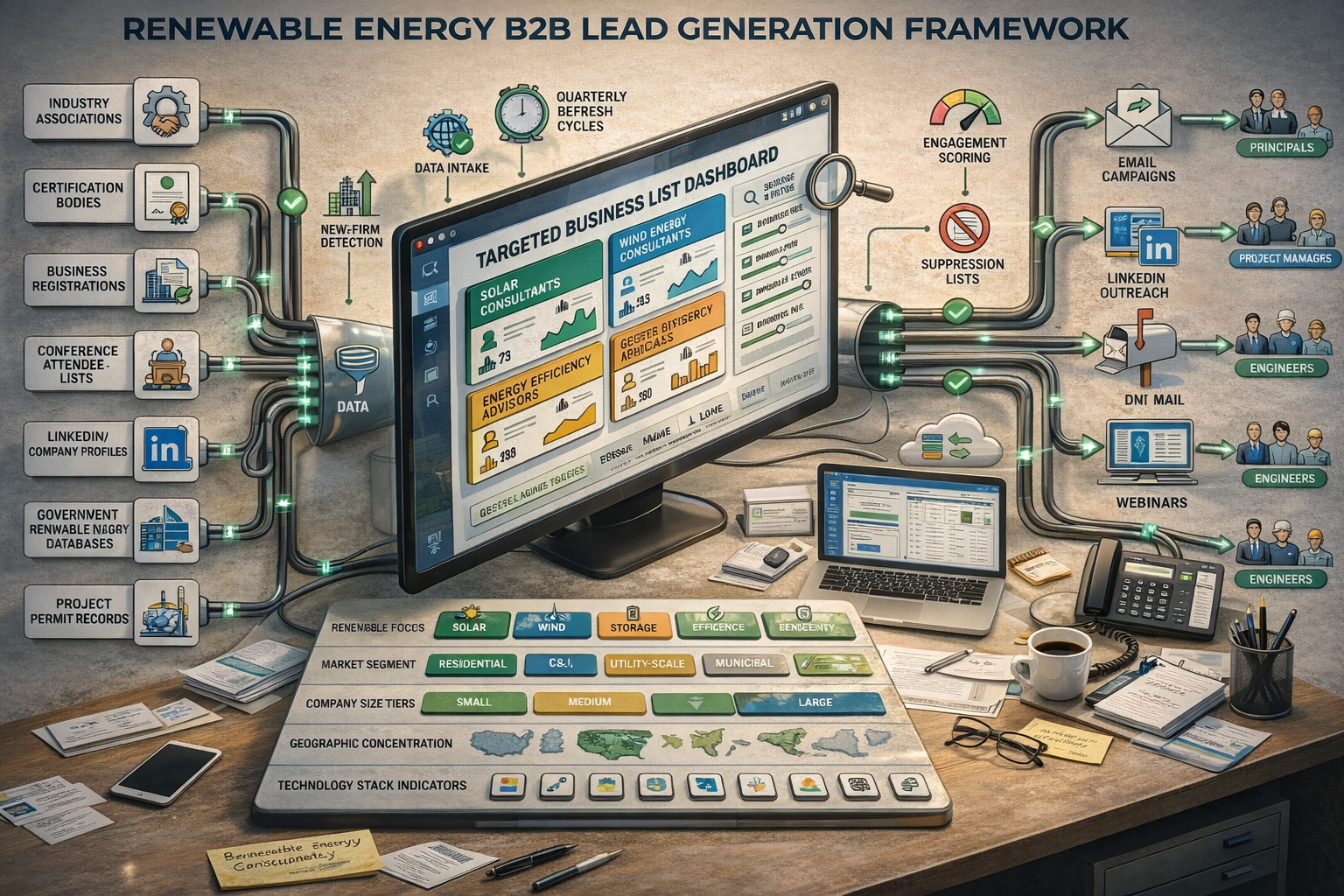
Building an accurate, targeted list of renewable energy consultants requires a multi-source approach:
Industry Associations and Directories
Start with professional organizations where renewable energy consultants congregate:
Association of Energy Engineers (AEE): Members include energy consultants, engineers, and managers. Membership directories (where available) provide contact information.
American Solar Energy Society (ASES): Solar professionals including consultants, engineers, and researchers.
American Wind Energy Association (AWEA): Wind energy professionals including project developers and consultants.
National Renewable Energy Laboratory (NREL) Partnerships: Companies and consultants working with NREL on research and development.
State and Regional Renewable Energy Associations: Organizations like the California Solar & Storage Association or Midwest Renewable Energy Association maintain member lists.
Professional Certification Bodies: Organizations offering LEED, NABCEP, or other renewable energy certifications maintain registries of certified professionals.
These sources provide high-quality contacts but may require membership or purchase agreements to access.
Business Registration and Licensing Data
Renewable energy consultants often require specific business registrations:
State Business Registrations: Secretary of State databases list registered businesses. Search for companies with “renewable energy,” “solar consulting,” “wind energy,” or “sustainability” in their business descriptions.
Professional Licenses: Many states require engineering licenses or energy consultant registrations. These public records identify legitimate practitioners.
Contractor Licenses: Consultants who also perform installations typically hold contractor licenses, which are public record in most states.
Environmental Consulting Permits: Firms conducting environmental impact assessments need specific permits, creating another data source.
Industry Publications and Conference Attendees
Renewable energy professionals show up in predictable places:
Trade Publication Subscriber Lists: Magazines like Solar Power World, North American Windpower, or Renewable Energy World have subscriber lists that may be available for marketing.
Conference and Event Attendees: Major industry events like Solar Power International, AWEA Windpower, or Intersolar North America attract thousands of renewable energy professionals. Attendee lists (where available) are gold.
Webinar Participants: Companies hosting technical webinars collect opt-in contact information from participants interested in specific topics.
White Paper Downloads: Gated content about renewable energy technologies captures contact information from people actively researching solutions.
Online Presence and Digital Footprints
Modern list-building incorporates digital signals:
LinkedIn Company Searches: Search for companies with “renewable energy consultant,” “solar consulting,” or similar terms in their profiles. Export contacts using LinkedIn Sales Navigator or similar tools.
Google Business Profiles: Renewable energy consultants with Google Business listings can be identified through searches and map data.
Industry Marketplaces and Directories: Platforms like EnergySage, FindSolar, or GreenBusinessLight list consultants and contractors.
Government Databases: DSIRE (Database of State Incentives for Renewables & Efficiency) and other government resources list firms working on incentivized projects.
Project Databases: Tracking companies listed as consultants on permitted renewable energy projects in public records.
Compiled Business Databases
Professional business list providers compile data from multiple sources:
Industry Classification Codes: Use NAICS codes to identify renewable energy consultants:
- 541620 (Environmental Consulting Services)
- 541330 (Engineering Services) with renewable energy specialization
- 541690 (Other Scientific and Technical Consulting Services)
Compiled Databases: Providers like Dun & Bradstreet, InfoUSA, or specialized B2B data companies compile business information including renewable energy consultants.
Specialty List Providers: Some companies specialize in specialty business lists for niche industries including renewable energy.
Working with experienced list brokers gives you access to multiple sources and helps identify the best options for your specific needs.
Key Targeting Criteria for Renewable Energy Consulting Lists
Once you have sources, you need to filter and segment effectively:
By Renewable Energy Focus
Solar Consulting: Firms specializing in photovoltaic systems, solar thermal, concentrated solar power, or solar project development.
Wind Energy Consulting: Wind resource assessment, wind farm development, turbine selection, or wind project permitting.
Energy Efficiency Consulting: Building energy audits, HVAC optimization, lighting retrofits, or energy management systems.
Geothermal Consulting: Ground-source heat pump design, geothermal resource assessment, or geothermal project development.
Biomass and Biofuel Consulting: Anaerobic digestion, biomass combustion, biofuel production, or agricultural energy projects.
Multi-Discipline Renewable Energy: Consultants working across multiple renewable technologies.
Microgrid and Energy Storage: Firms specializing in distributed energy, battery storage, or grid integration.
Your product or service likely aligns with specific renewable energy types. Target accordingly.
By Market Segment
Residential Solar Consultants: Helping homeowners with residential installations. Typically smaller projects, higher volume.
Commercial and Industrial (C&I) Consultants: Serving businesses with energy needs. Mid-size projects with moderate complexity.
Utility-Scale Project Consultants: Large solar farms, wind farms, or major renewable energy installations. Complex projects, long sales cycles.
Municipal and Government Consultants: Serving public sector clients with renewable energy goals.
Agricultural Consulting: Specialized in on-farm renewable energy systems, agricultural biogas, or agrivoltaics.
Different segments have different buying patterns, budgets, and decision-making processes.
By Company Size
Solo Consultants (1 employee): Independent practitioners. Lower budgets but more agile decision-making.
Small Firms (2-10 employees): Growing practices with specialized expertise. Can afford professional tools and services.
Mid-Size Firms (11-50 employees): Established consultancies with diverse capabilities and substantial project pipelines.
Larger Firms (50+ employees): Multi-office operations with corporate purchasing processes and enterprise-level needs.
Match your offering’s price point and complexity to appropriate firm sizes.
By Geographic Location
High Solar States: California, Arizona, Nevada, Texas, Florida, North Carolina, Utah.
Strong Wind States: Texas, Iowa, Oklahoma, Kansas, Illinois, Minnesota.
Progressive Policy States: California, New York, Massachusetts, New Jersey, Maryland, Colorado.
Emerging Markets: States with recent renewable energy mandates or incentive programs.
Urban vs. Rural: Urban consultants often focus on commercial buildings; rural consultants may emphasize agricultural or utility-scale projects.
For service-based businesses, geographic targeting is essential since you can’t support clients nationwide.
By Business Age
Established Firms (10+ years): Proven track records but may have legacy systems and established vendor relationships.
Growing Firms (3-10 years): Building capabilities and often seeking better tools and services to scale operations.
New Firms (under 3 years): New businesses establishing processes and selecting initial technology and service providers.
Recent Formations: Firms launched in the last 6-12 months represent opportunities to become their initial vendor before competitors establish relationships.
By Revenue and Project Volume
Annual Revenue: Higher-revenue firms can afford premium solutions and enterprise pricing.
Number of Employees: Proxy for project volume and internal capabilities.
Active Project Count: Firms with large project pipelines have more immediate needs.
Client Base Size: Firms with established client bases may need CRM, marketing, or business development tools.
By Technology and Systems Used
Software Stack: What project management, energy modeling, or CAD software do they currently use? This reveals compatibility needs and replacement opportunities.
Website Sophistication: Professional websites suggest firms investing in business development likely buyers for marketing services.
Digital Presence: Active LinkedIn profiles, published articles, or webinar participation indicate engaged professionals.
Best Practices for Reaching Renewable Energy Consulting Firms
Once you’ve built your list, execution matters:
Direct Mail for High-Value Prospects
Business direct mail works exceptionally well for technical audiences:
What Works:
- Technical white papers or case studies
- Product samples or demonstration kits
- Invitations to industry events or webinars
- Dimensional mailers with physical prototypes
What Doesn’t:
- Generic sales letters
- Overly promotional brochures
- Vague value propositions
Renewable energy consultants appreciate substantive information, not fluff.
Email Marketing for Thought Leadership
Business opt-in email lists allow you to deliver ongoing value:
Effective Email Content:
- Industry research and market data
- Technical tutorials or how-to guides
- Regulatory updates and policy changes
- ROI calculators or assessment tools
- Invitations to educational webinars
Email Strategy:
- Lead with education, not sales
- Segment by specialization (solar vs. wind vs. efficiency)
- Personalize based on company size and project focus
- Nurture over time these are not impulse buyers
Telemarketing for Direct Engagement
Business telemarketing can work but requires a consultative approach:
Calling Best Practices:
- Research each firm before calling
- Lead with questions about their challenges, not your product
- Demonstrate industry knowledge
- Offer immediate value (free assessment, industry report)
- Respect timekeep initial calls brief
When to Call:
- Mid-morning (10-11 AM) or mid-afternoon (2-4 PM)
- Tuesday through Thursday
- Avoid Mondays (planning meetings) and Fridays (project wrap-ups)
LinkedIn and Social Selling
Renewable energy professionals are active on LinkedIn:
LinkedIn Strategy:
- Connect with principals and key decision-makers
- Share valuable content consistently
- Engage with their posts and articles
- Join renewable energy LinkedIn groups
- Use LinkedIn ads to target specific job titles at consulting firms
Industry Event Participation
Face-to-face remains powerful in this relationship-driven industry:
Event Strategy:
- Exhibit at Solar Power International, AWEA, or regional conferences
- Host educational sessions or workshops
- Sponsor industry association events
- Collect business cards and follow up systematically
Multi-Channel Integration
The most effective campaigns use multi-channel approaches:
Sample Sequence:
- Send personalized direct mail with valuable content
- Follow up with email referencing the mailer
- Connect on LinkedIn with custom message
- Make a consultative phone call
- Invite to relevant webinar or event
- Continue email nurture sequence
Multiple touchpoints build familiarity and trust over time.
Maintaining and Updating Your Renewable Energy Consulting List
Lists decay quickly in rapidly growing industries:
Regular Updates: Refresh your list quarterly at minimum. Monthly is better for this fast-changing sector.
Track Changes: Monitor when firms close, merge, or change focus. Remove or update accordingly.
New Business Tracking: Continuously identify newly formed consulting firms in your target markets.
Contact Verification: Regularly verify email addresses and phone numbers to maintain deliverability.
Engagement Tracking: Monitor who opens emails, clicks links, or engages with content. These signals identify hot prospects.
CRM Integration: Feed all interactions into your CRM to build comprehensive profiles and inform future outreach.
Suppression Lists: Immediately remove anyone who opts out or requests no further contact.
Common Mistakes When Targeting Renewable Energy Consultants
Avoid these pitfalls:
Mistake 1: Too Broad Targeting
Lumping all renewable energy consultants together ignores specialization differences. Solar consultants don’t need wind turbine design software.
Mistake 2: Focusing Only on Large Firms
Small and solo consultancies represent significant cumulative market opportunity. Don’t ignore them if your offering fits their scale.
Mistake 3: Generic B2B Messaging
These are technical experts. Generic “increase productivity” messages fall flat. Speak their language with specificity and data.
Mistake 4: Ignoring Geographic Relevance
If you’re a regional service provider, why waste budget targeting firms 2,000 miles away?
Mistake 5: One-Touch Campaigns
Single emails or calls won’t cut it. Build multi-touch sequences that provide value over time.
Mistake 6: No Follow-Up on Engagement
If someone downloads your white paper or attends your webinar, they’re signaling interest. Follow up immediately.
Mistake 7: Overlooking Seasonality
Renewable energy projects have seasonal patterns (construction seasons, policy deadlines). Time your campaigns accordingly.
Measuring Success: Key Metrics for Renewable Energy Consultant Campaigns
Track these metrics to evaluate list quality and campaign effectiveness:
List Quality Metrics:
- Deliverability rate (email bounce rate, mail returned)
- Contact accuracy (right person, right title, right company)
- Company qualification (actually renewable energy consultants)
Engagement Metrics:
- Email open rates (20-30% is solid for B2B technical audiences)
- Click-through rates (3-7% indicates strong content relevance)
- Website visits from campaign traffic
- Content download rates
Lead Generation Metrics:
- Response rate (inquiries, demo requests, information requests)
- Qualified lead rate (percentage meeting your criteria)
- Meeting or demo booking rate
- Sales pipeline value generated
Conversion Metrics:
- Lead-to-customer conversion rate
- Average deal size
- Sales cycle length
- Customer lifetime value
- Return on marketing investment
Benchmark Expectations:
Response rates for well-targeted renewable energy consultant campaigns typically range from 1-5% depending on offer relevance, message quality, and timing. Conversion rates from lead to customer vary widely (5-30%) based on product complexity, price point, and sales process.
Working with List Brokers for Renewable Energy Consulting Lists
Given the specialized nature of this market, working with experienced list brokers offers significant advantages:
Industry Expertise: Brokers familiar with renewable energy understand the nuances of different consulting specializations and can help target more precisely.
Multi-Source Access: Rather than being limited to one database, brokers can compare options from multiple list providers to find the best coverage and quality.
Customization Capability: Need solar consultants in California with 5-20 employees who’ve been in business 3+ years? Brokers can create highly customized lists.
Quality Vetting: They know which list providers maintain accurate data on emerging industries versus those recycling outdated information.
Cost Efficiency: Established brokers often negotiate better pricing and can recommend the most cost-effective approach for your needs.
Ongoing Support: They help analyze campaign results and refine targeting for future efforts, treating the relationship as a partnership rather than a transaction.
For businesses serious about the renewable energy consulting market, the broker relationship ensures you’re building lists that actually reach your target audience.
The Growing Opportunity in Renewable Energy Consulting
The fundamentals driving this market are powerful:
Policy Support: Inflation Reduction Act tax credits, state renewable portfolio standards, and international climate commitments create ongoing demand for renewable energy expertise.
Corporate Sustainability Goals: Major corporations committing to net-zero emissions need consulting support to achieve renewable energy targets.
Technology Cost Declines: Solar and wind becoming cost-competitive with fossil fuels drives adoption across market segments.
Grid Modernization: Distributed energy resources and microgrids require sophisticated consulting expertise.
Workforce Development: Growing need for renewable energy education and training creates opportunities for consulting firms offering these services.
Market Maturation: As the industry matures, specialized consulting firms are replacing generalist environmental consultants.
The businesses that successfully reach renewable energy consulting firms with targeted marketing will capture a piece of this rapidly growing market.
Final Thoughts: Precision Targeting Creates Opportunity
Marketing to renewable energy consulting firms isn’t like marketing to accountants or insurance agents there’s no massive, comprehensive directory you can simply purchase and mail to.
This market requires research, multiple data sources, careful segmentation, and ongoing list maintenance. It requires understanding the different specializations within renewable energy consulting and targeting the firms that actually need what you’re selling.
But for businesses willing to invest in quality list-building and strategic outreach, the opportunity is substantial. Renewable energy consultants are actively growing their practices, investing in tools and services, and looking for partners who understand their industry.
Whether you need to reach small consulting businesses, newly formed firms, or established consulting practices, the key is combining accurate, targeted business lists with messaging that demonstrates industry knowledge and genuine value.
The renewable energy consulting market is growing. The question is whether you’ll reach these firms effectively or watch your competitors capture the opportunity.
Build your list strategically. Target precisely. Message authentically. And watch your pipeline fill with opportunities in one of the fastest-growing professional service sectors.
Ready to build a targeted list of renewable energy consulting firms for your B2B marketing? Work with experienced list brokers who can help you identify and reach specialty business markets with precision targeting and multi-channel campaign strategies.