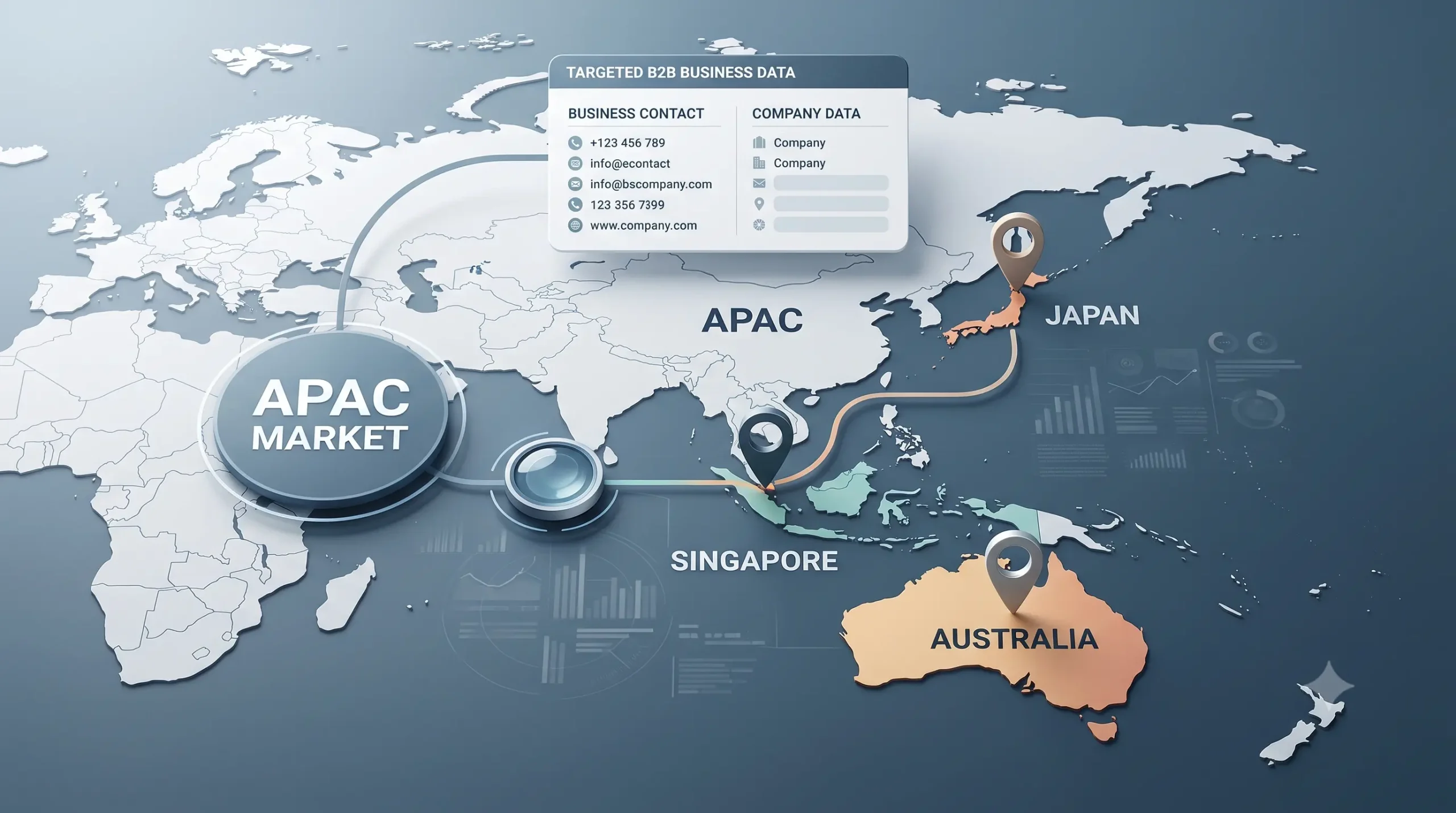
The Asia Pacific region contains some of the fastest-growing B2B markets in the world, but it is not a single market. A company expanding into Australia operates in a very different regulatory, cultural, and data environment than one entering Japan, Singapore, or Malaysia. Using a single “APAC email list” without understanding these distinctions is one of the most common and costly mistakes US and European companies make when they try to scale outreach into the region.
This guide breaks down the top six APAC markets for B2B expansion, the privacy and spam laws that affect email outreach in each, and what to look for in a verified Asia Pacific business email list before you run your first campaign. If you are also targeting companies involved in cross-border trade, our import and export company lists are a natural complement to a geographic APAC file.
Why APAC B2B Lists Require a Different Approach
In North America, the dominant regulatory frameworks for email are CAN-SPAM (US) and CASL (Canada). Both have well-understood compliance requirements and years of enforcement precedent that most B2B marketers are at least broadly familiar with.
The Asia Pacific region has its own equivalent frameworks, and they vary significantly by country. Some are stricter than CAN-SPAM. Some have enforcement mechanisms that differ in important ways. A pan-APAC list sourced without country-specific compliance filtering can expose your company to regulatory risk in markets you may not have anticipated.
Beyond regulation, the cultural context for cold B2B outreach differs across APAC. Email response rates, preferred outreach channels, and the role of relationship-building in the sales process all vary by country. Understanding these differences at even a basic level improves campaign performance meaningfully. For complex international campaigns, our guide on why custom lists outperform off-the-shelf databases explains why a tailored APAC file beats a generic one.
Australia
Regulatory framework: Australia’s Spam Act 2003 is the primary legislation governing commercial electronic messages. Unlike CAN-SPAM, which allows opt-out-based marketing, the Australian Spam Act generally requires consent before sending commercial messages. The consent standard has some flexibility for business-to-business communications, particularly when there is an existing business relationship or when contact details are published specifically for business purposes.
Market characteristics: Australia’s B2B market is mature and English-language, which makes it the most natural entry point for US and UK companies entering APAC. Decision-making in Australian businesses tends to be less hierarchical than in Northeast Asian markets, which means outreach to mid-level managers can be effective rather than requiring C-suite entry.
List quality note: Australian business contact data is generally well-maintained due to ASIC (Australian Securities and Investments Commission) registration requirements and active company registry systems.
Singapore
Regulatory framework: Singapore’s Personal Data Protection Act (PDPA) governs the collection, use, and disclosure of personal data. The PDPA’s Do Not Call registry applies to telemarketing. For B2B email, the framework allows commercial communications to business contacts where a reasonable business relationship exists.
Market characteristics: Singapore is the regional headquarters hub for APAC operations across industries including financial services, technology, logistics, and professional services. Decision-makers in Singapore are often regionally accountable, meaning a contact in Singapore may influence purchasing decisions across Southeast Asia. If your product targets technology leadership, our high-tech executives lists include Singapore-based contacts across the technology sector.
List quality note: Singapore’s compact geography and highly formalized business environment make company registration data reliable. Roles can shift frequently as APAC organizational structures change, so verifying recency of contact data is particularly important.
Japan
Regulatory framework: Japan’s Act on Regulation of Transmission of Specified Electronic Mail (the Specified Email Act) requires opt-in consent for commercial email to individual recipients. B2B outreach to business email addresses with a legitimate business purpose has somewhat more flexibility, but the standard is higher than US CAN-SPAM.
Market characteristics: Japan is among the largest B2B markets in the world by GDP and industrial output, but it is also one of the most challenging for foreign companies to enter through cold outreach alone. Business relationships in Japan are built through introductions, trust, and consistent follow-through. Cold email performs significantly worse than in English-language markets. Direct mail and printed materials often achieve higher engagement in Japan than digital-first campaigns.
List quality note: Japanese company and contact data is available but requires careful sourcing. English-language records for Japanese companies are often limited to large enterprises. For SMBs and regional companies, Japanese-language data compiled through domestic sources tends to have better coverage.
South Korea
Regulatory framework: South Korea’s Personal Information Protection Act (PIPA) is one of the stricter data protection laws in the region. It applies to personal data broadly and has significant penalties for violations. B2B outreach should be approached with explicit attention to how contact information was collected and whether the use is within the scope of the original collection purpose.
Market characteristics: South Korea has a highly developed technology and manufacturing sector. Large conglomerates (chaebol) like Samsung, LG, Hyundai, and SK dominate many industries, but a substantial ecosystem of mid-size and specialized companies operates in their supply chains and adjacent markets.
List quality note: South Korean B2B data in English is most reliable for the technology and export-oriented sectors. Contacts within domestic-focused industries may require Korean-language sourcing.
Malaysia
Regulatory framework: Malaysia’s Personal Data Protection Act 2010 (PDPA) governs personal data processing. Commercial electronic messages require consent or a pre-existing business relationship. The enforcement environment for B2B outreach has been relatively pragmatic, but the legal standard is clear.
Market characteristics: Malaysia is a diversified economy with strong manufacturing, oil and gas, financial services, and technology sectors. Kuala Lumpur serves as the regional base for many Southeast Asian operations. English is widely used in business contexts, which facilitates outreach from English-speaking markets.
List quality note: Malaysian business contact data quality varies significantly by sector. Companies with significant export activity or international partnerships tend to have more complete and up-to-date records in English.
China (APAC Considerations)
Regulatory framework: China’s Personal Information Protection Law (PIPL), effective since November 2021, is one of the most comprehensive data privacy laws globally. It applies extraterritorially to processing of Chinese citizens’ data and has strict requirements around consent, data localization, and cross-border data transfer. B2B outreach into mainland China from outside the country requires careful legal review.
Market characteristics: China represents the largest potential market in APAC by scale, but also the most complex entry environment for foreign companies. Email is less dominant as a business communication channel in China compared to WeChat and other domestic platforms. A general APAC email list typically performs poorly for China specifically, and a dedicated China-market strategy is required.
What to Look for in an Asia Pacific Business Email List
Given the regulatory and data quality diversity across APAC, a useful list needs to address the following:
Country-level segmentation. A single flat APAC file is useful only if you are running a single undifferentiated campaign across the region. For most companies, you need the ability to filter by country, which requires that the data be tagged at the country level with reliable accuracy. Our multichannel list options include international files that can be segmented this way.
Compliance documentation. Ask how contacts were collected and whether the collection method is compliant with the laws of each country where the contacts are based. This is harder to verify than domestic list compliance, which is why working with a list provider that has specific APAC expertise matters more for international data than for domestic campaigns.
Recency. APAC business contact data degrades faster than US data in many markets due to high rates of organizational change, particularly in technology and financial services. A list verified more than 12 months ago should be treated with caution for high-stakes campaigns.
Local language availability. For markets like Japan, South Korea, and China, English-only contact records represent only a subset of the business universe. If your campaign will include localized language outreach, confirm that the provider can deliver records with the appropriate name and company formatting.
Explore our international business email lists including our Asia Pacific business email list and import and export company lists. For custom APAC targeting, learn why custom lists outperform off-the-shelf databases for complex international campaigns.