A recurring thread on r/b2bmarketing goes something like this: “I sell a tool that integrates with Oracle. How do I find companies that are actually Oracle customers, not just companies in the right industry vertical?”
The responses split into two camps. One camp recommends cold LinkedIn prospecting filtered by self-reported tech tools. The other camp points to technographic data providers. What both camps agree on is that a standard industry list filtered by SIC or NAICS code does not solve the problem. If your product only delivers value to a company already running Oracle, then knowing they are in manufacturing or financial services is not enough. You need to know what software is inside the building.
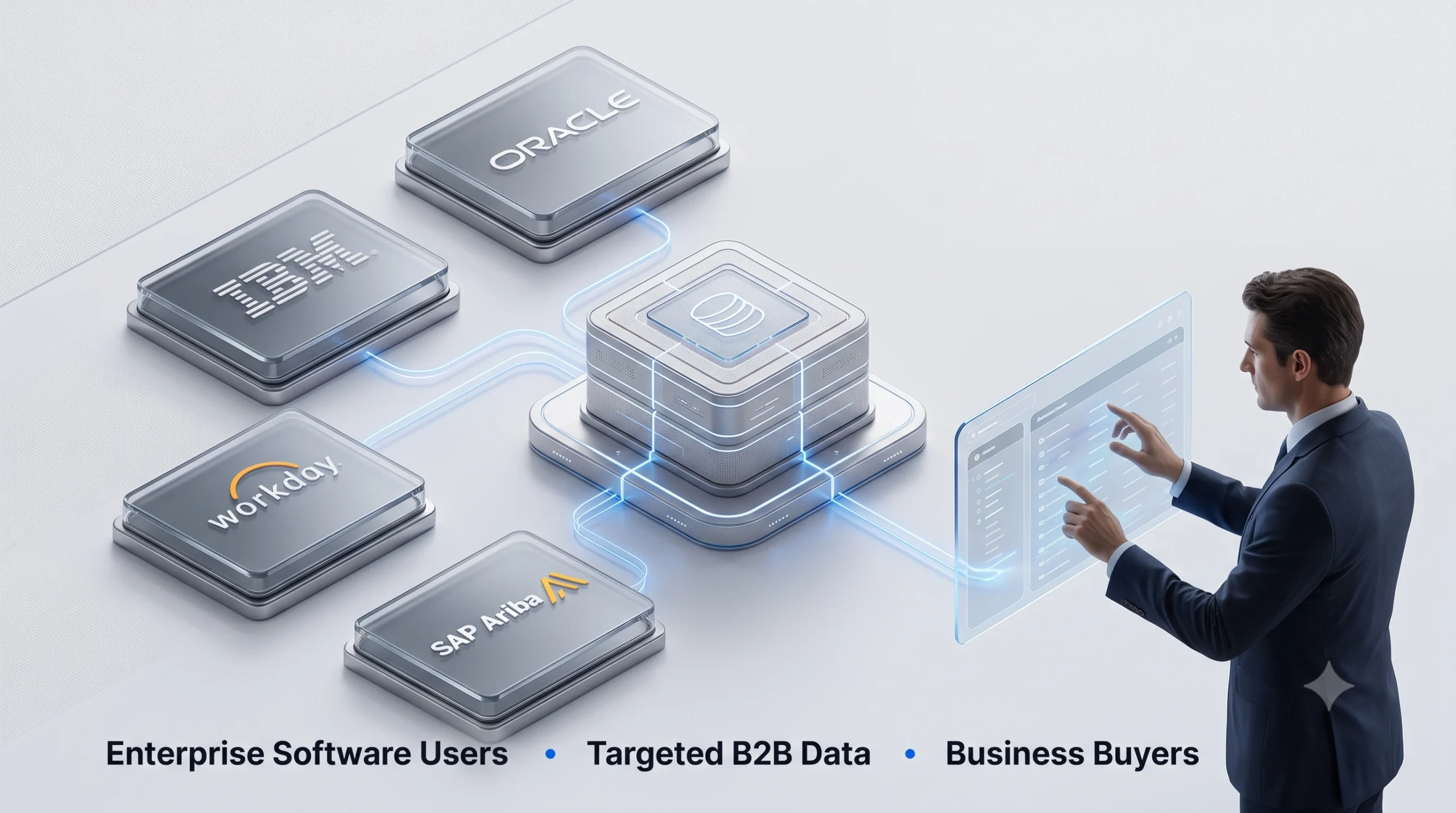
This is the business case for enterprise software users email lists, and it is why IBM users email lists, Oracle users email lists, Workday users email lists, and SAP Ariba users email lists are among the fastest-moving segments in B2B data. This post explains who buys these lists, what problems they solve, and what to look for before you purchase.
Why Enterprise Software Users Are a Distinct Targeting Category
B2B targeting has traditionally operated on two axes: firmographic (company size, industry, revenue, geography) and demographic (job title, seniority, department). Both of these dimensions describe who a company is and who within it you are trying to reach.
Technographic targeting adds a third axis: what technology the company runs. For most vendors, this third dimension is more predictive of purchase intent than either firmographic or demographic data alone.
Here is why. A company running Oracle Database and Oracle ERP has already made a capital commitment to Oracle’s ecosystem. That commitment tells you several things simultaneously: they have an enterprise-scale IT budget, they have a dedicated IT or procurement team capable of evaluating adjacent solutions, they are likely running on-premise or hybrid infrastructure (which affects what cloud tools they are receptive to), and they are part of a user community that attends Oracle OpenWorld and reads Oracle-specific trade content. None of that information appears in a firmographic filter.
The same logic applies across the enterprise software stack. A company running Workday for HR and finance is a growth-stage or mature enterprise that has moved beyond spreadsheet-based people management. An SAP Ariba customer has formalized procurement workflows and an established vendor approval process. An IBM customer is most likely running infrastructure at scale, whether mainframe, middleware, or hybrid cloud.
In a Quora thread about targeting enterprise software buyers, one sales consultant described the value this way: “You stop selling to the category and start selling to the installed base. Those are completely different conversations.”
Who Buys IBM Users Email Lists
IBM has one of the broadest product footprints in enterprise technology, spanning mainframe systems, cloud infrastructure (IBM Cloud), security software (QRadar), AI (watsonx), middleware (MQ, WebSphere), and storage. The companies running IBM products tend to be large, regulated, and infrastructure-heavy.
The buyers who invest in an IBM users email list typically fall into several categories:
- Competing or complementary cloud platforms that want to reach IT decision-makers currently running IBM infrastructure and position a migration or augmentation path. AWS, Google Cloud, and Azure all target IBM customers through technographic-informed campaigns.
- Security and compliance vendors that know IBM shops are often in regulated industries (banking, government, healthcare) with complex compliance requirements. A cybersecurity vendor selling to a federal agency running IBM mainframes is a far better fit than one cold-calling random enterprise companies.
- Systems integrators and consultancies that specialize in IBM environments and want to prospect for new clients who are already running the platforms they are certified to support.
- Independent software vendors (ISVs) whose products are built to run on IBM infrastructure. If your application requires IBM MQ or runs on IBM i, then IBM customers are your only relevant market. The technographic filter is not additive here, it is the entire targeting strategy.
Who Buys Oracle Users Email Lists
Oracle’s enterprise presence spans database (Oracle Database, MySQL), ERP (Oracle Fusion Cloud ERP), CRM (Oracle CX), supply chain management, and cloud infrastructure (OCI). Oracle customers span industries but cluster heavily in financial services, retail, manufacturing, and government.
The Oracle users email list is used by companies that sell in the following situations:
- Database performance and optimization tools that work on top of Oracle Database. This includes query optimization software, database monitoring tools, and backup and recovery solutions. The selling point is always improvement of the Oracle environment the buyer already owns, not replacement.
- ERP integration middleware companies that help Oracle Fusion connect to other enterprise systems (Salesforce, SAP, Workday). These companies need to reach IT directors and integration architects at Oracle ERP customers specifically.
- Migration-path vendors that position their cloud database or ERP product as an Oracle alternative. These campaigns require knowing who the Oracle customers are because the migration conversation requires a high degree of specificity.
- Oracle implementation and support partners that provide managed services, upgrade support, or customization for Oracle applications. These firms use Oracle customer lists to find prospects who are running versions of Oracle that are approaching end of support, since those customers are actively evaluating their next step.
A Blind forum thread from 2024 had an enterprise sales rep at a database management company describe their process: “We run Oracle customer lists quarterly. Any company that just upgraded to Oracle 23c or is still on 12c is a different conversation. The list tells us the version signal, the outreach tells us the migration readiness.”
Who Buys Workday Users Email Lists
Workday is used by organizations that have outgrown legacy HR and finance systems. The typical Workday customer is a company with 500 to 50,000 employees that needs unified HR, payroll, and financial management in a cloud environment. Workday’s penetration is especially strong in professional services, healthcare, higher education, and technology companies.
The buyers who target Workday users email lists tend to be:
- HR tech and benefit administration vendors that sell workforce analytics, employee engagement platforms, performance management tools, or benefit marketplaces that integrate with Workday. The integration point is the hook: these vendors lead with Workday compatibility and use the customer list to find the exact audience for that message.
- Learning and development (L&D) platforms that integrate with Workday Learning or compete for the same training budget. LMS vendors, skills assessment tools, and coaching platforms all target Workday customers as their ideal enterprise segment.
- Finance and accounting software that connects to Workday Financial Management. Vendors selling FP&A tools, expense management, or treasury management platforms that plug into Workday’s financial data model need to reach Workday finance users specifically.
- Managed payroll and compliance services that offer outsourced payroll processing for Workday environments. This is particularly relevant for multinational companies using Workday who need local payroll compliance in markets where Workday’s native capabilities have gaps.
Who Buys SAP Ariba Users Email Lists
SAP Ariba is an enterprise procurement and supply chain platform. Companies running SAP Ariba have formalized, digital procurement workflows, an approved vendor database, and a structured process for onboarding new suppliers. That procurement formality is both a barrier and a signal.
The barrier: you cannot cold-call your way into an SAP Ariba customer’s approved vendor list. There is a formal supplier onboarding process.
The signal: a company running SAP Ariba is making significant procurement volumes in a structured environment. If you sell products or services that procurement teams buy, and you can get into that vendor process, the deal sizes tend to be meaningful.
Buyers of the SAP Ariba users email list include:
- Vendor management and supplier diversity software companies that help procurement teams manage their Ariba-connected supplier base. These tools are sold to the same procurement directors who own the Ariba deployment.
- E-invoicing and accounts payable automation vendors that integrate with Ariba’s procurement workflows. If your product connects upstream or downstream from Ariba’s PO and invoice process, Ariba customers are your core market.
- Supply chain risk and compliance platforms that help procurement teams monitor suppliers within Ariba for financial, ESG, or regulatory risk. This category has grown significantly as companies face pressure on supply chain transparency.
- Consulting and implementation firms that help companies configure, optimize, or migrate their SAP Ariba environments. Like Oracle partners, these firms use customer lists to identify Ariba deployments at various stages of maturity.
How Technographic Lists Are Built: What to Verify Before You Buy
In LinkedIn discussions about B2B data quality, one question comes up consistently: “How do they actually know what software a company is using?”
The answer matters because the accuracy of technographic data varies significantly by provider and by software type. Some data is easy to verify programmatically (web-facing tools that leave JavaScript tags). Enterprise software like Oracle Database, Workday, or IBM mainframe products leaves no public-facing trace and requires different sourcing methods.
Quality providers use a combination of approaches: job posting analysis (a company advertising for “Oracle DBA” or “Workday HRIS administrator” is publicly disclosing their tech stack), data licensing agreements with resellers and implementation partners, opt-in panels of IT professionals who self-report their company’s software environment, and conference and event attendance data from user group events like Oracle OpenWorld or SAP Sapphire.
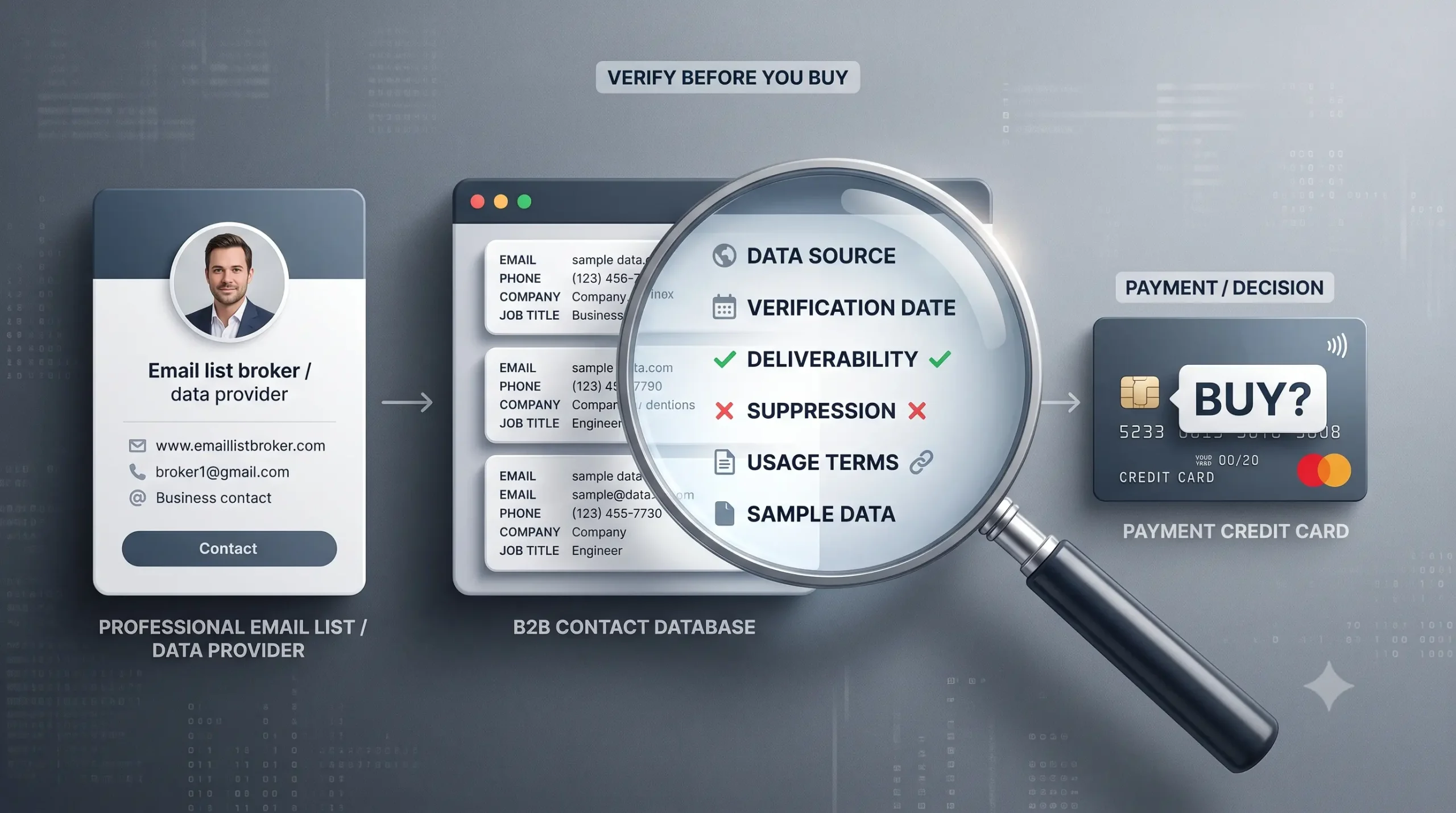
Before purchasing any enterprise software users list, ask the provider: what sources were used to confirm this company is running this product? Multi-source verification produces more reliable data than any single signal.
For a full breakdown of how technographic data is compiled and what distinguishes quality from noise, our guide on how technographic data works covers the mechanics in detail.
Combining Technographic and Firmographic Filters
The most effective enterprise software targeting campaigns do not rely on the technographic filter alone. They layer it on top of firmographic criteria to arrive at a segment that is both running the right software and is the right size and type of company for the offer.
For example, a vendor selling Oracle performance optimization tools might filter to: US-based companies, 500 to 10,000 employees, running Oracle Database, with IT decision-maker contacts at the director level or above. The technographic filter (Oracle Database) eliminates the irrelevant majority. The firmographic filters (size, geography) eliminate Oracle customers who are too small or in markets the vendor does not serve. The title filter ensures the outreach reaches someone with purchasing authority.
This combined approach is far more precise than either firmographic or technographic targeting alone. Our guide on NAICS codes for business lists covers how to apply industry-level firmographic filters alongside technographic data for maximum precision.
What Good Deliverability Looks Like for These Lists
Enterprise software users lists have a specific deliverability challenge: the contacts within them tend to be senior IT and procurement professionals who receive high volumes of vendor outreach. Their corporate email accounts often have aggressive spam filtering, especially at large enterprises with dedicated IT security teams.
A deliverability guarantee matters more for this audience than for a general business list. Before purchasing, confirm the provider runs each record through email verification that checks mailbox existence, not just domain validity. A record with a valid @oracle.com or @company.com domain can still have a non-existent mailbox.
Also confirm that the list is suppressed against known role-based aliases (info@, support@, sales@) and shared inboxes, which generate bounces and spam flags without ever reaching an individual decision-maker.
Ready to reach verified enterprise software users? Explore our lists for IBM customers, Oracle users, Workday customers, and SAP Ariba users. Each file is multi-source verified, segmentable by company size and industry, and comes with a deliverability guarantee. Request a sample or get a custom count today.
For more on how technographic targeting works, read our full guide on how vendors know which companies use specific software. For QuickBooks-specific outreach, see our post on reaching QuickBooks users for B2B campaigns.