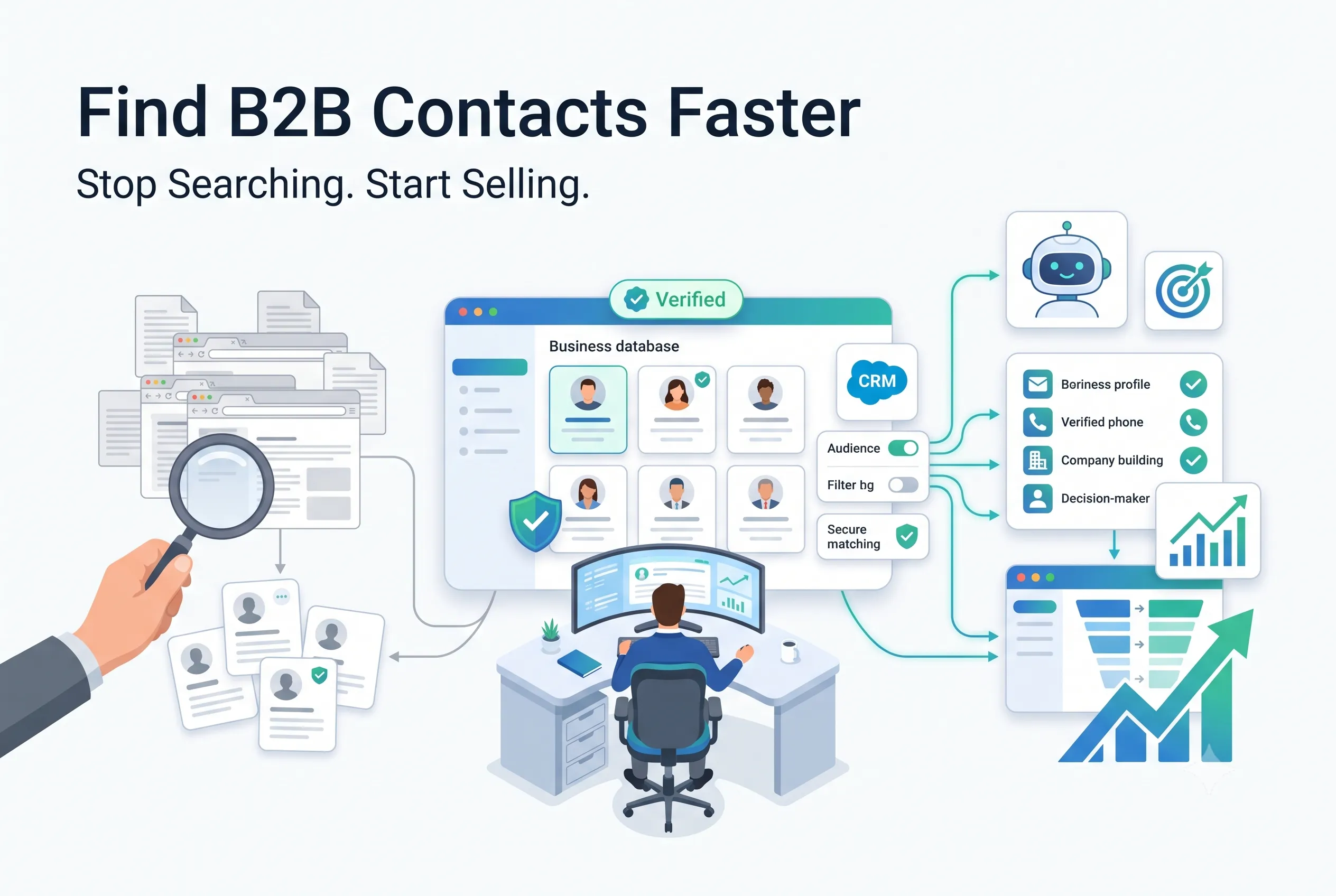
Every B2B sales and marketing effort eventually runs into the same wall: you know who you want to reach, but you don’t have their contact information. So you start looking.
In 2026, the options for finding B2B email addresses and phone numbers are more plentiful than ever. Free tools, paid tools, browser extensions, LinkedIn scrapers, AI-powered enrichment platforms. There’s no shortage of ways to find contacts. The real question isn’t whether you can find them yourself. It’s whether you should.
This guide walks through the main methods for finding B2B contact data, where each one works well, and the point at which doing it yourself starts costing more than it saves.
Method 1: LinkedIn and LinkedIn Sales Navigator
LinkedIn remains the most reliable source of professional information for B2B contact finding. Most business professionals keep their profiles reasonably current, which makes it useful for identifying the right person at a company. Finding their actual email address or direct phone number is a separate challenge.
LinkedIn’s own messaging (InMail) lets you reach people without their contact details, but response rates are inconsistent and InMail credits are limited. Sales Navigator adds filtering and saved search functionality, making it useful for building prospect lists at scale, but it doesn’t give you email addresses directly.
Where it works well: identifying the right decision maker by name and title before reaching out through other channels.
Where it breaks down: extracting verified email addresses and direct dials at volume is not what LinkedIn is built for, and scraping contact details from LinkedIn violates their terms of service.
Method 2: Email Finding Tools
Tools like Hunter.io, Snov.io, and similar platforms let you enter a company domain and find associated email addresses. They work by crawling publicly indexed web pages, press releases, contact pages, and other sources where emails appear.
For finding the email address of a specific person at a specific company, these tools can be genuinely useful, especially for smaller lists where you’re targeting named individuals. Typical accuracy on well-indexed companies is reasonable, though it degrades quickly for smaller businesses, companies with non-standard email formats, or organisations that keep contact information off the public web.
Where it works well: finding emails for a short list of specific named targets at recognisable companies.
Where it breaks down: building a list of hundreds or thousands of contacts across many companies, or targeting industries where contacts are harder to find online (trades, manufacturing, healthcare, financial services).
Method 3: Contact Enrichment Platforms
Platforms like Apollo.io, ZoomInfo, Lusha, and Cognism give you access to large databases of pre-compiled B2B contact data. You search by job title, industry, company size, location, and other filters, and the platform returns matching contacts with email addresses and sometimes phone numbers.
These tools have become widely used, and for good reason. When they work, they save significant time. When they don’t, the experience is frustrating.
The recurring complaint in B2B marketing and sales communities is data quality. Contacts change jobs frequently (average B2B job tenure continues to shorten), companies restructure, email addresses change. Large databases struggle to keep pace with this churn. Users regularly report bounce rates of 20 to 30 percent on cold email campaigns run against database-sourced lists, and similar issues with phone numbers that are no longer valid.
Where it works well: high-volume prospecting in tech, SaaS, and other sectors where contacts are well-documented and relatively easy to find.
Where it breaks down: niche industries, smaller companies, regional markets, and any sector where contacts are less digitally visible. The generic database problem gets worse the more specific your targeting requirements.
Method 4: Manual Research
The most reliable data often comes from the most time-consuming source: doing the research yourself. Company websites, press releases, association directories, trade publications, event speaker lists, and regulatory filings all contain contact information that doesn’t appear in generic databases.
This approach produces high-quality results for a small number of targeted accounts. For any campaign that requires more than a handful of contacts, the time cost becomes prohibitive.
The Hidden Cost of DIY Contact Finding
Time. Researching, finding, verifying, and organising contact data takes significant time from people who could be spending it on actual outreach, sales conversations, or campaign execution. At a loaded cost of even $50 per hour for a sales or marketing team member, a few days of list-building work represents a significant investment.
Verification. Finding a contact is not the same as confirming it’s current. Email addresses change when people change jobs or companies rebrand. Phone numbers change. Without a verification step, even freshly sourced data can have meaningful error rates by the time a campaign launches.
Scale. DIY methods work at low volume. Once you need hundreds or thousands of contacts that match specific criteria across industry, geography, company size, and job title, the manual approach stops being practical.
Consistency. When different team members build different parts of a list using different sources and methods, the quality is uneven. Deduplication becomes a problem. Formatting inconsistencies create CRM headaches.
When It Makes More Sense to Use a List Provider
A custom-built marketing list from a specialist provider solves most of the problems above. Instead of your team spending days sourcing, cleaning, and verifying contacts, you describe exactly who you need to reach and receive a list built to those specifications.
The key word is custom. The difference between a list prepared to your specific brief and a generic database export is significant. A well-built custom list matches your criteria on every dimension: the right industry or SIC code, the right geography, the right company size, the right contact title or seniority level, and the right channel (email, phone, or mailing address).
This approach works particularly well when:
- Your target audience is specific or niche (a particular industry, a particular region, a particular business size)
- You need a large volume of contacts that meet consistent criteria
- Your team’s time is better spent on outreach and conversion than on data sourcing
- You’ve had poor results with generic database tools and want a more targeted starting point
- You’re running a campaign where data quality directly affects deliverability, response rate, or compliance
What to Expect From the Process
When you work with a list provider, the process typically starts with a brief: who are you trying to reach, in what geography, at what type of organisation, and through what channel. The more specific you can be, the more useful the resulting list.
A custom list built to a clear brief typically takes one to two business days to prepare. Once you receive it, it’s yours to use across as many campaigns as you need, with no cap on usage.
This is a different model from paying for ongoing database access, where you’re renting the ability to export contacts on a subscription basis. With a custom list, you own the file and can use it however your campaigns require.
A Practical Framework for Deciding
Before spending time on DIY contact finding, run through these questions:
- How many contacts do I need? If it’s under 50 highly targeted accounts, DIY tools may be sufficient. If it’s hundreds or thousands, the time cost argues for a specialist.
- How specific is my targeting? Generic industries in major cities are reasonably well-served by large databases. Niche sectors, regional markets, and specific contact titles are better served by custom list building.
- What’s the cost of poor data quality? If you’re running a direct mail campaign, bad addresses waste print and postage costs on top of list costs. If you’re running a cold email campaign, high bounce rates damage your sender reputation. The more the campaign depends on data quality, the more it pays to get the list right.
- What’s my team’s time worth? Build vs. buy decisions always come down to whether internal time is cheaper than the external alternative. For most businesses, a purpose-built list from a specialist is the more efficient option at any meaningful scale.
Getting Started
If you’re ready to move past the DIY approach and want a contact list built to your exact specifications, get in touch with us. Tell us who you’re trying to reach, in what geography, and through what channel, and we’ll prepare a list matched to your brief.
For additional guidance on contact finding methods and tools, our guide to finding email addresses and phone numbers covers the current landscape in more detail.