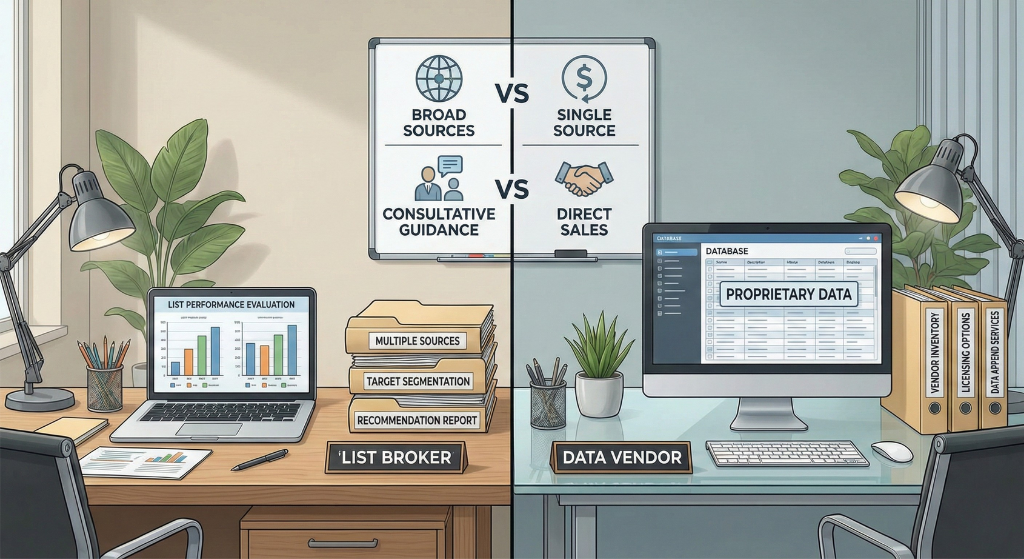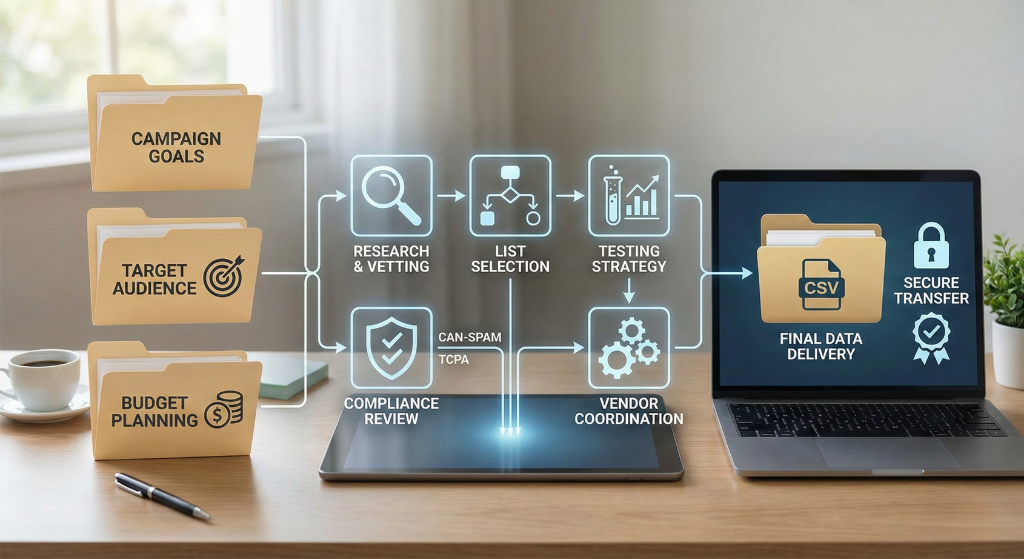
Understanding how list brokers actually work helps organizations maximize value from these partnerships. The process involves far more than simply ordering names and addresses. Professional list brokers guide clients through systematic workflows optimizing targeting, ensuring compliance, managing vendors, and delivering quality data that drives campaign success.
The broker process transforms vague campaign ideas into precisely targeted prospect files while protecting clients from data quality issues, compliance violations, and strategic mistakes. Each step builds on previous ones, creating comprehensive campaign strategies rather than just transactional list purchases.
This guide walks through the complete list broker workflow from initial client contact through final data delivery, explaining what happens at each stage and how professional brokers add value throughout the journey.
Initial Consultation: Understanding Campaign Goals and Target Audience
The broker relationship begins with discovery conversations establishing campaign foundations.
Campaign objective clarification determines everything that follows. Are you acquiring new donors? Recruiting event attendees? Selling products? Growing membership? Each objective requires different list characteristics and targeting approaches. Brokers probe beyond surface-level goals to understand true campaign purposes.
Target audience definition moves from general to specific. Rather than accepting “seniors” or “Christians” as complete targeting, brokers ask detailed questions. What age ranges specifically? What income levels? What geographic areas? What behaviors or interests indicate qualified prospects? This granular definition enables precise list recommendations.
Offer and value proposition analysis helps brokers understand what will resonate with prospects. A $25 donation ask differs from a $1,000 major gift solicitation. A free seminar invitation differs from a paid product offer. Understanding offers helps brokers recommend lists of people predisposed to respond.
Budget discussion establishes realistic parameters. Knowing whether clients can spend $5,000 or $50,000 affects list recommendations, testing strategies, and campaign scope. Brokers help clients allocate budgets across lists, creative, production, and postage.
Timeline requirements influence vendor selection. Rush campaigns requiring data within days limit list options compared to campaigns with four-week lead times. Brokers manage client timeline expectations while identifying sources meeting deadlines.
Previous campaign history provides critical context. Have clients used lists before? What worked well? What disappointed? Learning from past experience prevents repeating mistakes while building on successes.
Compliance requirements vary by industry. Healthcare, financial services, and nonprofits face different regulations. Brokers identify applicable compliance obligations during initial discussions.
List Research and Recommendation Phase
Armed with campaign understanding, brokers research optimal list sources from comprehensive inventories.
Database query across broker inventory identifies potential matches. Established brokers maintain relationships with hundreds or thousands of list sources. They query these databases finding lists matching client targeting criteria.
Consumer lists, business lists, and specialty lists get evaluated based on client needs. A B2B campaign focuses on business lists. Consumer product marketing uses consumer lists. Niche targeting might require specialty compilations.
Source vetting ensures quality recommendations. Brokers check update frequencies, deliverability guarantees, compilation methods, and historical performance before recommending sources. They filter out questionable vendors protecting clients from bad data.
Pricing research compares costs across similar sources. One vendor might charge $150 per thousand while another charges $200 for comparable data. Brokers identify best value options.
Count verification confirms sufficient quantity. If clients need 50,000 names but a recommended list contains only 12,000, brokers identify this limitation upfront rather than discovering it during ordering.
Recommendation presentation explains each suggested list. Brokers provide descriptions of recommended sources, explain why each matches campaign goals, estimate costs, project expected quantities, and suggest testing strategies.
Alternative options get presented for client consideration. Rather than single recommendations, brokers typically present multiple options enabling clients to choose approaches matching their comfort levels and budgets.
Testing Strategy Development
Professional brokers structure testing maximizing learning while controlling risk.
Test quantity determination balances statistical validity with budget constraints. Most brokers recommend testing 3,000 to 5,000 names per list segment. Smaller quantities lack statistical significance. Larger quantities waste money on unproven sources.
Segment selection identifies which list variations to test. Should you test different age ranges? Geographic markets? Income levels? Donor history segments? Brokers recommend 3 to 5 test segments revealing performance variations.
Control group inclusion enables performance comparison. If clients have proven lists from previous campaigns, including small control quantities provides benchmarks showing whether new sources outperform, match, or underperform existing approaches.
Tracking mechanism design ensures accurate attribution. Brokers help clients establish unique phone numbers, reply codes, or URLs for each test segment definitively revealing which lists generated responses.
Budget allocation across test segments prevents over-concentration. Rather than testing 15,000 names from one source and 3,000 from another, brokers recommend balanced test quantities enabling fair comparisons.
Rollout planning establishes decision criteria. What response rate justifies scaling? What cost per acquisition is acceptable? Setting thresholds upfront prevents emotional decision-making after results arrive.
Order Processing and Vendor Coordination
Once clients approve recommendations, brokers handle administrative details.
Order placement with list owners initiates data delivery. Brokers submit formal orders specifying quantities, selection criteria, data format requirements, delivery deadlines, and any special instructions.
Selection criteria confirmation ensures accurate targeting. Age ranges, income levels, geographic areas, and behavioral selects get documented precisely preventing misunderstandings.
Data format specification matches client mail house requirements. Do clients need CSV files? Fixed-width text? Specific field orders? Brokers coordinate format details between list owners and client vendors.
Delivery scheduling coordinates timing across multiple list sources. When campaigns use five different lists, brokers ensure all deliver simultaneously enabling consolidated processing.
Suppression file management prevents duplicates and unwanted contacts. Brokers coordinate suppression of client house files, previous renters, and competitor suppressions ensuring clean prospect lists.
Pricing negotiation leverages broker relationships. Volume discounts, waived minimums, and multi-use arrangements get negotiated on client behalf.
Quality Assurance and Data Verification
Before delivering data to clients, brokers perform quality checks.
Record count verification confirms ordered quantities. If clients ordered 10,000 names but receive 9,200, brokers investigate discrepancies before client delivery.
Data format inspection ensures files match specifications. Brokers check that fields appear in correct order, data types match requirements, and special characters don’t corrupt files.
Sample record review identifies obvious errors. Examining first 100 records reveals issues like missing data fields, formatting problems, or suspicious patterns.
Deliverability guarantee documentation protects clients. Brokers ensure list owners provide written guarantees of 90 to 95 percent deliverability with replacement policies for undeliverable records.
NCOA processing confirmation verifies address accuracy. Lists should undergo National Change of Address updates ensuring current addresses.
Deduplication across sources prevents paying for same names multiple times. When campaigns use multiple lists, brokers coordinate deduplication ensuring each unique name appears only once.
Compliance Review and Final Checks
Legal compliance protection represents critical broker value.
CAN-SPAM compliance verification for email lists confirms permission requirements. Brokers ensure email lists contain proper opt-ins and campaigns include required unsubscribe mechanisms.
TCPA compliance for telemarketing lists verifies consent documentation. Mobile phone numbers require express written consent. Landline numbers need Do Not Call Registry scrubbing.
State law compliance checking addresses charitable solicitation requirements, state do-not-call registries, and privacy regulations. Brokers identify applicable state requirements based on campaign scope.
Industry-specific regulation review covers healthcare, financial services, or political marketing rules. Each industry faces unique compliance obligations brokers help navigate.
Licensing terms clarification ensures proper usage. One-time rental agreements prohibit multiple uses without additional licensing. Brokers ensure clients understand usage limitations.
Data Delivery and Campaign Support
Final data delivery represents project milestone but not necessarily relationship end.
Secure file transfer protects sensitive prospect data. Brokers use encrypted FTP, secure email, or password-protected downloads ensuring data security during transfer.
Delivery confirmation verifies client receipt. Brokers confirm clients successfully downloaded files and can access data before considering delivery complete.
Technical support for data integration helps clients import files into their systems. While brokers aren’t IT departments, they can troubleshoot common import issues.
Campaign timing coordination ensures data arrives when clients need it. Delivering lists too early risks data aging. Delivering too late delays campaigns.
Final invoice processing handles financial settlement. Brokers coordinate payment to list owners while billing clients for services rendered.
Post-Campaign Analysis and Optimization
Professional broker relationships extend beyond single campaigns.
Results gathering requests campaign performance data. Which lists generated best response? What were actual response rates? What did cost per acquisition run?
Performance analysis by segment reveals patterns. Did certain age ranges outperform? Did specific geographic markets excel? Did donor history segments justify premium pricing?
List source evaluation determines which vendors delivered as promised. Did lists achieve guaranteed deliverability? Were record counts accurate? Was data quality acceptable?
Recommendation refinement for future campaigns applies learnings. Underperforming lists get eliminated. Top performers get scaled. New variations get tested based on insights.
Ongoing relationship building maintains broker value over time. Regular communication keeps brokers informed about business changes, new product launches, or evolving target audiences.
Multi-Channel Campaign Coordination
Multi-channel campaigns add complexity brokers manage effectively.
Channel-specific list sourcing coordinates direct mail, email, and phone data. Each channel requires different data elements and compliance considerations.
Append services add email addresses or phone numbers to mailing lists. Brokers coordinate append processes ensuring proper consent and regulatory compliance.
Timing sequencing across channels optimizes impact. Direct mail followed by email follow-up three days later then phone calls to engaged prospects creates effective sequences brokers orchestrate.
Suppression coordination prevents channel conflicts. Someone unsubscribing from email shouldn’t receive phone calls. Brokers maintain cross-channel suppression files.
Ongoing Account Management
Established broker relationships evolve into strategic partnerships.
Regular check-ins maintain communication outside active campaigns. Quarterly reviews discuss upcoming needs, market changes, or new opportunities.
Proactive recommendations suggest relevant new list sources. When brokers encounter lists matching client profiles, they share opportunities even without immediate campaigns planned.
Market intelligence sharing provides competitive insights. Brokers working across industries share relevant trends, emerging list sources, or regulatory changes.
Strategic planning support helps clients think beyond immediate campaigns. Annual marketing planning benefits from broker input on list budgets, testing priorities, and channel allocation.
The list broker process encompasses far more than transactional list rental. Professional brokers provide strategic consultation, quality assurance, compliance protection, vendor management, and ongoing optimization creating measurable value throughout campaign lifecycles.
Organizations viewing brokers as true partners rather than just vendors maximize returns from these relationships through collaborative approaches spanning multiple campaigns and years.
Ready to experience professional list broker services? Contact Prospects Influential to discuss your campaign goals and discover how systematic broker processes deliver superior results across consumer lists, business lists, and specialty lists.