The short answer
Use NAICS when you want the current federal standard, more granular targeting, and coverage across the US, Canada, and Mexico. Use SIC when your data source, CRM, or legacy campaign history is keyed to it, or when you are matching records held by the SEC or older databases. For the widest reach on a B2B list, target by both, because the two systems do not map one to one.
What NAICS and SIC actually are
Both systems classify a business by its primary economic activity, but they come from different eras, and that difference explains almost everything else.
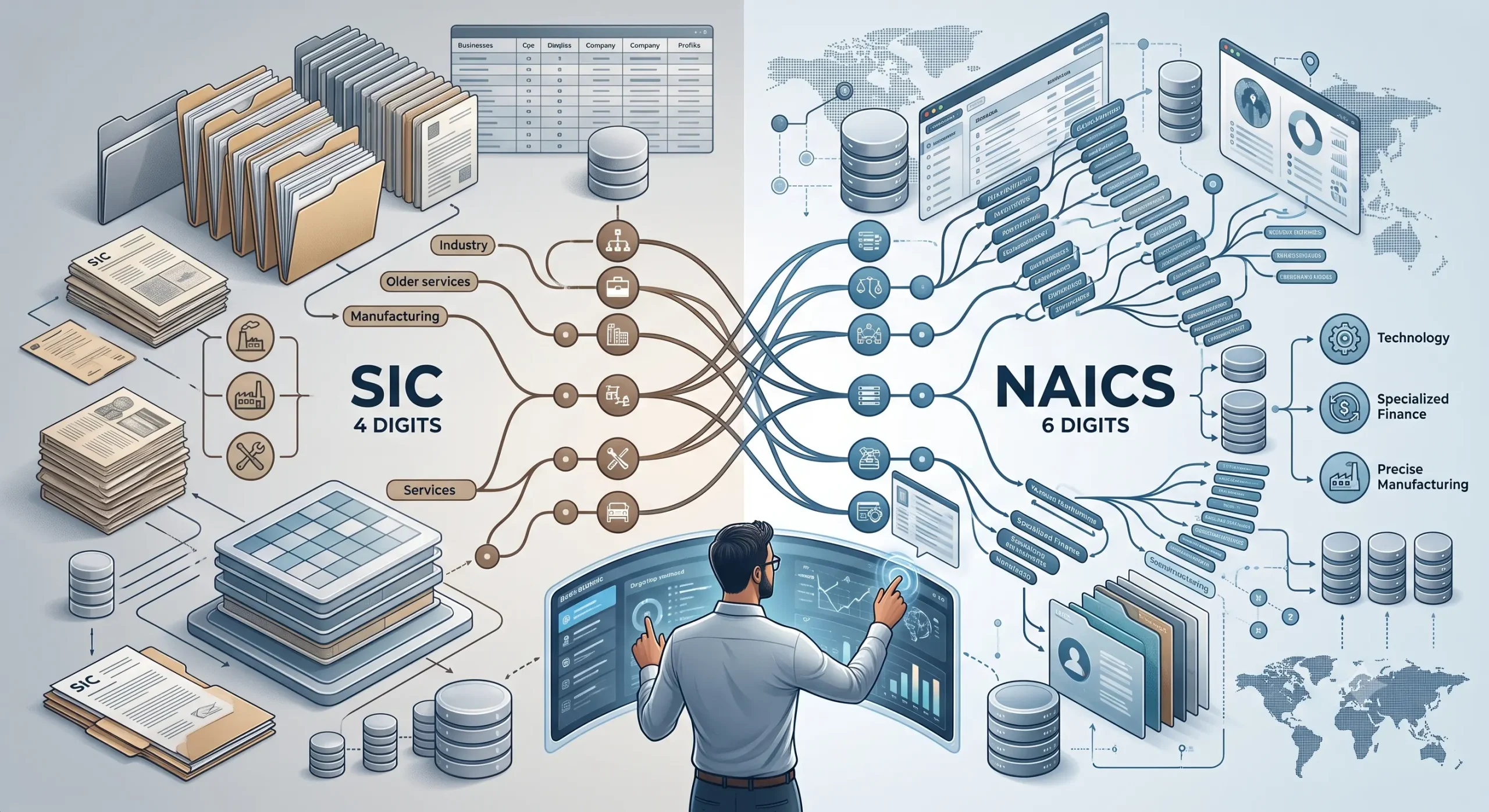
The Standard Industrial Classification, or SIC, was created by the US government in 1937 and last revised in 1987. It uses a four-digit code and groups the economy into roughly a dozen broad divisions. The North American Industry Classification System, or NAICS, replaced SIC as the federal statistical standard in 1997. According to the US Census Bureau, NAICS was developed jointly by the United States, Canada, and Mexico so that industry statistics could be compared across all three countries, and it was also designed to align with the United Nations’ international classification. NAICS uses a six-digit hierarchical code and organizes the economy into 20 sectors, with far better coverage of technology, information, and modern service industries that barely existed when SIC was written.
The core differences at a glance
The practical distinctions come down to structure, coverage, geography, and how often each is updated. This table is the fast version.
| Feature | SIC | NAICS |
|---|---|---|
| Digits | 4 | 6 |
| Top-level groups | ~10 to 11 divisions | 20 sectors |
| Geography | US only | US, Canada, Mexico |
| Created / last updated | 1937 / 1987 | 1997 / 2022 |
| Update cycle | No longer updated by government | Every 5 years |
| Maintained by | Frozen (private extended versions exist) | US Census Bureau |
Two consequences matter for anyone building a list. NAICS is more granular, so it lets you target a narrower slice of an industry, and NAICS keeps evolving while the government version of SIC is frozen in 1987. A furniture retailer, for example, might carry SIC 5712 and NAICS 442110, and the codes were assigned based on the activity that generates the most revenue, not chosen by the business itself.
How to read a NAICS or SIC code
The digits are not random, they are a hierarchy that gets more specific as you read left to right. Knowing this helps you target at the right level rather than too broadly or too narrowly.
A SIC code has four digits. The first two identify a broad industry group, and the last two narrow it to a specific line of business. A NAICS code has up to six digits that step down through more levels: the first two digits are the sector, the third the subsector, the fourth the industry group, the fifth the industry, and the sixth a national-level detail specific to the US, Canada, or Mexico. That extra depth is why NAICS lets you separate businesses that SIC would lump together. When you build a list, you can choose to target a whole sector by using fewer leading digits, or a precise niche by using the full code.
Here is how a handful of common industries look in each system, which is useful when you are sanity-checking a target list.
| Industry | Example SIC | Example NAICS |
|---|---|---|
| General building contractors | 1521 | 236115 |
| Manufacturing (plastics products) | 3089 | 326199 |
| Grocery stores | 5411 | 445110 |
| Offices of physicians | 8011 | 621111 |
| Legal services | 8111 | 541110 |
| Computer systems design | 7372 | 541511 |
Notice that the software and services rows are where NAICS shines, because it carves out modern sectors that SIC, frozen in 1987, never fully captured. For technology install-base and service targeting, that granularity is the difference between a clean list and a noisy one, which is why our business opt-in email lists are built with current NAICS selects in mind.
Why SIC has not gone away
If NAICS replaced SIC almost thirty years ago, you would expect SIC to be extinct. It is not, and understanding why keeps you from targeting the wrong field in your data.
Several major institutions still run on SIC. The US Securities and Exchange Commission classifies public-company filings by SIC code, and OSHA and many insurance and underwriting systems still use it too. On the commercial side, Dun and Bradstreet maintains an extended six and eight-digit SIC system that it continues to update for market segmentation, and a large share of private B2B databases and marketing tools still index records by SIC. So while NAICS is the modern federal standard, SIC remains the working language of a lot of the data you will actually encounter. That is exactly why the smart move on a list is often to know both.
Which one to use when building a B2B list
The right choice is not universal, it depends on your data source and your goal. Here is how to decide quickly.
Reach for NAICS when you want the current standard and the most precise industry selection, when you are targeting modern technology or service sectors, or when your audience spans the US and Canada, since NAICS is common to both. Our NAICS code business lists reference covers how NAICS selects work in practice.
Reach for SIC when your existing data, CRM, or past campaigns are already coded that way, when you are matching against SEC or other SIC-based records, or when a data source you rely on only offers SIC. Our SIC code business lists reference shows the SIC selects available.
Use both when you want maximum coverage or need to reconcile audiences across different sources. Because the two systems do not convert one to one, a business captured under one code is not guaranteed to appear under the mapped code in the other, so querying both catches records a single system would miss. This is the single most common mistake in industry targeting, and it quietly shrinks your reachable universe.
Worth knowing: NAICS runs on a five-year revision cycle. The 2022 edition is current, and the next scheduled revision is 2027, when new and reclassified industries are added. SIC, by contrast, has not been officially updated since 1987. If you are building a list you will reuse for years, targeting by NAICS keeps you aligned with how industries are actually being reclassified, per the US Census Bureau’s NAICS program.
How a broker handles both for you
Reconciling two classification systems by hand is tedious, and it is one of the reasons businesses use a broker rather than a raw database. A broker appends and targets by both NAICS and SIC, so your list is built from the widest possible pool and matched to whichever system your downstream tools expect. If you are unsure which codes best capture your ideal customer, that translation is part of the service. Explore our full range on the direct marketing list broker hub or the business specialty lists page for niche verticals that cut across both systems.
Frequently asked questions
What is the difference between NAICS and SIC codes?
Both classify a business by its primary activity. SIC is an older four-digit US-only system last updated in 1987. NAICS is the current six-digit system, introduced in 1997, shared by the US, Canada, and Mexico, and revised every five years. NAICS is more detailed and current.
Did NAICS replace SIC?
Yes, NAICS replaced SIC as the federal statistical standard in 1997. However, SIC is still widely used by the SEC, OSHA, insurance systems, and many private business databases, so both systems remain in circulation.
Can I convert a SIC code to a NAICS code?
Not cleanly. The two systems do not map one to one, so crosswalk tools give an approximate match rather than an exact equivalent. Some activities are grouped differently, which is why querying both can improve coverage.
Which code should I use for marketing and list building?
Use NAICS for the most precise and current targeting, especially in technology and service sectors and across North America. Use SIC when your data, CRM, or legacy campaigns rely on it. For the widest reach, target by both.
Does the SEC still use SIC codes?
Yes. The SEC classifies public-company filings by SIC code, which is one reason SIC persists despite NAICS being the official federal standard.
Why does my company have both a NAICS and a SIC code?
Because different agencies and databases adopted different systems. Statistical agencies assign codes based on your primary business activity from tax and registration data, and older systems kept their SIC classifications while newer ones moved to NAICS.
Which system do data providers use?
It varies. Many carry both, some index primarily by SIC out of legacy, and some lead with NAICS. When buying a list, confirm which system the provider uses so your selects match your targeting.
How do I find my industry code?
You can search by keyword on the US Census Bureau’s NAICS site for NAICS, and through SIC lookup tools for SIC. Your code reflects the activity that generates the most revenue.
Build a precisely targeted B2B list
Choosing between NAICS and SIC should not decide who you can reach. Tell us the industries you want to target, and a Prospects Influential broker will build a list matched by both classification systems for the widest, most accurate reach, with a free count and quote and no obligation. Our brokers in West Vancouver and Bellingham respond within one business day on our contact page.