If you sell to restaurants, you have probably asked this question at least once before reaching for your credit card to buy a list.
Is this actually legal? Could I get fined? What does GDPR actually say? Does California have its own rules?
These are the right questions to ask, and the answers are more nuanced than the blog posts that just say “yes it is legal, buy our list” or the ones that say “email lists are illegal, do not touch them.” Both of those are wrong in different ways.
The truth is: buying a restaurant email list is legal in the United States. What becomes legally meaningful is what the list contains, where those contacts are located, and how you use it from the moment you hit send.
This guide gives you a clear, plain-language breakdown of CAN-SPAM, GDPR, and CCPA as they apply specifically to restaurant email lists, with no legal jargon and no agenda beyond helping you understand what the rules actually require.
What is a restaurant email list?
A restaurant email list is a B2B contact database of verified professional contact details for restaurant owners, operators, managers, executive chefs, general managers, and purchasing directors. It is used by food and beverage suppliers, POS software vendors, hospitality technology companies, restaurant insurance brokers, linen and uniform suppliers, payment processors, staffing agencies, and any other B2B company whose products or services are sold into the restaurant industry.
A restaurant email list is not a list of diners, customers, or consumers. It is a list of business contacts at commercial food service establishments, compiled for the purpose of B2B outreach.
The short answer before anything else
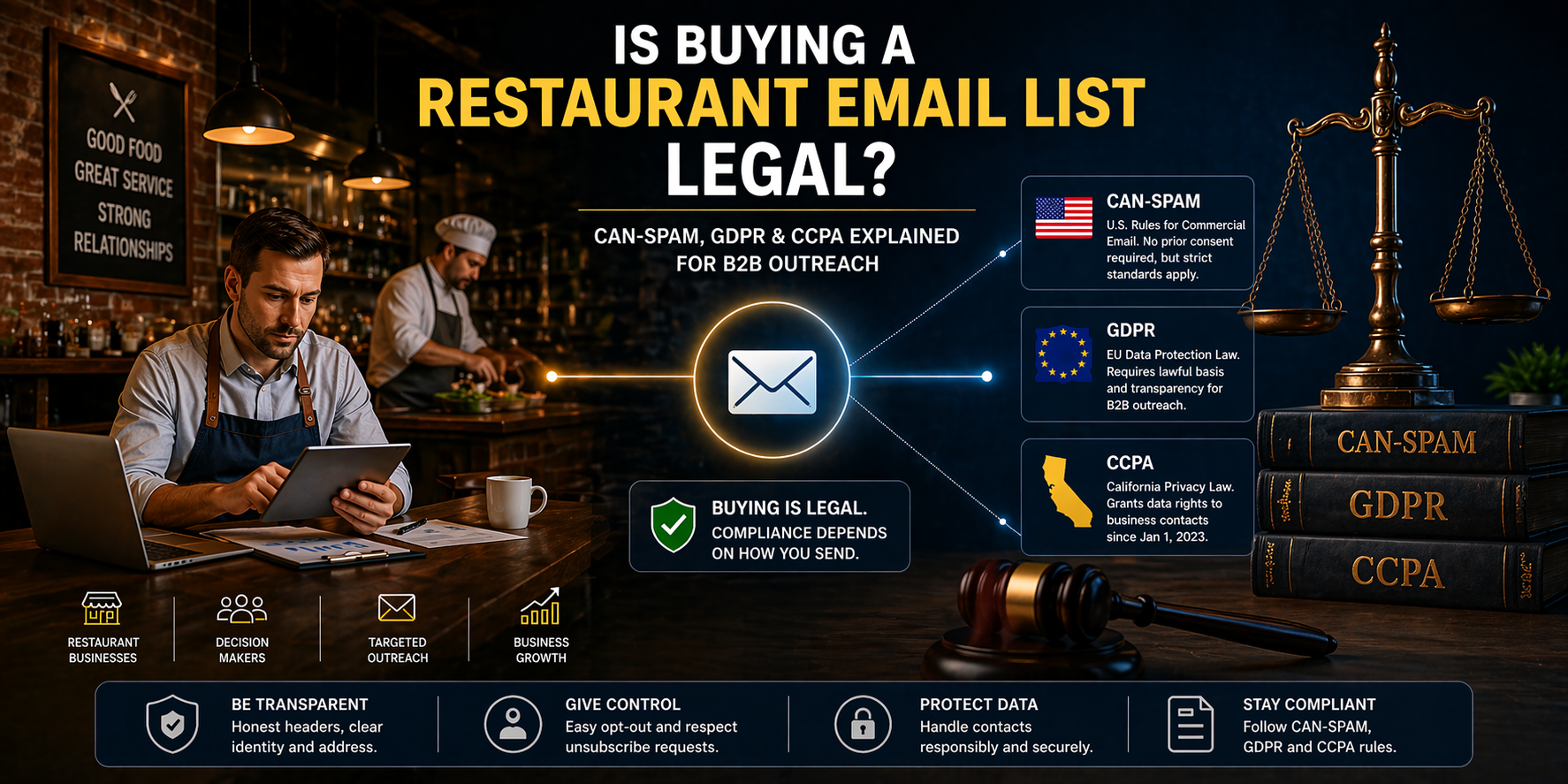
Buying a restaurant email list is legal in the US. CAN-SPAM does not prohibit purchasing business contact data. The legal risk activates when you send, not when you buy, and it depends entirely on how your emails are structured and where your contacts are located. GDPR raises the compliance bar for EU-based restaurant contacts. CCPA introduces additional requirements for California-based contacts since the B2B exemption expired in January 2023.
Is Buying a B2B Email List Legal?
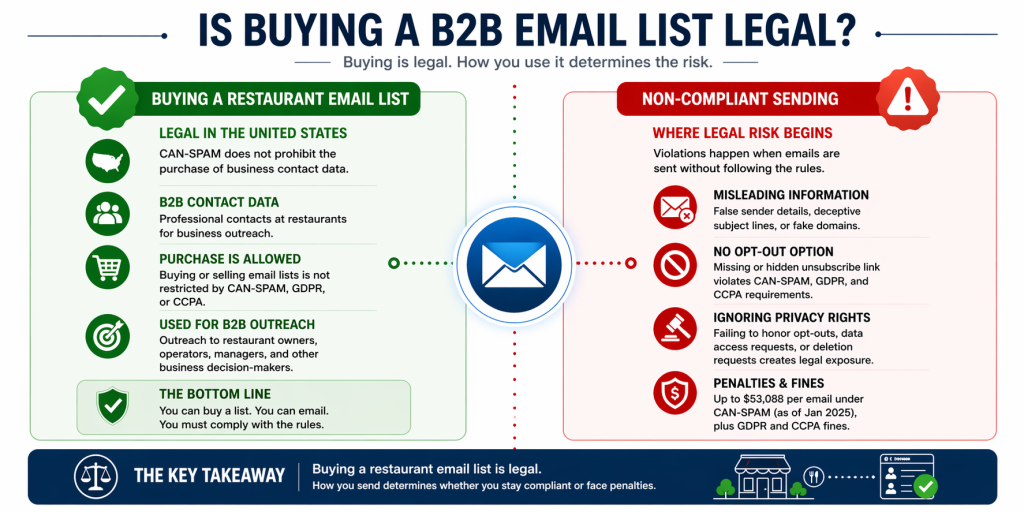
Yes, in the United States. This is one of the most commonly misunderstood points in email marketing compliance discussions on Quora and in B2B forums.
The CAN-SPAM Act of 2003 does not ban the purchase or sale of email lists. It does not ban cold emailing from purchased lists. What it does is establish rules for how commercial emails must be sent once you use that list. The legal exposure is not in the buying. It is in the sending.
GDPR, which applies to contacts in the European Union, also does not ban the purchase of B2B email lists. It does not ban cold B2B outreach. What it does is establish a higher standard for the lawful basis under which you process and contact those people, and it requires that your data sourcing is documentable and your outreach is professionally relevant.
CCPA, which applies to California residents, has become more relevant to B2B contact data since the B2B exemption expired on January 1, 2023. For California-based restaurant contacts, this means certain privacy rights now apply that did not exist before.
The short version across all three jurisdictions: you can buy, you can email, you must comply with how you do it.
CAN-SPAM: What It Actually Requires for Restaurant B2B Emails
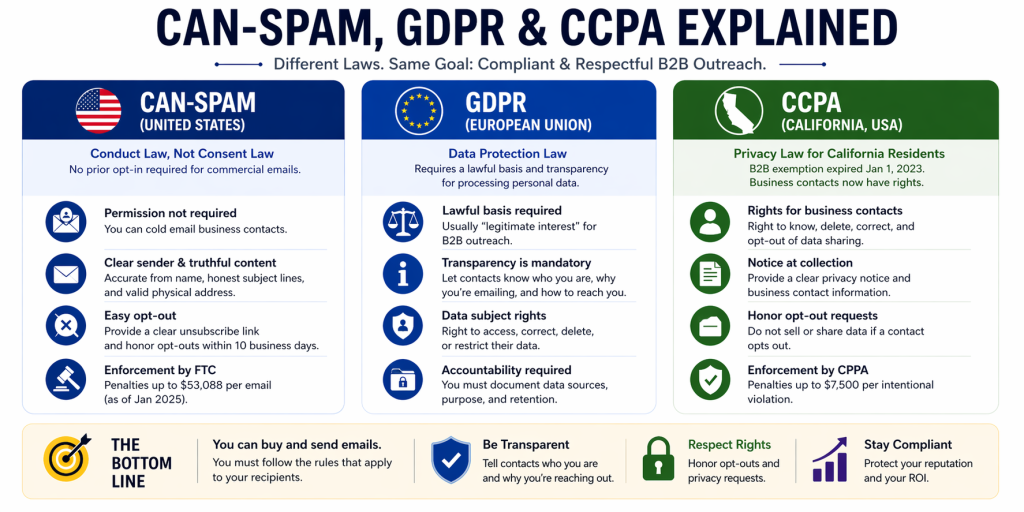
CAN-SPAM is a US federal law that governs all commercial emails sent to recipients in the United States. It is a conduct law, not a consent law. It does not require prior opt-in from your recipient. It requires that the email itself meets specific standards.
Can you send cold emails to restaurants without prior consent under CAN-SPAM?
Yes. CAN-SPAM does not require prior consent for commercial emails. This is one of the key differences from GDPR. Under CAN-SPAM, you can legally cold email a restaurant owner, operator, or manager from a purchased list without them having previously opted in to hear from you, provided your email meets all the required standards.
What are the key CAN-SPAM requirements for restaurant B2B emails?
Every commercial email you send to US restaurant contacts must include:
Accurate sender identification. Your “From” name, “Reply-To” address, and email routing headers must correctly identify who is actually sending the email. Using a misleading sender name or a spoofed domain is a direct violation.
Honest subject lines. The subject line cannot be deceptive about the content of the email. A subject line designed to mislead the restaurant owner into opening it violates CAN-SPAM regardless of how clever it is.
Physical postal address. Every email must contain a valid physical mailing address for your business. A P.O. box or registered private mailbox is acceptable.
Clear identification as an advertisement. Commercial emails must be clearly identifiable as such, though the law gives flexibility in how this is communicated.
A functional unsubscribe mechanism. Every email must include a clear, easy way for the recipient to opt out of future communications. That mechanism must remain active for at least 30 days after the email is sent.
Prompt opt-out processing. Once a restaurant contact unsubscribes, you have 10 business days to stop emailing them. You cannot require them to log in, pay a fee, or take more than one action to unsubscribe.
What are the CAN-SPAM penalties?
The FTC’s civil penalty cap increased to $53,088 per individual email in violation as of January 2025. For high-volume campaigns, non-compliance compounds across every message sent. Multiple violations in a single campaign can reach significant sums quickly.
Do you need to label every restaurant email as an advertisement?
Yes, but this requirement has flexibility. Commercial emails must be identifiable as advertising, though CAN-SPAM does not require a specific format or placement. Standard practice is to include a clear identifier in the footer alongside your unsubscribe link and physical address.
GDPR: What It Means for EU Restaurant Email Lists
GDPR is the General Data Protection Regulation of the European Union. It applies whenever you contact someone located in the EU, regardless of where your business is based. If your restaurant email list includes contacts at EU-based restaurants, GDPR governs those contacts.
Does GDPR ban buying restaurant email lists or cold B2B outreach?
No. GDPR does not ban either. Since May 2018, more than 1,600 companies have been fined under GDPR, and the cumulative total of fines has reached 7.1 billion euros according to DLA Piper’s January 2026 report. But those fines are overwhelmingly for consent violations, inadequate data handling, and unauthorized data transfers, not for B2B outreach conducted with proper documentation.
GDPR does not differentiate between personal and business contacts. A named work email like owner@restaurantname.com identifies a specific person and is therefore personal data under GDPR. A generic role email like info@restaurantname.com does not identify a specific individual and sits outside GDPR’s scope. This distinction matters when you are cleaning and segmenting a EU restaurant list.
Can you use legitimate interest for B2B outreach to EU restaurants?
Yes. Under GDPR Article 6(1)(f), legitimate interest is the most commonly used lawful basis for B2B cold email outreach. You can legally contact an EU-based restaurant owner or manager without their prior consent if three conditions are met:
Your outreach is genuinely relevant to their professional role. A food supplier emailing a restaurant owner about a product relevant to their purchasing function has a legitimate interest case. An unrelated company emailing the same person about something with no connection to their business does not.
You disclose where you obtained their data. Your first email to a cold EU contact should tell them who you are, why you are contacting them, and how you obtained their contact information. This transparency is a GDPR requirement.
You include a clear, easy opt-out in every email. EU contacts have the right to object to processing under Article 21, and you must honor that objection immediately.
Do you need explicit opt-in for EU restaurant business emails?
No, if you are using legitimate interest as your lawful basis. Explicit consent is one lawful basis under GDPR but not the only one. Legitimate interest allows B2B outreach without prior consent, provided the conditions above are met and you conduct and document a Legitimate Interest Assessment for your campaign.
What are the key GDPR obligations for restaurant email outreach?
Transparency in every first contact. EU restaurant contacts you are emailing cold must be told who you are, why you are contacting them, and how you got their data.
Data subject rights. Any EU contact can request access to the data you hold on them, correction of inaccurate data, or deletion. You must respond within 30 days.
Right to object. EU contacts can object to marketing at any time. You must stop processing their data for marketing purposes immediately when they do.
Documentation of lawful basis. For every campaign targeting EU contacts, you should document your legitimate interest assessment: why your outreach is relevant, proportionate, and respectful of the recipient’s interests.
Data minimization. Only collect and retain the data fields you actually need for your campaign. GDPR best practice limits B2B contact retention to three years from the last interaction.
What are the GDPR penalties?
GDPR fines reach up to 20 million euros or 4% of global annual turnover, whichever is higher. Even for small B2B operations, a documented GDPR violation in a commercially visible category carries meaningful reputational and financial risk.
Is a restaurant owner’s email treated as B2B data or personal data under GDPR?
This is the edge case that most guides do not address. It depends on the ownership structure of the restaurant.
A restaurant owned by a limited company or incorporated entity: the owner’s work email used for business correspondence is business data, though named individual emails still technically qualify as personal data under GDPR.
A sole trader running an independent restaurant: under GDPR, the owner is both the business and an individual. Their professional contact information is simultaneously business data and personal data. This means GDPR’s requirements apply with the same force as they would for a consumer contact. Outreach to sole trader restaurant owners in the EU requires the same legitimate interest documentation and transparency as any other GDPR-covered contact.
This distinction matters in the UK and Europe where many independent restaurants and cafes are operated as sole proprietorships rather than incorporated entities.
CCPA: What California Restaurant Contacts Mean for Your Campaign
The California Consumer Privacy Act, as amended by the California Privacy Rights Act, is the most relevant US state law for restaurant email marketing. California is currently the only US state where comprehensive privacy law explicitly covers B2B contact data.
What happened to the CCPA B2B exemption?
The CCPA originally included a partial exemption for B2B data. That exemption expired on January 1, 2023. Since that date, personal information collected from California business contacts, including restaurant owners and managers, is treated the same as any other consumer data under CCPA. The exemption is gone and it has not been reinstated.
This is one of the most practically important compliance changes for B2B marketers in recent years, and it is consistently underreported in email list guides.
Does CCPA apply to every company buying a restaurant email list?
No. CCPA applies only to businesses that meet specific thresholds. As of January 2025, your business must meet at least one of the following to be covered:
Annual gross revenue exceeding $26.625 million. Or it processes personal data of 100,000 or more California consumers or households annually. Or it derives 50% or more of its annual revenue from selling personal data.
If your business does not meet these thresholds, CCPA does not directly apply to you as the buyer. However, the list provider itself may be subject to CCPA as a data broker, which affects what compliance documentation they should be able to provide you.
What rights do California restaurant contacts have under CCPA?
Since the B2B exemption expired, California restaurant contacts have the same privacy rights as consumers:
The right to know what personal information you hold about them. The right to request deletion of their data. The right to correct inaccurate information. The right to opt out of the sale or sharing of their data. CCPA opt-out requests must be processed within 15 business days.
What does CCPA mean practically for restaurant email outreach?
If your business is covered by CCPA and your restaurant email list includes California contacts, you must have a privacy policy that discloses your data practices, provide a clear mechanism for California contacts to exercise their rights, honor opt-out and deletion requests within 15 business days, and ensure your list provider can provide documentation of how the California data was collected and what rights have been communicated to those contacts.
What are the CCPA penalties?
The California Privacy Protection Agency can impose penalties of $2,500 per unintentional violation and $7,500 per intentional violation. Private right of action for data breaches allows statutory damages of $107 to $799 per consumer per incident as adjusted for 2025.
The Sole Proprietor Edge Case for Restaurant Owner Lists
This is worth its own section because it affects a significant portion of independent restaurant contacts.
Many restaurants, particularly independent operators, are run by sole proprietors who have not incorporated a separate legal entity. Under both GDPR and CCPA, a sole proprietor is an individual as well as a business operator. Their personal and business identities are legally the same.
Under GDPR: a sole trader’s work email is personal data, and their individual privacy rights apply in full. Legitimate interest still permits outreach but requires the same documentation and transparency as any EU consumer contact.
Under CCPA: a sole proprietor qualifies as a “consumer” under the CCPA definition of natural persons who are California residents. If they are on a California restaurant email list, they have full CCPA rights even though you are marketing to them in a B2B capacity.
A quality restaurant email list provider differentiates between incorporated restaurant entities and sole proprietor contacts. When evaluating a provider, ask whether their US restaurant contacts are primarily corporate entities or whether the list includes sole proprietor operators, and what compliance protocols apply to each.
Quick Reference: CAN-SPAM vs. GDPR vs. CCPA for Restaurant Email Lists
| Requirement | CAN-SPAM (US) | GDPR (EU) | CCPA (California) |
| Prior consent required | No | No (legitimate interest) | No |
| Honest subject lines | Required | Required | Required |
| Physical address in email | Required | Required | Required |
| Unsubscribe mechanism | Required | Required | Required |
| Honor opt-outs within | 10 business days | Without undue delay | 15 business days |
| Right to data access | Not required | Required within 30 days | Required |
| Right to deletion | Not required | Required | Required (since Jan 2023) |
| Sole proprietor coverage | Not distinguished | Full personal data rights | Full consumer rights |
| Maximum penalty | $53,088 per email | €20M or 4% global turnover | $7,500 per violation |
How to Avoid Common Compliance Mistakes With Restaurant Email Lists
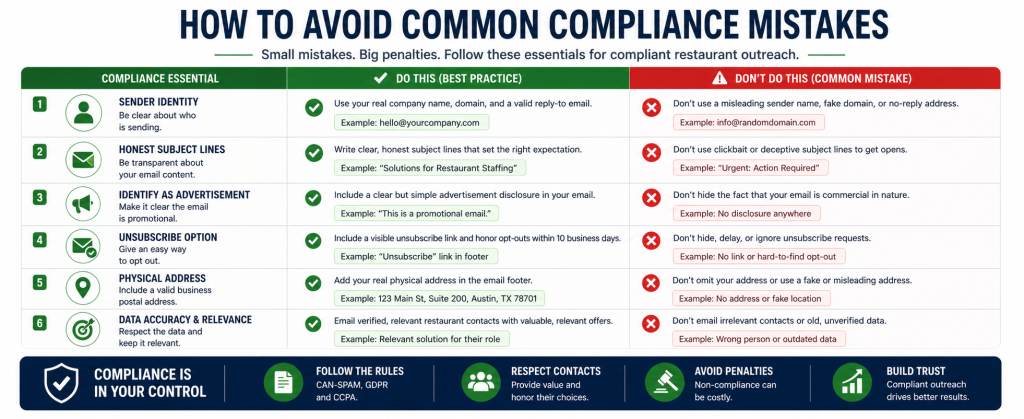
Do not send from a generic or misleading domain. Restaurant contacts receive high volumes of promotional email. A sending domain that does not match your business name raises spam flags with both email providers and recipients, and it puts you in direct violation of CAN-SPAM’s sender identification requirement.
Process unsubscribes before every send. Emailing a contact who has already opted out is a violation under all three regulatory frameworks. Sync your email platform with your list and suppress opt-outs before every campaign send.
Do not use vague subject lines to trick recipients into opening. A subject line that misrepresents the email’s content is a CAN-SPAM violation. It also generates higher spam complaint rates, which damages your sending domain reputation independently of any regulatory exposure.
For EU restaurant contacts, document your legitimate interest. Before any campaign targeting EU-based restaurants, write a brief Legitimate Interest Assessment. Record why your outreach is professionally relevant to the restaurant operators you are targeting, why your interest is proportionate to their privacy rights, and how you will handle objections. This documentation protects you if a contact or regulator ever challenges your basis for contact.
Ask your list provider about their CCPA compliance protocols. Since the B2B exemption expired in 2023, any reputable provider of California restaurant contacts should be able to confirm how those contacts’ data was collected, whether a privacy notice was provided at collection, and how they handle deletion or opt-out requests from California contacts. If they cannot answer these questions, the list carries compliance risk you cannot manage on your end.
Warm up your sending domain before any volume campaign. Hospital IT environments are not the only ones with aggressive spam filters. Restaurant industry contacts are often managed through Gmail, Outlook, and small business email providers that flag unknown senders. A domain with no prior sending history sending a high volume of cold emails is likely to be filtered regardless of list quality.
Frequently Asked Questions
Is buying a restaurant email list legal? Yes in the United States. CAN-SPAM does not prohibit purchasing B2B contact data. The legal risk activates when you send, not when you buy. GDPR and CCPA impose additional requirements for EU-based and California-based contacts respectively, but neither bans the purchase or use of B2B contact lists.
Is buying a B2B email list illegal in the EU? No. GDPR does not ban buying or using B2B email lists. It requires that you have a documented lawful basis for processing the contacts on the list and that your outreach is professionally relevant, transparent, and includes a clear opt-out. Legitimate interest is the most commonly used lawful basis for B2B cold email outreach to EU contacts.
Does GDPR allow buying business email lists? Yes, with conditions. Business email lists are permissible under GDPR provided the contacts’ data was collected in a compliant manner, you have a lawful basis for processing it, and you handle the contacts’ privacy rights correctly. The key obligations are transparency in first contact, easy opt-out, and documentation of your legitimate interest.
Does CCPA apply to restaurant owner email lists? Potentially yes. Since the B2B exemption expired on January 1, 2023, California restaurant contacts have the same privacy rights as consumers under CCPA. CCPA applies to your business if you meet the revenue or data volume thresholds. Sole proprietor restaurant owners in California are particularly relevant because they qualify as consumers under CCPA’s definition.
Are restaurant email lists GDPR-compliant if they only include work emails? Not automatically. Named individual work emails like owner@restaurantname.com are personal data under GDPR even if they are business addresses. Generic role-based emails like info@ are not personal data. The compliance question is not whether the email is a work address. It is whether the email identifies a specific person. For most restaurant owner and manager contacts, it does.
Can you send cold emails to restaurants without prior consent under CAN-SPAM? Yes. CAN-SPAM does not require prior consent. It requires that the email itself meets the conduct standards: accurate sender identity, honest subject lines, physical address, and a working unsubscribe mechanism. Prior consent is required under GDPR for some bases of processing but not under CAN-SPAM.
What happens if you violate CAN-SPAM using a restaurant email list? The FTC can impose civil penalties of up to $53,088 per individual email in violation. Multiple violations across a campaign compound quickly. The more common practical risk is domain blacklisting from high bounce rates or spam complaint rates, which can permanently damage your ability to send email from that domain.
How do you handle GDPR deletion requests from EU restaurant contacts? Stop all marketing communications to that contact immediately. Remove them from your active list and add them to your suppression list. Document the request and your response. Under GDPR, you must respond within 30 days and may retain a minimal record of the deletion request solely to prevent future accidental contact with that address.
Working With a Restaurant Email List the Right Way
The compliance picture for restaurant email lists is clear once you understand what each law actually requires:
CAN-SPAM permits cold B2B restaurant outreach without prior consent. Follow the conduct rules on every send and you are compliant.
GDPR permits B2B outreach to EU restaurant contacts under legitimate interest. Document your lawful basis, be transparent in first contact, and honor opt-outs immediately.
CCPA requires that if your business meets the coverage thresholds and you are targeting California restaurant contacts, those contacts now have full consumer privacy rights that you must respect.
A quality restaurant email list built from verified, professionally sourced data with documented compliance protocols significantly reduces your exposure across all three frameworks. The list provider’s ability to demonstrate how their data was collected, how consent was handled, and how opt-outs are managed is the clearest signal of whether the list is worth buying.
Prospects Influential builds restaurant contact lists from verified, sourced business data with compliance documentation across both US and Canadian markets. Their restaurant email list covers restaurant owners, operators, managers, and food service decision-makers with segmentation options by restaurant type, geography, and company size.
For an overview of how direct marketing regulations apply to B2B email outreach, visit the Prospects Influential direct marketing regulations resource.
You can also read how compliance applies to other B2B list categories in our guide on buying a pharmacists email list without violating CAN-SPAM or GDPR and our overview of when it makes sense to use a list broker instead of buying directly.
Get in touch with Prospects Influential to discuss a restaurant contact list built to your campaign’s specific geographic and compliance requirements.