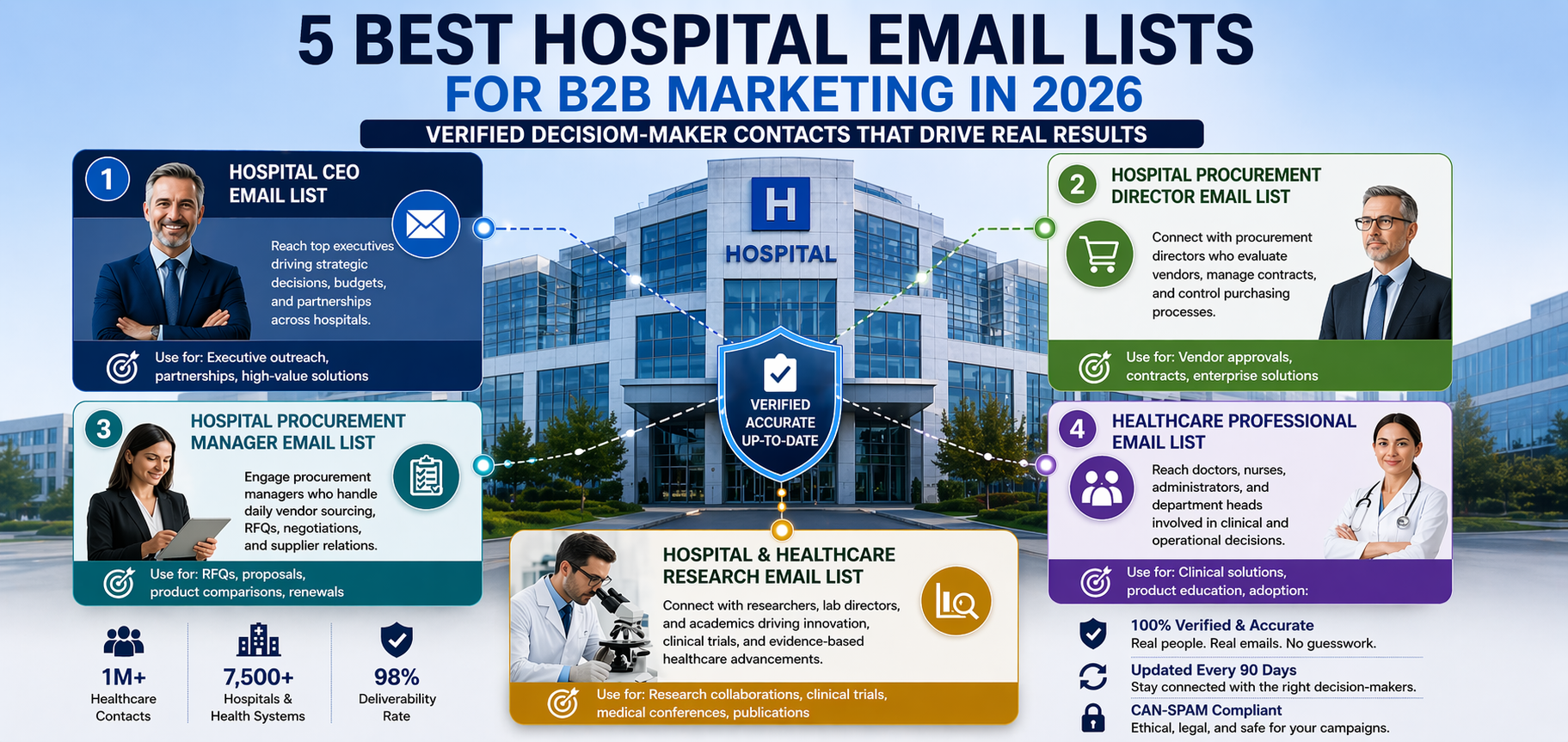
If you are trying to sell a product or service to hospitals, you have probably already figured out that hospitals are not simple businesses to market to.
There is no single inbox you can email. There is no one person who says yes to everything. A hospital is a large organization with multiple departments, multiple budgets, and multiple people who all have a say in what gets bought, approved, or ignored.
That is exactly why “a hospital email list” is not really one thing. The right list depends entirely on who you need to reach and what decision you need them to make.
This guide breaks down the five types of hospital email lists that actually move the needle for B2B marketers in 2026, who each list is for, and why reaching the right contact in a hospital is more important than reaching the most contacts.
What is a hospital email list?
A hospital email list is a database of verified contact details for professionals who work inside hospitals and health systems. These are not patient records. These are business contacts, executives, administrators, procurement heads, and department leaders who make purchasing decisions on behalf of their hospitals. B2B marketers use hospital email lists to run targeted outreach campaigns, promote products and services, and build relationships with the people who control hospital spending.
Why Most Hospital Email Campaigns Fall Flat
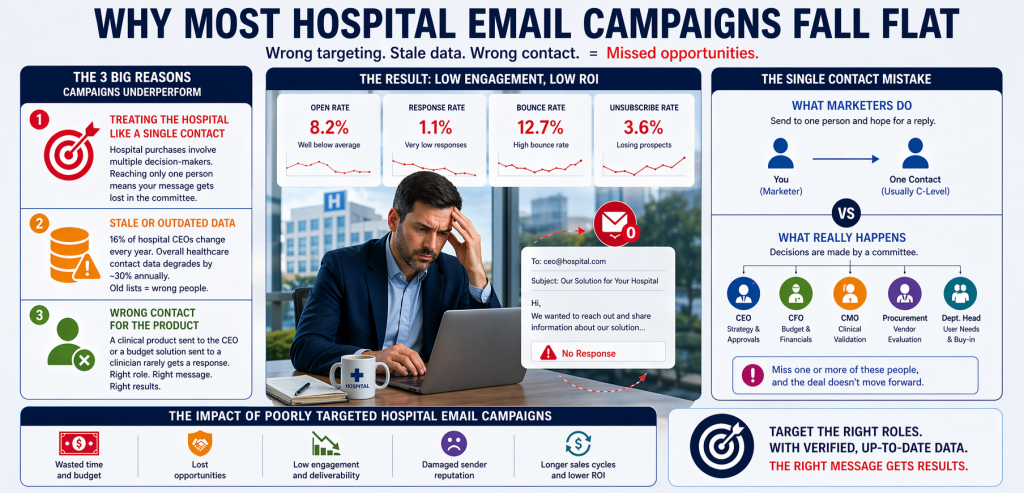
Before getting into the five list types, it helps to understand why so many hospital marketing campaigns underperform.
The most common mistake is treating a hospital like a single contact. In reality, a hospital buying decision moves through a committee. The CEO may approve the budget. The CFO evaluates the financials. The procurement director manages the vendor process. The department head champions the product internally. If your campaign only reaches one of these people, you are pitching to one voice in a much larger conversation.
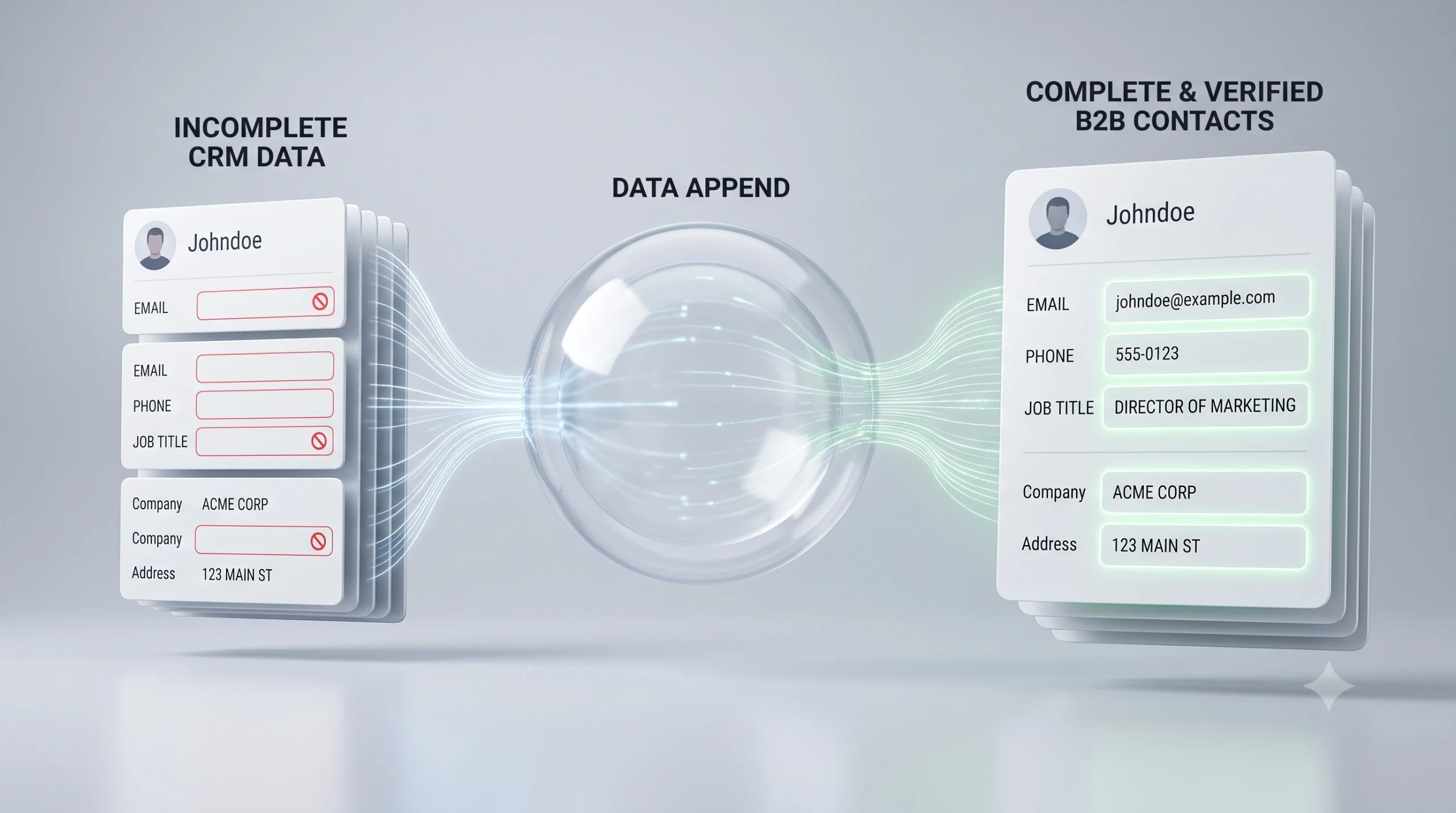
The second problem is stale data. Hospital leadership changes frequently. According to the American College of Healthcare Executives, hospital CEO turnover runs at around 16% annually. That means roughly one in six CEO contacts on any list becomes outdated every single year. Combined with the fact that healthcare contact data broadly degrades at around 30% per year, a list that has not been reverified in the past 90 days is already working against you before you hit send.
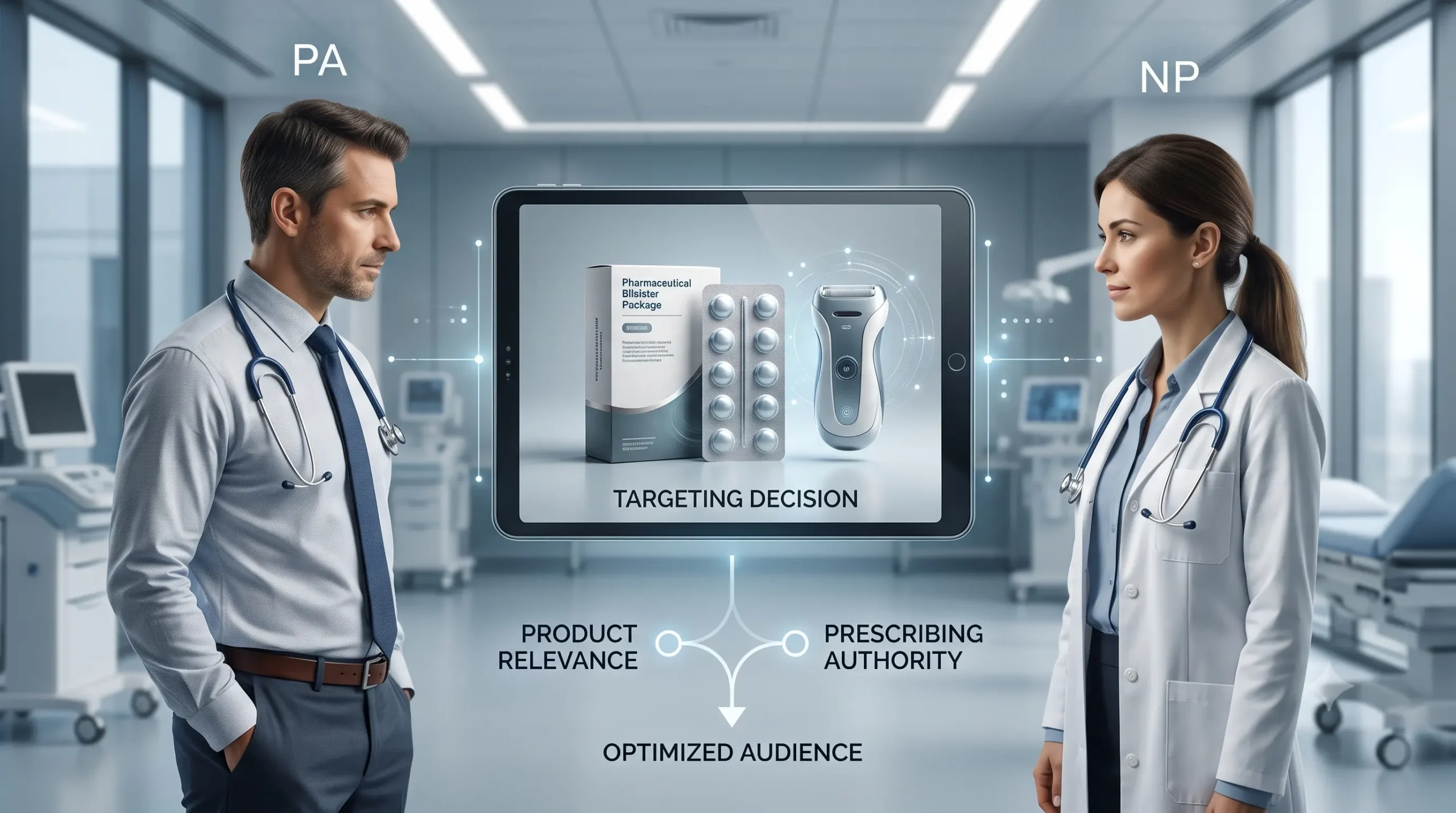
The third problem is the wrong contact for the product. A medical device company emailing a hospital CEO about a clinical instrument is unlikely to get a response. That same email sent to the procurement director or the relevant clinical department head lands in a completely different place.
Getting all three of these right, the right roles, the right data freshness, and the right message match, is where hospital B2B campaigns either win or waste budget.
Who Are the Decision-Makers in a Hospital?
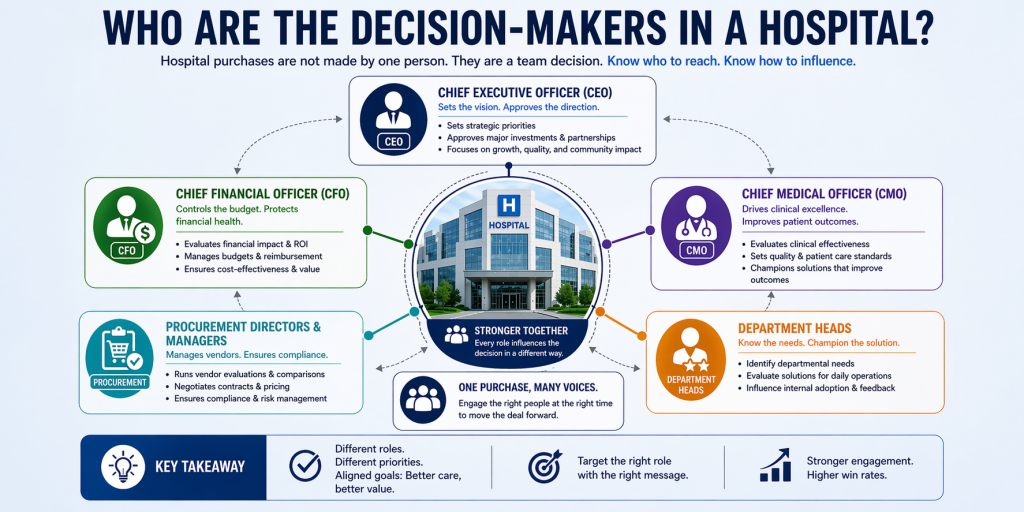
Hospital purchasing decisions involve several key roles, and the relevant contact shifts depending on what you are selling.
The CEO sets the hospital’s strategic direction and approves major partnerships and vendor relationships. If you are selling something that affects the hospital at an organizational level, such as a technology platform, a consulting service, or a capital investment, the CEO is a relevant target for awareness and executive-level positioning.
The CFO controls budget allocation and financial approval. Any product or service with a significant price tag will pass through the CFO at some point in the buying process.
The CMO drives clinical decisions. Products that affect patient care, clinical outcomes, or medical practice require buy-in from the CMO and the clinical leadership team.
Procurement Directors and Procurement Managers manage the actual vendor evaluation and approval process. For most B2B vendors, these are the most commercially active contacts in the hospital. They are actively evaluating suppliers, comparing proposals, and managing existing vendor relationships throughout the year.
Department Heads are the end users and internal champions. A radiology director, an ICU head, or a pharmacy director often initiates the vendor search for their department before it ever reaches procurement or the C-suite.
Understanding which role to lead with based on your product is what separates a campaign that generates responses from one that generates bounces.
The 5 Hospital Email Lists That Cover Every B2B Use Case
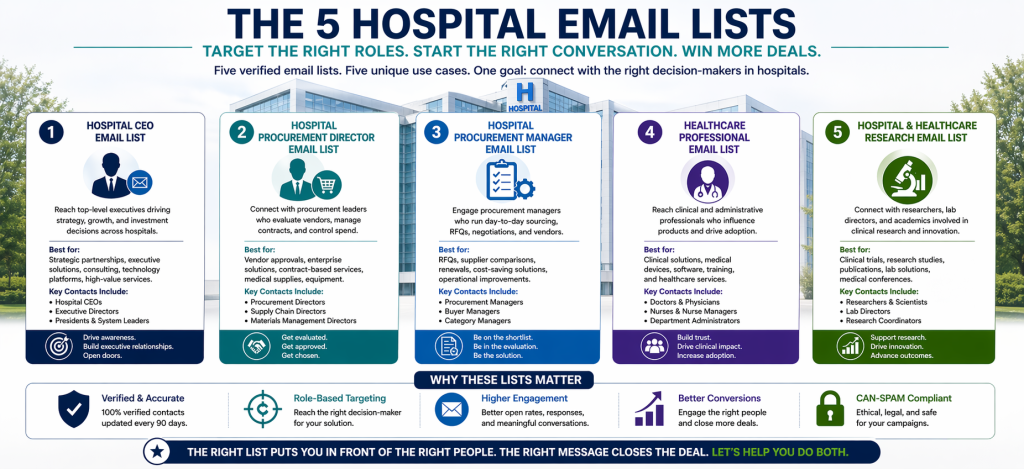
1. Hospital CEO Email List
Who it is for: Vendors, consultants, and service providers who need to reach the top of the house at American hospitals.
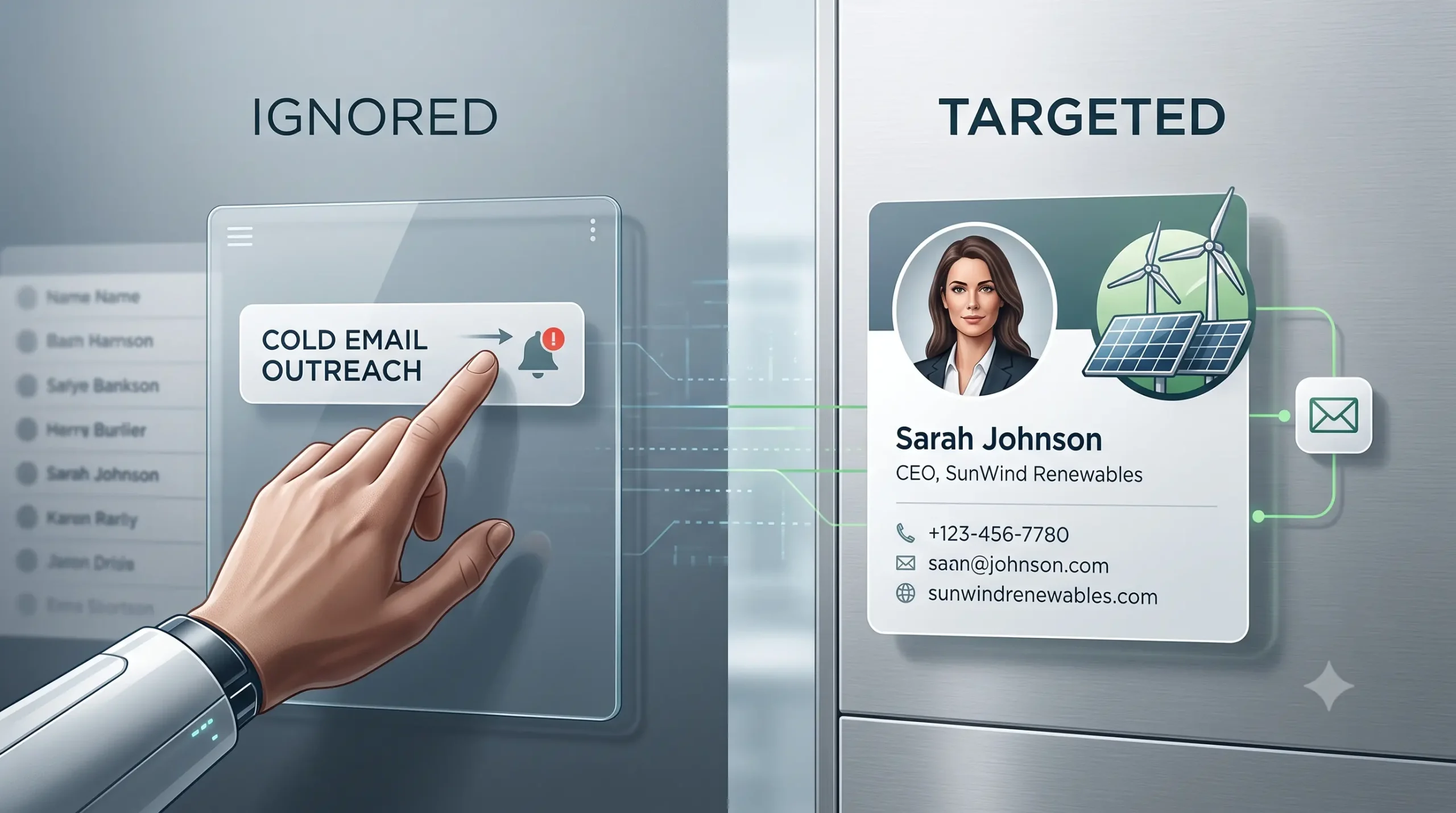
Hospital CEOs are the hardest contacts to reach in the building. They do not respond to generic outreach. They respond to messages that are directly relevant to the strategic challenges they are managing right now, which in 2026 includes staffing pressures, technology investment decisions, cost containment, and post-pandemic financial recovery.
A verified hospital CEO email list gives you direct access to the executives leading America’s medical facilities, without going through gatekeepers or spending months trying to find a warm introduction.
Because CEO turnover runs at 16% per year, the freshness of this list matters more than any other hospital contact category. A list that was compiled a year ago could have one in six CEO names pointing to someone who has already left. When you work with a verified, regularly updated CEO list, you send your campaign to the person currently in the chair, not the person who was there last year.
This list works best for companies selling high-value or strategic solutions where executive awareness and relationship building drive the sales cycle. Think technology platforms, financial services, consulting, insurance, and large-scale supply arrangements.
Connect with verified hospital CEO contacts here.
2. Hospital Procurement Email List
Who it is for: B2B vendors selling products or services that go through a formal hospital procurement process.
Most hospital purchases do not start with the CEO. They start with procurement. The procurement department manages vendor relationships, evaluates proposals, and controls which suppliers get access to the hospital’s buying process in the first place.
If you are selling medical supplies, equipment, software, facilities services, or anything that requires a vendor contract, the procurement department is your entry point. Getting past procurement is not a formality. It is the actual gate that determines whether your product gets seriously evaluated or politely ignored.
A hospital procurement email list connects you directly with the professionals running that process. These are the contacts who are actively in market throughout the year, managing budgets, comparing vendors, and looking for solutions that improve efficiency and reduce cost.
For B2B campaigns where the goal is to get into the vendor evaluation process, this list gives you the most direct route to the people who control it.
Access verified hospital procurement contacts here.
3. Hospital Procurement Managers Email List
Who it is for: Vendors who want to go deeper into the procurement layer and reach the managers handling day-to-day purchasing decisions.
Directors set the strategy. Managers execute it. In a large hospital, procurement managers are the people handling actual purchase orders, supplier communications, contract renewals, and vendor performance reviews on a daily basis. They have real purchasing authority within defined categories and are often the first people to flag a new supplier or product to their director.
Reaching procurement managers alongside directors gives your campaign two entry points into the same buying process. A director-level contact who does not respond may have a manager-level contact who actively engages. And a manager who champions your product internally carries significant influence with the director who ultimately approves.
For campaigns targeting mid-market hospital accounts or for vendors selling products in categories where purchasing decisions happen at the manager level rather than the director level, this list covers the right contact tier.
Reach hospital procurement managers directly here.
4. Healthcare Professionals List
Who it is for: B2B marketers who need to reach across the full hospital workforce including clinicians, administrators, and specialists, not just the executive or procurement layer.
Sometimes the relevant contact is not the CEO or the procurement head. It is the pharmacist who recommends the drug dispensing system. It is the nursing director who evaluates the wound care product. It is the radiologist who tests the imaging equipment before it reaches a formal procurement review.
Clinical professionals inside hospitals hold significant influence over purchasing decisions in their specialty areas. Their endorsement often precedes a formal procurement process. Their objection can kill a vendor evaluation that otherwise looked promising.
A healthcare professionals list gives you access to this wider layer of hospital contacts, covering physicians, nurses, allied health professionals, administrators, and clinical department leads across hospital settings. For campaigns where product education, clinical awareness, or specialist outreach drives the pipeline, this list covers the contacts that a CEO-only or procurement-only list will miss.
It also serves companies that market across multiple healthcare settings beyond hospitals, including clinics, outpatient facilities, and health systems.
Explore the healthcare professionals list here.
5. Health and Cancer Research Contacts List
Who it is for: Pharmaceutical companies, biotech firms, research organizations, medical device companies, and nonprofits targeting hospital research departments and cancer care professionals.
Research-focused hospital departments operate differently from general administration. They have their own budgets, their own procurement relationships, and their own decision-making processes that are often separate from the main hospital purchasing chain.
Cancer care is one of the fastest-growing areas of hospital investment. Oncology departments at major medical centers manage significant budgets for treatment technologies, clinical trial partnerships, research tools, and patient care programs. Reaching the professionals who run these departments requires a list that specifically covers this segment rather than pulling from a general hospital database.
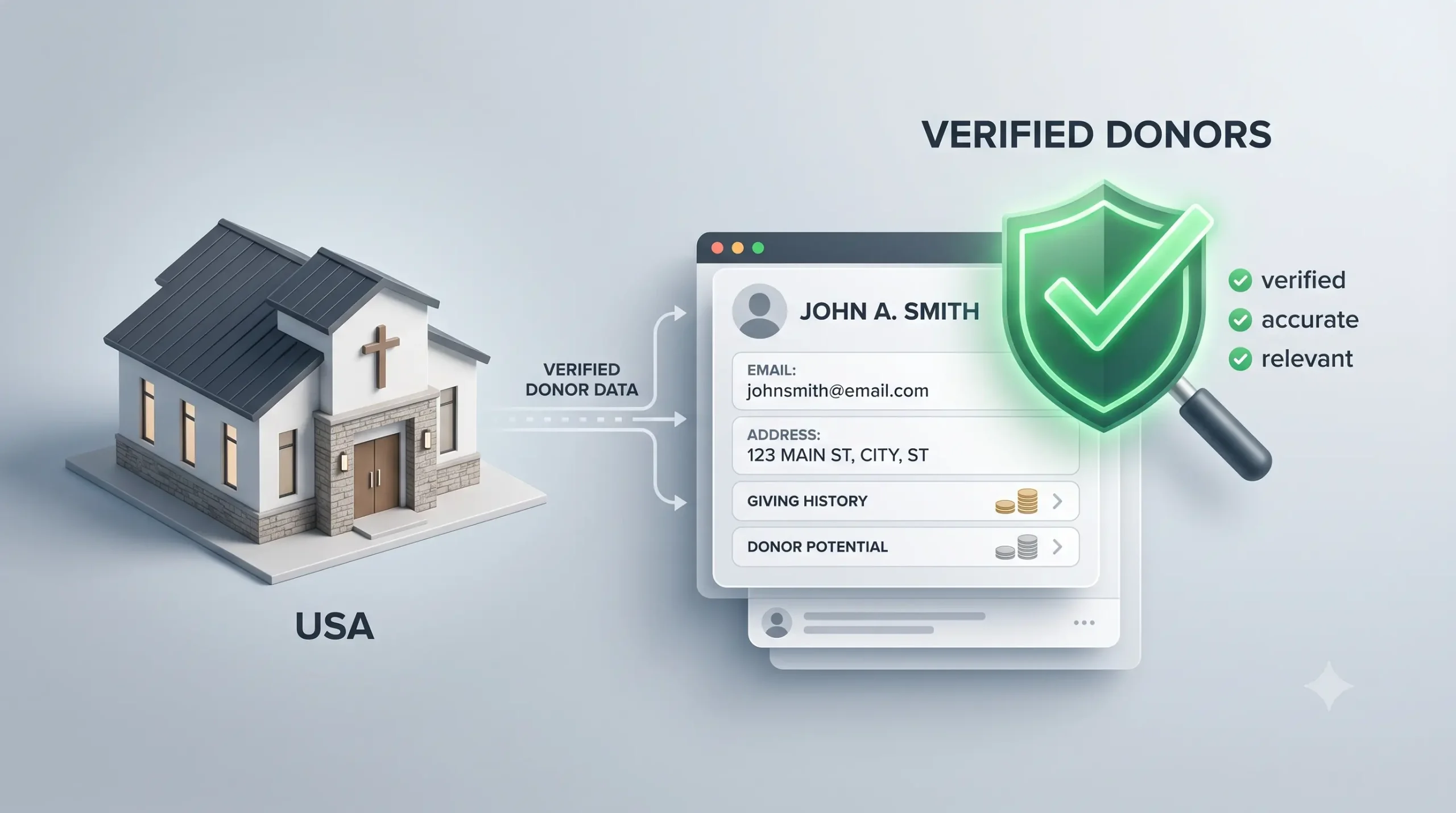
This list also serves organizations involved in health research fundraising and donor engagement within hospital and cancer research communities, where the relevant contacts are development officers, research directors, and foundation administrators rather than clinical or procurement staff.
Connect with health and cancer research contacts here.
How Do Hospital Email Lists Work?
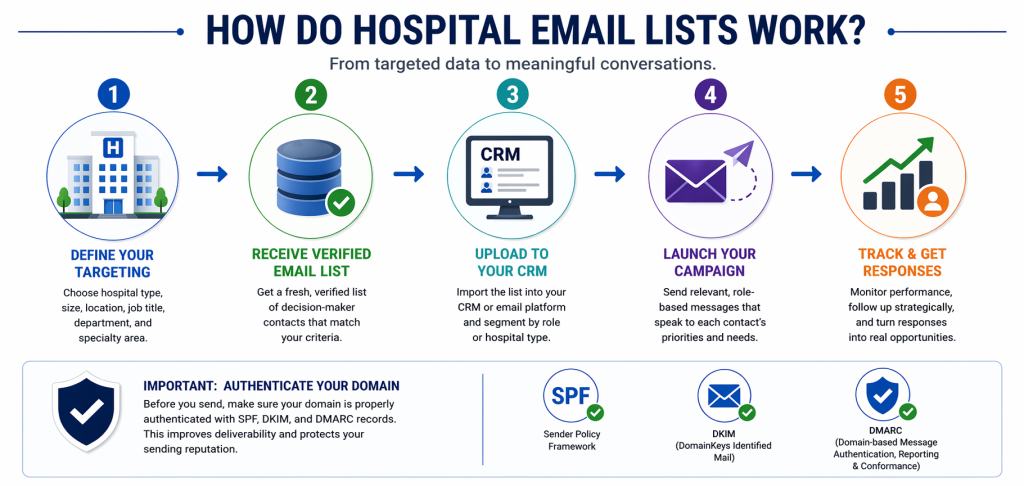
You request or purchase the list based on your targeting criteria, which can include hospital type, size, geographic location, job title, department, and specialty area. The list is delivered as a file you can upload directly into your CRM or email marketing platform. You then build your campaign around the contacts in the list, segmenting by role or hospital type to make sure each message is relevant to the person receiving it.
The most important step before you send is to confirm your domain is properly authenticated with SPF, DKIM, and DMARC records. Sending a cold campaign from an unauthenticated domain signals inbox providers that your message may be spam, regardless of how good the list quality is.
How Accurate Are Hospital Email Lists in 2026?
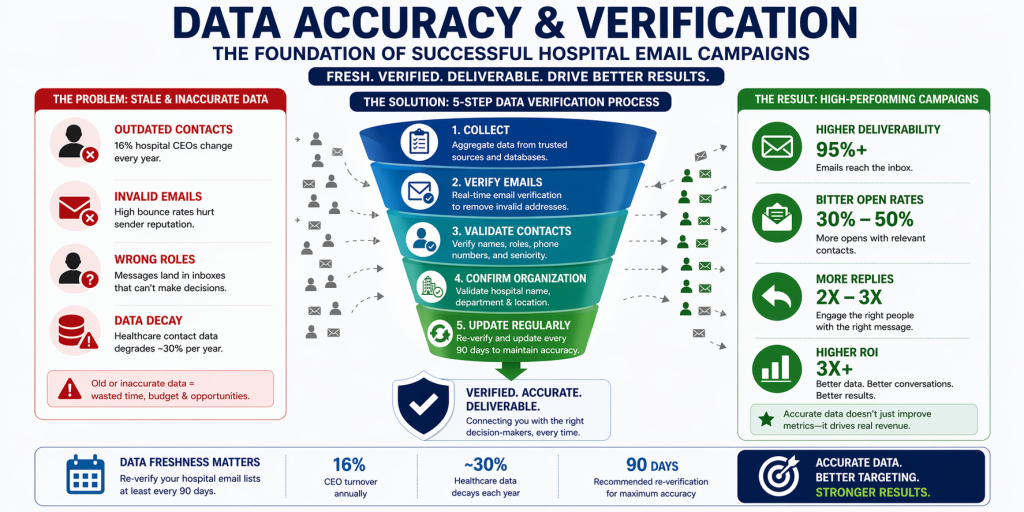
This depends almost entirely on how recently the data was verified and through what method. Real email verification pings the receiving mail server to confirm an address is live. Address formatting checks, which only confirm an email looks correct, are not the same thing and will not catch inactive inboxes.
Given that hospital leadership changes at the rate it does, any list that is not reverified at minimum every 90 days is accumulating inaccuracies in the background. A bounce rate above 4% on a cold campaign is the signal that your list has aged past its useful life. High bounce rates trigger inbox provider filters that affect not just the current campaign but your sending reputation for future ones.
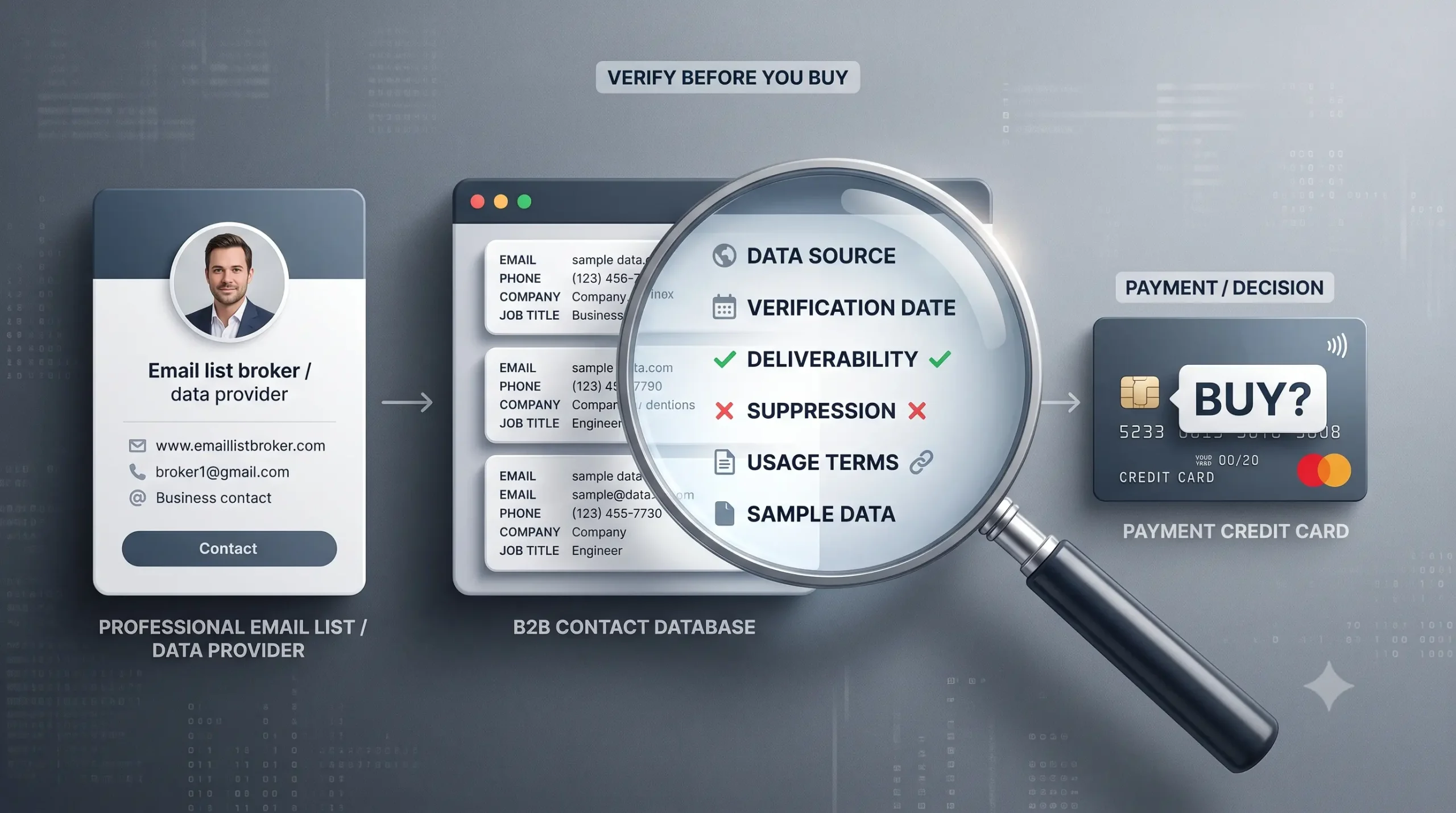
The practical question to ask any list provider is simple: when was this data last verified, what method did you use, and what do you guarantee on deliverability?
Are Hospital Email Lists HIPAA-Compliant?
Yes, when used correctly. HIPAA governs protected health information about patients. It applies to healthcare providers, health plans, and their business associates. A B2B marketer emailing a hospital procurement director or a hospital CEO is not handling patient data and is not subject to HIPAA.
Hospital email lists for B2B marketing are business contact databases. As long as your campaign does not involve patient health information, HIPAA is not a compliance concern for the list buyer or the sender.
CAN-SPAM and GDPR are the relevant regulations to understand. CAN-SPAM requires honest sender identification, no deceptive subject lines, a physical postal address in every email, and a working unsubscribe mechanism honored within 10 business days. GDPR applies to EU-based contacts and permits B2B outreach under the legitimate interests basis when the message is professionally relevant and includes a clear opt-out.
Frequently Asked Questions
What is the difference between a hospital email list and a healthcare email list? A hospital email list specifically covers professionals within hospital settings. A healthcare email list is broader and covers professionals across all healthcare settings including clinics, physician practices, dental offices, long-term care, and more.
Who are hospital decision-makers in B2B marketing? The key decision-makers are the CEO, CFO, CMO, COO, Directors of Procurement, Supply Chain Managers, Procurement Managers, IT Directors, and Department Heads. The most relevant contact depends on what you are selling and where in the hospital buying process your product sits.
How often do hospital CEO positions change? According to the American College of Healthcare Executives, hospital CEO turnover runs at approximately 16% annually. Through July 2025, hospital CEO departures were up 15% compared to the same period in 2024. This level of turnover makes frequent list reverification essential for campaigns targeting executive contacts.
How accurate are hospital decision-maker email lists in 2026? Accuracy depends on verification frequency and method. Healthcare contact data degrades at roughly 30% per year. Lists reverified every 90 days using SMTP validation maintain substantially higher accuracy than lists verified annually or through basic formatting checks.
Are hospital email lists legal for B2B marketing? Yes. Under US federal law, purchasing and using business contact data for B2B marketing is legal. CAN-SPAM governs how commercial emails are sent, not whether you can use purchased contact data. GDPR permits B2B outreach to EU contacts under the legitimate interests basis. HIPAA does not apply to B2B marketers sending commercial email to hospital professionals.
How do I know if a hospital email list is verified? Ask the provider when the data was last verified, what verification method they used, what their guaranteed deliverability rate is, and what their replacement policy covers. A credible provider answers all of these directly. Real verification uses SMTP server validation, not just formatting checks.
What data is included in a hospital email list? A quality hospital email list includes full name, job title, direct business email, phone number, hospital name and health system affiliation, hospital size by bed count and revenue, mailing address, department, geographic targeting fields, and NPI or license information for clinical contacts.
Can I target specific hospital types or sizes? Yes. Good hospital email lists support segmentation by hospital type, bed size, revenue, geographic location, department, and job title. Segmentation is what makes a campaign relevant rather than generic, and relevance directly affects both response rates and deliverability.
Ready to Reach the Right People Inside Hospitals?
The five list types above cover every major B2B use case in hospital marketing. The one that is right for your campaign depends on which contact in the hospital drives the decision for your product.
If you need C-suite access, the hospital CEO email list connects you directly with America’s hospital executives.
If your sale moves through procurement, the hospital procurement email list and procurement managers email list put you in front of the people managing that process.
If your campaign needs broader clinical or administrative reach, the healthcare professionals list covers the full workforce.
And if your focus is research, oncology, or health science outreach, the health and cancer research contacts list covers that specialized audience.
Prospects Influential has been building healthcare contact lists for over 30 years with no allegiance to a single data source. Get in touch to discuss which list best fits your campaign