A list of companies filtered by industry is a starting point. A list of companies filtered by the specific software they are actively using is a targeting upgrade that most of their competitors have not yet made.
That is the core value of technographic targeting, and it is why accounting software users email lists, Informatica users email lists, and similar technology-based segments are among the fastest-growing categories in B2B data. For a deeper explanation of how technographic data is compiled and why it works, our guide on how technographic data workswalks through the mechanics from source to delivery.
This post covers who these lists work for, how the underlying data is compiled, and what to look for when evaluating a technographic list provider.
What Is an Accounting Software Users Email List?
An accounting software users email list is a compiled database of businesses (or professionals within those businesses) that are known to use a specific accounting or financial management platform. Depending on the scope, this could mean:
- Users of SMB-focused platforms like QuickBooks Online, FreshBooks, or Wave
- Users of mid-market platforms like Sage Intacct, Xero, or Zoho Books
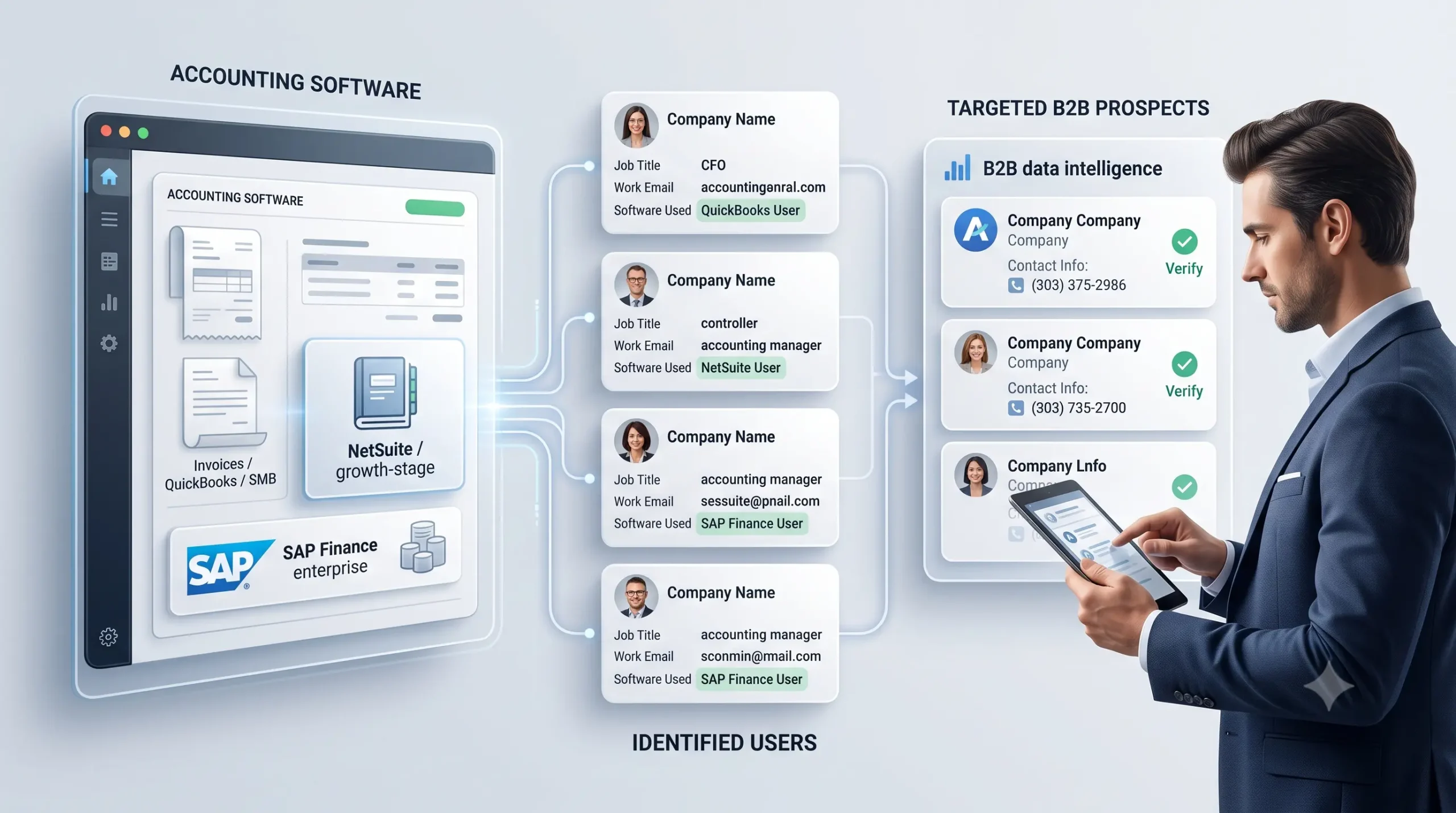
- Users of enterprise platforms like Oracle NetSuite, SAP S/4HANA, or Microsoft Dynamics 365 Finance
Each of these segments represents a meaningfully different type of company. A QuickBooks Online user is most likely a small business with under 50 employees. A NetSuite user is typically a growth-stage company with multi-entity financial complexity. An SAP Finance user is almost certainly a large enterprise with sophisticated procurement processes.
Targeting by accounting platform tells you not just what industry a company is in, but what stage of growth they are at, how technically sophisticated their finance team is, and implicitly, what their technology budget looks like.
Who Buys Accounting Software Users Lists
Payroll and HR software companies are among the most active buyers. If a company uses QuickBooks for accounting, they are likely using a separate payroll tool or they are looking to consolidate. Payroll platforms like Gusto, Rippling, and ADP target QuickBooks users specifically because the integration compatibility is a direct selling point.
Accounting workflow and automation vendors sell tools that sit on top of existing platforms: automated bank reconciliation, expense management, accounts payable automation, and close management software. These tools are useless to a company not already using an accounting platform, so reaching existing platform users is the only segment that converts.
Financial services companies including lenders, insurance providers, and B2B payment processors use accounting software users lists because financial tool adoption is a reasonable proxy for business health and sophistication. A business that has graduated from spreadsheets to accounting software is more likely to be creditworthy, more likely to have formalized financial processes, and more likely to be receptive to financial product offers.
Accounting and bookkeeping service firms that want to offer outsourced services to companies using specific platforms use these lists to find businesses whose current platform they are already certified to support. A QuickBooks ProAdvisor firm targeting QuickBooks Online users is a precise match between provider capability and prospect need.
What Is an Informatica Users Email List and Who Needs It?
Informatica is an enterprise data management platform used primarily by large organizations for data integration, ETL (extract, transform, load) workflows, master data management, and cloud data operations. Informatica users tend to be Fortune 1000 companies or large public sector organizations with significant data infrastructure.
The companies that buy Informatica users email lists typically sell one of the following:
- Complementary data integration or migration tools (Fivetran, Talend, Boomi, MuleSoft)
- Cloud data warehouse platforms (Snowflake, Databricks, Google BigQuery) that position themselves as destinations for Informatica-managed data
- Data governance, data quality, and data observability tools
- Systems integrators and consultancies that implement or optimize Informatica environments
The use case is precise: if you sell a tool that works alongside Informatica or replaces a function Informatica currently handles, a list of verified Informatica users is your most qualified prospect segment. These are companies already investing in enterprise-grade data infrastructure, which means they have the budget, the technical staff, and the organizational willingness to evaluate adjacent solutions.
How Technographic Data Is Compiled
The question that serious buyers always ask is: how do you actually know what software a company is using?
There are several legitimate methods that quality data providers use:
Web technology scanning detects software signals from a company’s public-facing web presence. This works well for tools that leave traces in JavaScript tags, cookies, or metadata (Google Analytics, certain CRM platforms, e-commerce tools). It is less reliable for backend systems like accounting software or enterprise data management platforms.
Job posting analysis is an underrated source. When a company posts a job requiring “QuickBooks experience” or “Informatica certification,” they are disclosing their tech stack publicly. Data providers that mine job boards at scale can infer current technology use with reasonable confidence.
Data partnerships and licensing are the most reliable source for confirmed software usage. Some providers have licensing agreements with software vendors or resellers that include usage data. Others maintain opt-in panels of IT professionals who self-report their company’s technology environment in exchange for participation in surveys or research.
Social and community signal analysis tracks participation in software-specific communities, user group events, and online forums associated with specific platforms.
A quality technographic list will typically combine multiple signals rather than relying on any one method. When evaluating a provider, ask them to describe their data sources. A provider who cannot answer that question clearly is probably reselling someone else’s file without understanding what is in it.
Technographic vs. Firmographic: Which Comes First?
The traditional approach to B2B list building starts with firmographic filters: company size, industry, revenue, geography. Standard classification systems like NAICS codes and SIC codes are the most common way to apply industry-level firmographic targeting. Technographic targeting adds a layer on top of or instead of some of those filters.
In practice, the best-performing B2B campaigns usually combine both. You might start with firmographic criteria (US-based, 50 to 500 employees, professional services or manufacturing) and then apply a technographic filter (uses QuickBooks, not NetSuite, which would signal a company likely still in growth mode rather than mid-market). The combination produces a segment that is both the right size and at the right technology maturity level for your offer.
If your product is platform-specific (it only integrates with Informatica, or it is built to replace a specific QuickBooks workflow), then the technographic filter is not just additive, it is the primary filter, and the firmographic parameters are secondary refinements.
What to Look for When Buying a Technology Users List
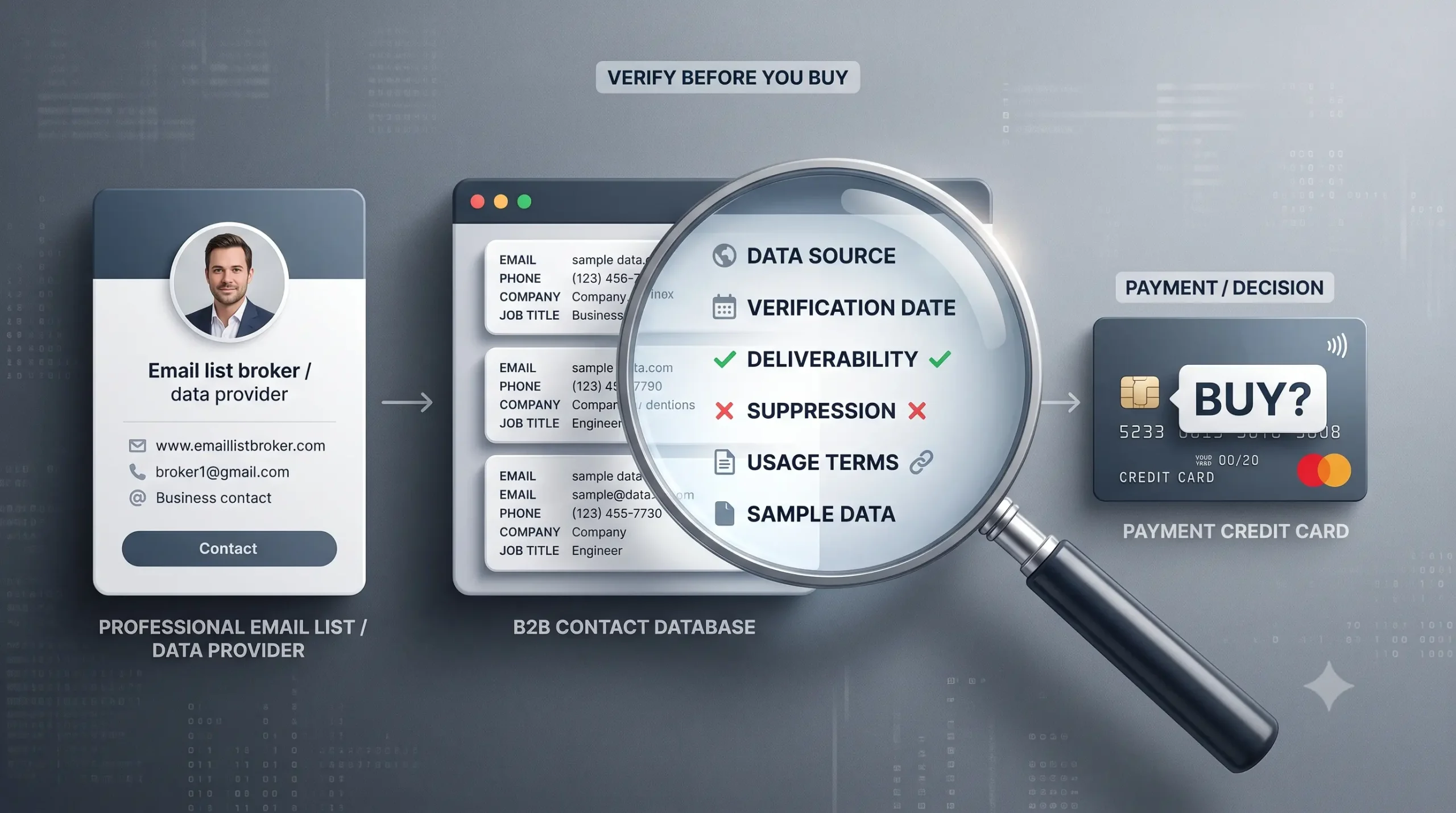
- Ask when the data was last verified. Software tool adoption changes, especially for cloud platforms that companies switch more frequently than on-premise systems.
- Ask what sources were used to confirm usage. Web scan only, or multi-source? Multi-source is more reliable.
- Ask about coverage gaps. If your product targets mid-market companies, confirm that the provider’s data has coverage at that segment size, not just enterprise.
- Ask about deliverability. A technographic contact who has an invalid email address is worthless. Request a deliverability guarantee or a sample you can verify before purchasing.
Learn how technographic data is compiled and what it tells you about a prospect in our guide to how technographic data works. For QuickBooks-specific outreach, see our post on reaching QuickBooks users for B2B outreach.