You spent hours writing the perfect fundraising letter. You designed a compelling package. You crafted an emotional story and a clear call to action.
And then almost nobody responds.
The problem isn’t your letter. It’s your list.
A great message sent to the wrong people gets ignored. A mediocre message sent to the right people gets results. Your fundraising mailing list the actual contacts you’re reaching out to matters more than almost anything else in your direct mail campaign.
When your list is clean, targeted, and well-maintained, response rates can hit 5-10%. When your list is messy, outdated, or poorly managed, response rates drop below 1%. You waste money on postage, printing, and staff time reaching people who will never give.
This guide breaks down the seven most common mailing list mistakes nonprofits make and exactly how to fix each one.
Why Your Mailing List Matters More Than Your Message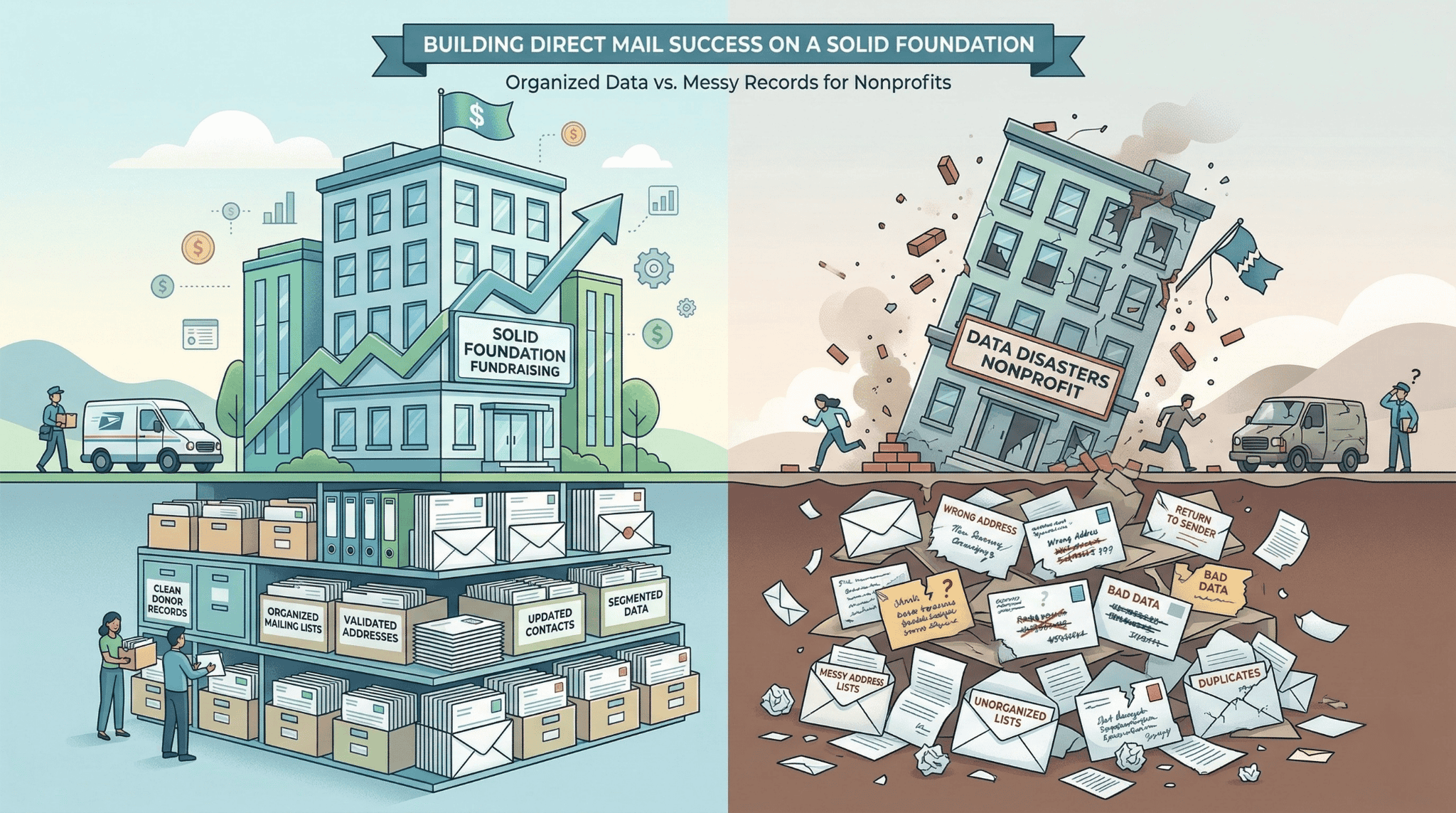
Here’s the truth about direct mail fundraising: the quality of your mailing list determines your results more than the quality of your letter.
The best-written appeal in the world fails if it goes to people who have no interest in your cause, no ability to give, or no valid address. Meanwhile, even a basic letter sent to engaged, qualified donors can generate strong responses.
Think of your mailing list as the foundation of a building. If the foundation is weak, nothing you build on top of it will stand. If the foundation is solid, everything else gets easier.
Response rates tell the story clearly. A well-maintained mailing list of engaged donors can pull 5-10% response rates. A poorly maintained list full of bad data might get 0.5-1%. That’s not a small difference it’s the difference between a campaign that works and one that loses money.
Your mailing list is also an asset that needs regular maintenance. Contacts change addresses. Donors pass away. People lose interest. If you’re not actively managing your list, it degrades by 20-30% every year. What worked last year stops working this year, and you don’t know why.
The mistakes below are the ones nonprofits make most often. Fixing them doesn’t require expensive software or a data team just attention and consistent effort.
Mistake 1: Buying Cheap, Low-Quality Lists
You need more contacts fast, so you buy a donor list from a discount broker promising 100,000 names for a few hundred dollars. It sounds like a deal.
It’s not.
Cheap lists are cheap for a reason. They’re filled with outdated contacts, incorrect addresses, and people who have no connection to causes like yours. Some are scraped from public records. Others are recycled from old campaigns run by organizations that went out of business. Many haven’t been updated in years.
Why this kills your response rates:
When 30-50% of the contacts bounce or have no interest in your cause, you’re wasting money on every piece you send. Even worse, high bounce rates damage your reputation with postal services and make future mailings more expensive.
Recipients who do receive your mail have no idea who you are and didn’t ask to hear from you. They’re not predisposed to give. They’re predisposed to throw your letter away.
How to fix it:
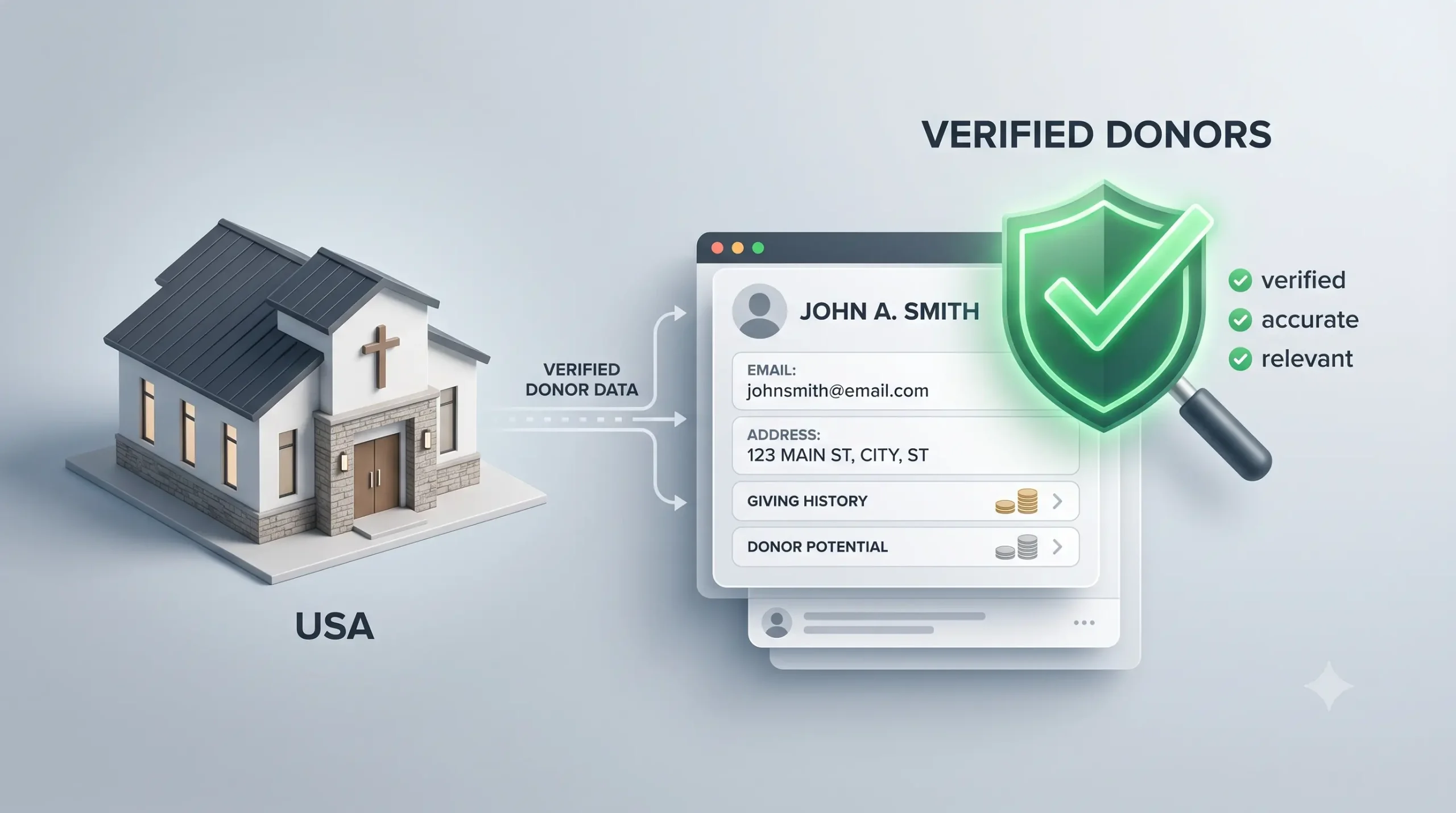
If you need to purchase a mailing list, work with reputable data brokers who specialize in nonprofit donor lists. Look for providers who offer “modeled” lists contacts selected based on their similarity to your existing best donors.
Start with a small test. Buy 5,000 names, run a campaign, and track the results before scaling up. This lets you verify quality without risking your entire budget.
Use address verification services like USPS NCOA (National Change of Address) to clean the list before mailing. This catches moved contacts and reduces bounces.
Yes, quality lists cost more upfront typically $0.10 to $0.50 per contact instead of pennies. But a list where 95% of contacts are valid and relevant delivers far better returns than a cheap list where half the contacts are useless.
Mistake 2: Never Cleaning Your List
Your mailing list grows over time. You add new donors, event attendees, newsletter subscribers, and prospects. But you never remove anyone.
Years go by. Your list now includes donors from 2015 who haven’t given since. It includes people who moved and whose mail bounces every time. It includes deceased donors whose families keep receiving your appeals.
You keep mailing everyone anyway, assuming someone might respond.
Why this kills your response rates:
Dead contacts drag down your overall performance. Every bounced letter wastes money. Every undeliverable piece counts against your delivery rate. Postal services notice high bounce rates and may charge you more or flag your mail as low-quality.
Lapsed donors who haven’t given in 2+ years respond at rates below 0.5%. Mailing them repeatedly costs far more than it generates.
Old, unengaged contacts dilute your list quality. When you’re tracking metrics like response rate, a list full of non-responders makes everything look worse than it is.
How to fix it:
Clean your list at least quarterly. Set a recurring calendar reminder and stick to it.
Remove hard bounces immediately addresses that the post office returns as undeliverable. These will never work.
Identify lapsed donors using a simple rule: anyone who hasn’t donated in 24+ months and hasn’t responded to your last three appeals should be moved to a separate reactivation list or removed entirely.
Use suppression files to remove deceased donors and people who have explicitly asked not to be contacted. Services like DMAchoice.org provide lists of people who’ve opted out of direct mail.
The goal isn’t to shrink your list for the sake of shrinking it. The goal is to focus your resources on contacts who might actually respond. A list of 5,000 engaged donors outperforms a list of 20,000 contacts where 15,000 will never give.
Mistake 3: Mailing Everyone the Same Way
Your mailing list includes first-time donors who gave $25 last month. It includes loyal supporters who’ve given $100 every year for a decade. It includes major donors who wrote a $5,000 check last quarter. And it includes prospects who’ve never donated at all.
You send all of them the exact same letter with the exact same ask.
Why this kills your response rates:
Different donors need different messages. A major donor who’s been supporting you for years doesn’t need to be convinced your organization matters they already know. They need to know what their next gift will accomplish and why it matters now.
A first-time donor needs reassurance that their gift will be used well. A lapsed donor needs a reason to come back. A prospect needs to understand why they should care about your cause in the first place.
Generic appeals feel impersonal. They signal that you don’t know who you’re talking to. When every nonprofit sends the same mass appeal, donors tune out.
How to fix it:
Segment your mailing list into at least three groups based on giving history:
New and first-time donors: Send welcome messages that thank them, explain your impact, and set expectations for future communication. Keep asks modest ($25-$50) until they’ve given multiple times.
Loyal repeat donors: These are your most valuable contacts. Thank them personally. Show them specific impact from past gifts. Make upgrade asks that acknowledge their history (“You’ve given $100 the past three years would you consider $150 this year?”).
Major donors: Send personalized appeals, not mass mailings. Handwritten notes work better than printed letters. Offer opportunities for deeper involvement like site visits or calls with program staff.
You don’t need expensive software to do this. A simple spreadsheet sorted by last gift date and lifetime giving can create basic segments. Track who gives what and when, then mail accordingly.
Segmented mailings consistently outperform one-size-fits-all appeals by 20-30% or more.
Mistake 4: Ignoring Lapsed Donors
Lapsed donors are people who gave once or gave regularly in the past, then stopped. They’re still on your mailing list. You’re not sure what to do with them.
Some nonprofits keep mailing lapsed donors indefinitely, hoping they’ll give again eventually. Others remove them quickly to keep the list clean. Both approaches have problems.
Why this kills your response rates:
Mailing lapsed donors forever wastes money. If someone hasn’t responded to your last six appeals over two years, they’re almost certainly not coming back. Every letter you send them is money you could spend reaching engaged prospects.
But giving up too quickly leaves money on the table. Donors lapse for lots of reasons that have nothing to do with your organization financial stress, life changes, simple forgetfulness. Many will give again if you reach out the right way.
Treating lapsed donors the same as active donors doesn’t work. They need a different message acknowledging the gap and giving them a reason to reconnect.
How to fix it:
Create a specific reactivation strategy for lapsed donors. Identify anyone who hasn’t donated in 12-24 months but gave at least once before.
Send them a targeted “we miss you” campaign 2-3 mailings over 8-12 weeks with messaging specifically acknowledging they haven’t given recently. Make it easy to give again with a suggested gift matching their last donation amount.
Track results carefully. Lapsed donors who respond to reactivation campaigns are back on your active list. Those who don’t respond after 2-3 attempts should be removed or moved to a low-frequency communication list.
This approach stops you from wasting money on people who’ll never give again while giving real reactivation opportunities to donors who just need a nudge.
Mistake 5: Not Tracking Who Actually Responds
You send out mailings and track total responses. You know how many people donated and how much you raised. But you don’t track which specific contacts on your list responded and which didn’t.
Over time, your list includes people who respond every time, people who responded once three years ago, and people who’ve never responded at all. You treat all of them the same.
Why this kills your response rates:
Some contacts are far more valuable than others. Donors who respond to multiple appeals should be prioritized and mailed more often. Contacts who never respond shouldn’t be mailed at all after a certain point.
Without tracking individual response history, you can’t identify your best prospects or weed out non-responders. You’re guessing instead of using data.
You also can’t measure lifetime value. A donor who gives $50 once isn’t as valuable as a donor who gives $50 four times a year. But if you’re not tracking response patterns, you treat them identically.
How to fix it:
Add response tracking to your database. Every time someone donates in response to a mailing, record it in your CRM or spreadsheet alongside their contact information.
Use this data to create a simple scoring system:
- High-value responders: Donated in the last 12 months, donated 3+ times total, lifetime giving over $500. Mail these contacts frequently.
- Medium-value responders: Donated in the last 24 months, donated 1-2 times, lifetime giving under $500. Mail these contacts regularly but less frequently.
- Low-value contacts: Haven’t donated in 24+ months, or never donated at all. Mail these contacts sparingly or remove them after a reactivation attempt.
This is essentially RFM analysis (Recency, Frequency, Monetary value) in simplified form. You’re prioritizing contacts based on when they last gave, how often they give, and how much they give.
The 80/20 rule applies here: roughly 20% of your donors will generate 80% of your revenue. Identify that 20% and treat them differently.
Mistake 6: Skipping Suppression Lists
Your mailing list includes people who’ve asked to be removed from your mailings. It includes deceased donors whose families still receive your appeals. It includes contacts who’ve moved and left no forwarding address.
You don’t have a systematic way to identify and remove these contacts, so they stay on your list indefinitely.
Why this kills your response rates:
Mailing people who’ve explicitly asked not to be contacted damages your reputation and may violate regulations. Some states have laws requiring nonprofits to honor opt-out requests promptly.
Mailing deceased donors is both wasteful and insensitive. Families who keep receiving appeals for a loved one who passed away form negative opinions of your organization.
High numbers of undeliverable mail increase your costs and hurt your standing with postal services.
Every piece sent to a contact who can’t or won’t respond is money thrown away.
How to fix it:
Maintain an active suppression list a list of contacts who should never be mailed. Update it regularly and check every mailing list against it before sending anything.
Your suppression list should include:
- Anyone who’s requested removal from your mailings
- Deceased donors (when you’re notified)
- Addresses that have bounced multiple times
- Contacts marked as “do not mail” for any reason
Use suppression services like DMAchoice.org to access national opt-out lists. Many donors who don’t want any direct mail register with these services. Checking your list against them prevents complaints.
Include a clear opt-out option in every mailing: “To remove yourself from our mailing list, contact us at [email/phone].” When someone uses it, honor the request immediately.
Run your list through USPS NCOA (National Change of Address) before major mailings to catch contacts who’ve moved.
Suppression isn’t about limiting your reach it’s about respecting preferences, avoiding waste, and protecting your organization’s reputation.
Mistake 7: Building Your List Without Permission
You need more contacts, so you add people to your mailing list without asking them. Maybe you buy an unverified list. Maybe you scrape email addresses from a website and add the mailing addresses from public records. Maybe you add everyone who attended a community event even though they didn’t sign up for your mailings.
You figure that more contacts means more potential donors, and people can always opt out if they don’t want to hear from you.
Why this kills your response rates:
People who didn’t choose to hear from you don’t respond well. They have no relationship with your organization. They didn’t express interest in your cause. To them, your mail is junk mail.
Unsolicited mailings generate high rates of complaints and opt-out requests. Too many complaints can get you flagged by postal services or land you on blacklists.
Depending on where your contacts live and how you obtained their information, mailing without consent may violate privacy laws like GDPR (Europe), CCPA (California), or CASL (Canada). Violations can result in significant fines.
Most importantly, mailing without permission damages trust. Donors expect nonprofits to respect privacy and communicate ethically. Starting the relationship with an unwanted mailing creates a negative first impression that’s hard to overcome.
How to fix it:
Only add contacts to your mailing list who’ve actively chosen to hear from you. This includes:
- People who filled out a form on your website requesting information or updates
- Donors who gave through any channel (they’ve demonstrated interest)
- Event attendees who checked a box opting in to future communications
- People who signed up for your newsletter or other communications
Make opt-in clear and explicit. Use checkboxes on forms that people have to actively select, not pre-checked boxes they have to uncheck.
Document how and when each contact joined your list. If you’re ever questioned about consent, you need to be able to prove it.
If you purchase a mailing list, verify that the provider obtained proper consent from everyone on it. Reputable list brokers can document how contacts were acquired and that they opted in to receive mailings from nonprofits.
Building a smaller list of people who actually want to hear from you will always outperform a larger list of people who didn’t ask for your mail.
Which Mistakes Should You Fix First?
You probably recognize several of these mistakes in your own mailing practices. The question is: where do you start?
If your bounce rate is high (more than 5% of your mail is returned as undeliverable), fix Mistakes 2 and 6 first. Clean your list, remove bad addresses, and set up suppression processes. This stops you from wasting money on mail that never gets delivered.
If your response rates are low (under 2-3%), fix Mistakes 3 and 5 first. Start segmenting your list and tracking who actually responds. This helps you focus your efforts on contacts most likely to give.
If you’re getting complaints or opt-out requests, fix Mistakes 6 and 7 first. Make sure you’re only mailing people who want to hear from you and that you’re honoring removal requests immediately. This protects your reputation and keeps you compliant.
If you’re starting from scratch or buying lists, focus on Mistakes 1 and 7. Only buy from reputable sources, and make sure everyone on your list consented to be there.
You don’t need to fix everything at once. Pick the biggest problem affecting your results right now and start there. Small improvements compound over time.
The Bottom Line on Mailing List Mistakes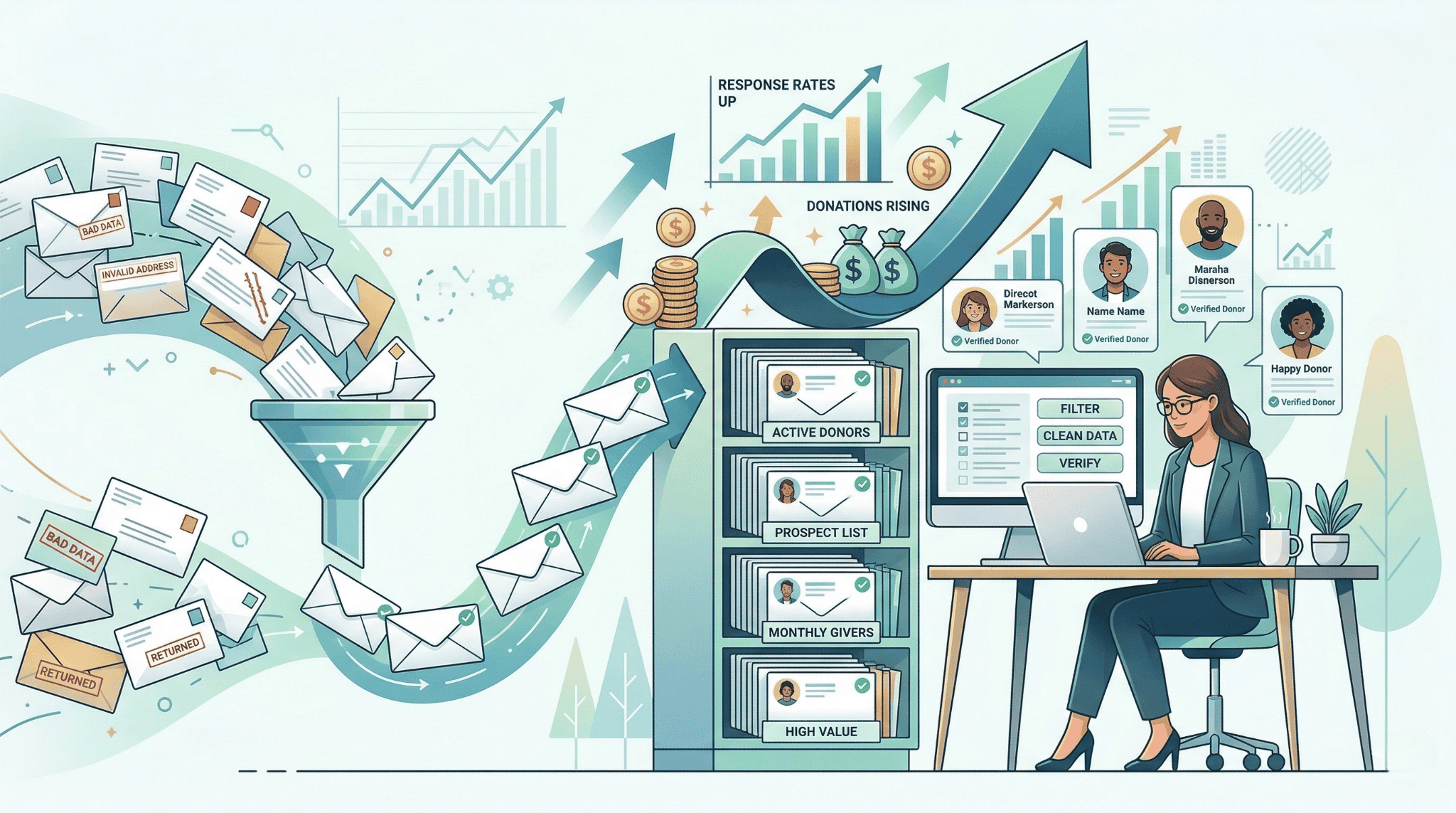
Your fundraising results are only as good as your mailing list. The best letter, the most compelling story, and the most urgent need won’t matter if you’re sending mail to the wrong people or to contacts who don’t exist.
The seven mistakes above are the most common reasons nonprofit mailing lists underperform. The good news is that all of them are fixable with time and attention. You don’t need expensive software or a data team just a commitment to treating your mailing list as the valuable asset it is.
Start by auditing your current list. How many contacts bounce? When did your donors last give? Are you mailing everyone the same way? Identify your biggest problem, fix it, and measure the results.
The nonprofits seeing strong direct mail results in 2026 aren’t the ones with the biggest lists. They’re the ones with the cleanest, most targeted, best-maintained lists and they’re focusing their resources on contacts who actually respond.
Need help building or sourcing a clean, targeted fundraising mailing list? Prospects Influential specializes in providing verified donor lists for nonprofits. Reach out to learn how we can help you connect with the right supporters.