You’re planning a marketing campaign. Budget is approved. Creative is ready. Your team is excited. But there’s one critical decision that will determine whether your campaign succeeds or fails: choosing the right marketing list.
Pick the wrong list, and you’ll waste thousands of dollars mailing to people who’ll never buy, calling disconnected numbers, or emailing contacts who immediately unsubscribe. Your campaign will underperform, your team will be demoralized, and your leadership will question whether direct marketing even works.
Pick the right list, and everything changes. Your message reaches genuinely interested prospects. Response rates exceed expectations. Your sales team stays busy with qualified leads. The campaign ROI justifies expanded budgets for future initiatives.
The difference between these two outcomes often comes down to understanding what types of marketing lists exist, which one fits your specific needs, and how to evaluate quality before you buy.
With thousands of available lists spanning every industry, demographic, and interest category, how do you choose? What criteria matter most? And how do you avoid the costly mistakes that plague inexperienced list buyers?
Let’s break down exactly how to choose the right marketing list for your business campaign whether you’re targeting consumers or businesses, running direct mail or telemarketing, seeking donors or customers.
Understanding the Marketing List Landscape: Types and Categories
Before you can choose the right list, you need to understand what options exist. Marketing lists fall into several major categories:
Business-to-Business (B2B) Lists
Business lists target companies and decision-makers within organizations. These lists help you reach the people who purchase products or services for their businesses.
What they include:
- Company name and industry classification
- Decision-maker names and titles
- Company size (employees, revenue)
- Geographic location
- Phone numbers and email addresses
Best for:
- B2B sales (software, equipment, professional services)
- Business consultants and agencies
- Commercial suppliers and distributors
- Technology vendors
- Financial and insurance services for businesses
Key consideration: B2B lists require more sophisticated targeting because you need to reach specific roles within specific types of companies.
Business-to-Consumer (B2C) Lists
Consumer lists target individual households and consumers making personal purchasing decisions.
What they include:
- Individual names and addresses
- Demographic data (age, income, homeownership)
- Behavioral indicators (purchase history, interests)
- Geographic information
- Contact methods (phone, email)
Best for:
- Retail and e-commerce
- Consumer services (insurance, financial planning, home services)
- Direct-to-consumer brands
- Local service providers
- Consumer product companies
Key consideration: Consumer lists require understanding lifestyle, behaviors, and demographics that predict purchasing likelihood.
Specialty Lists
Specialty lists are highly targeted databases focused on specific niche markets, industries, or consumer segments that don’t fit standard classifications.
Business specialty lists include:
- Industry-specific businesses (automotive, healthcare, hospitality)
- New businesses and startups
- Women-owned or minority-owned businesses
- Home-based businesses
- Businesses with specific certifications or technologies
Consumer specialty lists include:
- Life event triggers (new movers, new parents, recent home buyers)
- Hobby and interest groups (pet owners, travel enthusiasts, book lovers)
- High-net-worth individuals
- Specific demographic niches
Best for:
- Companies with very specific target markets
- Products or services with narrow ideal customer profiles
- Premium offerings requiring precise targeting
- Niche market leaders
Key consideration: Specialty lists cost more but deliver significantly higher response rates due to precision targeting.
Donor and Nonprofit Lists
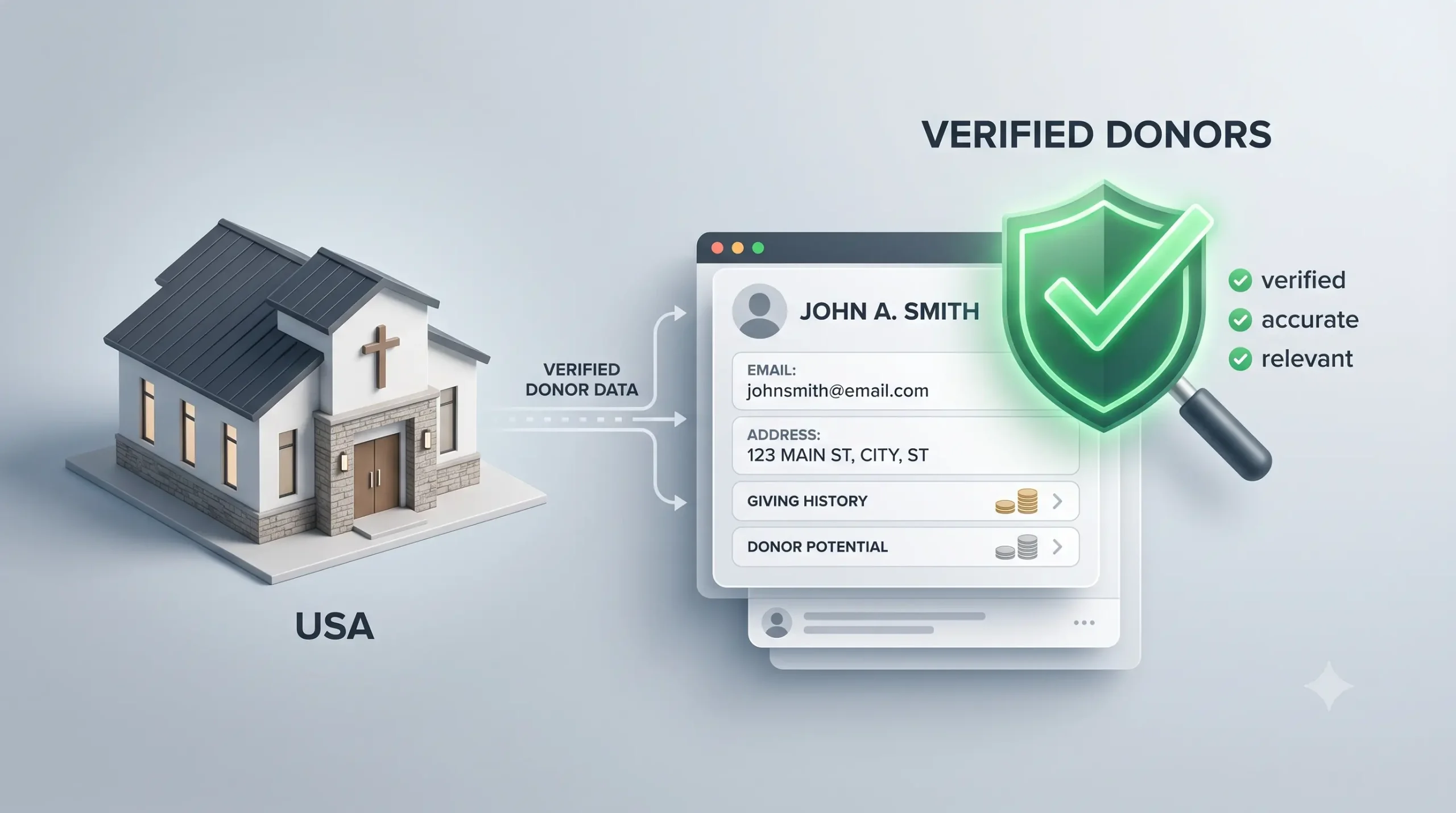
Donor lists target individuals with proven charitable giving histories, essential for nonprofit fundraising and cause-related marketing.
What they include:
- Giving history (frequency, amounts, causes)
- Wealth indicators
- Cause affinity (health, education, environment, animals)
- Demographics and lifestyle data
Best for:
- Nonprofit organizations
- Charities and foundations
- Political campaigns
- Educational institutions
- Faith-based organizations
Key consideration: Donor lists require understanding giving capacity and cause alignment to avoid wasting outreach on poor matches.
Multi-Channel Lists
Multi-channel lists provide multiple contact methods (mail, phone, email) for the same individuals or businesses, enabling coordinated campaigns across touchpoints.
What they include:
- All standard data fields
- Multiple verified contact methods
- Consistency across channels (same person, all methods)
Best for:
- Integrated marketing campaigns
- Account-based marketing
- High-value prospect nurturing
- Complex B2B sales processes
- Campaigns requiring multiple touchpoints
Key consideration: Multi-channel lists cost more but deliver superior results through reinforced messaging across channels.
Step 1: Define Your Campaign Objectives
Before evaluating any lists, get crystal clear on what you’re trying to achieve:
Lead Generation: Are you trying to fill your sales pipeline with qualified prospects? You need lists with decision-maker contacts and clear qualification criteria.
Direct Sales: Selling directly through the campaign? You need lists of people ready to buy, with strong purchase intent indicators.
Brand Awareness: Building recognition in new markets? Broader targeting may work, but still focus on audiences likely to eventually need your offering.
Customer Reactivation: Winning back lapsed customers? You need lists that look like your existing customer base (lookalike modeling).
Market Testing: Validating product-market fit? Small, highly targeted test lists help you learn before scaling.
Donor Acquisition: Raising funds for nonprofit work? You need proven donor lists with cause alignment and giving capacity.
Your objective determines which list characteristics matter most and how you should evaluate options.
Step 2: Understand Your Ideal Customer Profile
The more precisely you define your ideal customer, the better you can target:
For B2B Campaigns, Define:
Industry: What industries do you serve best? Use SIC/NAICS codes or industry classifications to target precisely.
Company Size: Employee count, annual revenue, number of locations what size companies get optimal value from your solution?
Geographic Location: Can you serve nationally, or are you limited to specific regions? If location-dependent, tight geographic targeting is essential.
Decision-Maker Roles: Who actually makes purchasing decisions for your category? CEOs? Purchasing managers? IT directors? Operations managers?
Technology Stack: For tech companies, knowing what systems prospects currently use helps identify compatibility or replacement opportunities.
Business Stage: Established companies have different needs than startups. Recent growth or funding events may signal readiness to buy.
For B2C Campaigns, Define:
Demographics: Age, income, education, homeownership status, marital status, family composition.
Geographic Location: Urban vs. suburban vs. rural? Specific regions or climates? Local service areas?
Psychographics: Values, attitudes, interests, lifestyle characteristics.
Behaviors: Purchase history, brand preferences, media consumption, online activities.
Life Stage: Life events (new baby, marriage, retirement, home purchase) create specific needs and buying windows.
The more specific your ideal customer profile, the more precisely you can target lists.
Step 3: Choose the Right Channel for Your Campaign
Different marketing channels require different list types:
Direct Mail Lists
Business direct mail lists and consumer direct mail lists provide physical mailing addresses for sending postcards, letters, catalogs, or dimensional packages.
When direct mail makes sense:
- High-value products or services justifying mail costs
- Complex offerings requiring space to explain
- Premium positioning benefiting from tangible materials
- Audiences less responsive to digital (older demographics, certain industries)
- Local service businesses targeting specific neighborhoods
Key list requirements:
- CASS-certified addresses (deliverability verification)
- NCOA processing (updated for moves)
- Accurate names (personalization improves response)
Email Marketing Lists
Business opt-in email lists and consumer opt-in email lists provide email addresses for digital campaigns.
When email makes sense:
- Fast campaign deployment needed
- Lower budgets (email costs far less than mail)
- Tech-savvy audiences who live in their inboxes
- Ongoing nurture campaigns with regular touchpoints
- Content marketing distribution
Key list requirements:
- Opt-in status (permission-based for compliance)
- Recent verification (email addresses decay quickly)
- CANSPAM compliance documentation
- Domain validation (real, active email domains)
Telemarketing Lists
Business telemarketing lists and consumer telemarketing lists provide phone numbers for outbound calling campaigns.
When telemarketing makes sense:
- High-value offerings justifying calling costs
- Complex sales requiring conversation and discovery
- Appointment setting for field sales teams
- Immediate feedback and objection handling needed
- Quick market testing with real-time results
Key list requirements:
- Do Not Call Registry scrubbing (legally required)
- Phone number verification (active, correct numbers)
- Direct dial numbers vs. switchboard (B2B efficiency)
- TCPA compliance for cell phone calls
Most successful campaigns combine multiple channels using multi-channel lists for coordinated outreach.
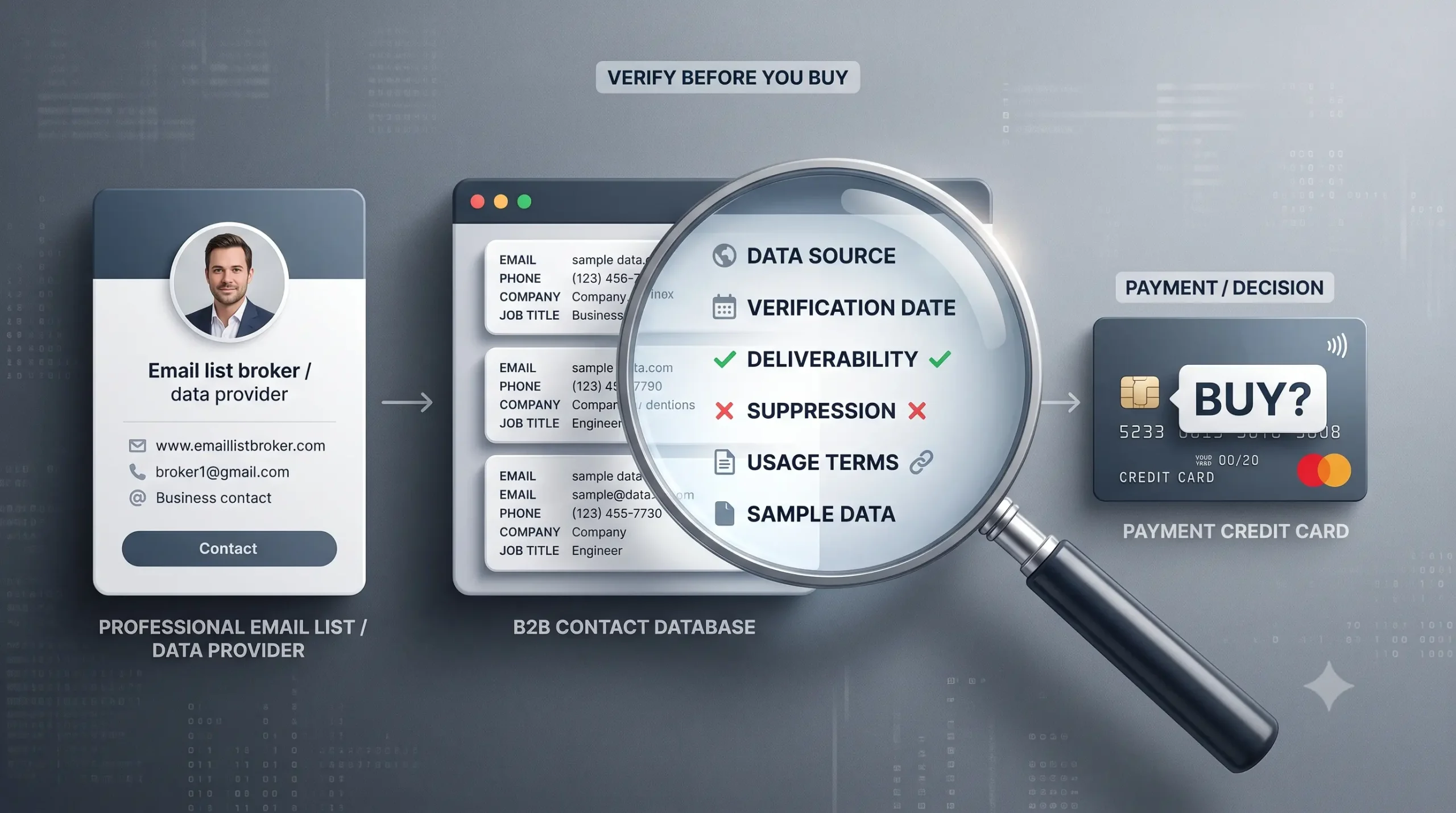
Step 4: Evaluate Critical List Quality Indicators
Not all lists are created equal. Here’s what separates quality from junk:
Data Freshness and Update Frequency
Why it matters: Contact information decays rapidly. People change jobs, move, disconnect phones, and change email addresses constantly.
What to ask:
- When was this list last updated?
- How often is it refreshed?
- What percentage of records change in each update?
Quality standard: Monthly or quarterly updates. Anything less frequent means significant decay.
Red flag: Providers who can’t specify update dates or update annually or less.
Source Transparency
Why it matters: List quality depends entirely on where data comes from.
What to ask:
- Where does your data originate?
- How do you compile information?
- Do you purchase from other sources or compile directly?
Quality standard: Clear explanation of reputable sources business registrations, verified surveys, opt-in subscriptions, public records.
Red flag: Vague answers, purchased from unknown brokers, or web-scraped data without verification.
Deliverability Guarantees
Why it matters: Bad addresses, disconnected phones, and bounced emails waste budget and hurt sender reputation.
What to ask:
- What deliverability rate do you guarantee?
- What happens if I get bad data?
- Do you offer replacements for undeliverable records?
Quality standard: 95%+ deliverability guarantee with clear replacement policy.
Red flag: No guarantee, rates below 90%, or refusal to stand behind data quality.
Targeting Precision
Why it matters: Generic broad lists waste money reaching people who’ll never buy.
What to ask:
- What selection criteria are available?
- Can I layer multiple filters?
- How granular can I get with targeting?
Quality standard: Extensive selection options allowing precise audience definition.
Red flag: Limited targeting options, one-size-fits-all lists, inability to narrow audiences.
Compliance Documentation
Why it matters: Non-compliant marketing risks fines, lawsuits, and reputation damage.
What to ask:
- How do you ensure CANSPAM compliance (email)?
- Are lists scrubbed against Do Not Call Registry (phone)?
- Can you document opt-in status and consent?
- What about GDPR or CASL for international contacts?
Quality standard: Clear compliance processes, documented scrubbing, written confirmation.
Red flag: Dismissing compliance concerns, no documentation, or encouraging questionable practices.
Step 5: Match List Type to Your Business Model
Different businesses need different list strategies:
If You’re a Local Service Business
Your needs: Hyperlocal targeting in your service area.
Best list types:
- Consumer lists filtered by ZIP code or radius
- Homeowners (for home services)
- Specific demographics matching your service (new parents for photographers, retirees for estate planning)
Channel priority: Direct mail for tangible local presence, followed by email for nurture.
If You’re a B2B SaaS Company
Your needs: Decision-makers at companies matching your ideal customer profile.
Best list types:
- Business lists filtered by industry, company size, and job titles
- Technology firmographic data (current systems used)
- Multi-channel for ABM campaigns
Channel priority: Email for scale, phone for high-value prospects, mail for premium positioning.
If You’re an E-Commerce Brand
Your needs: Consumers with purchase behaviors matching your products.
Best list types:
- Consumer lists with lifestyle and interest targeting
- Catalog buyer lists in complementary categories
- Previous customers of similar brands
Channel priority: Email for cost-effective scale, mail for premium product launches.
If You’re a Nonprofit
Your needs: Donors with capacity and cause alignment.
Best list types:
- Donor lists with giving history
- Wealth indicators and philanthropic patterns
- Cause-specific affinity (environment, health, education)
Channel priority: Direct mail for fundraising appeals (highest ROI), email for stewardship and updates.
If You’re a Manufacturing Supplier
Your needs: Manufacturers in specific industries who need your components or services.
Best list types:
- Manufacturing companies lists by industry vertical
- Decision-maker contacts (purchasing, operations, engineering)
- Company size matching your ideal customer
Channel priority: Phone for relationship building, email for technical content, mail for product samples.
If You’re Targeting Specific Industries
Many businesses serve specific industry verticals exclusively:
Automotive industry: Automotive industry lists targeting dealers, repair shops, or suppliers.
Healthcare: Healthcare professional lists for medical equipment, services, or pharmaceuticals.
Hospitality: Hospitality industry lists for restaurants, hotels, or tourism businesses.
Real estate: Real estate professional lists for services targeting agents, brokers, or developers.
Industry-specific lists deliver better results than generic business lists because they already filter for relevance.
Step 6: Determine Appropriate Budget and Volume
List costs vary dramatically based on targeting, quality, and channel:
Pricing Considerations
Consumer Lists: $50-$150 per thousand (CPM) depending on targeting complexity.
Business Lists: $100-$300+ per thousand depending on contact level and industry.
Specialty Lists: $200-$500+ per thousand for highly targeted niche markets.
Email Lists: Often more expensive due to opt-in requirements and higher value.
Multi-Channel Lists: Premium pricing but better campaign ROI.
Volume Decisions
Minimum Orders: Most lists have minimums (1,000-5,000 contacts).
Test Before Scaling: For first campaigns, order minimum quantities to test list performance before committing to larger volumes.
Budget Allocation: Spend 70-80% of budget on the best-performing list after testing, 20-30% on testing new segments.
Frequency Planning: Can you re-rent lists for multiple campaigns, or is this one-time? Plan volumes accordingly.
Remember: cheap lists are expensive when they don’t work. Quality data costs more upfront but delivers far better ROI.
Step 7: Test and Validate Before Scaling
Never commit to large list purchases without testing:
Design Smart Tests
Order Test Quantities: 250-1,000 records matching your targeting criteria.
Test Multiple Segments: Compare 2-3 different list options to identify best performers.
Test Offers: Sometimes list performs fine but offer needs adjustment test both variables.
Track Meticulously: Monitor deliverability, response rates, conversion rates, and ROI for each test segment.
What to Measure
Deliverability: What percentage actually reaches intended recipients? Target 95%+.
Response Rate: What percentage take desired action? Benchmarks vary by industry and channel but 1-5% is typical for cold campaigns.
Conversion Rate: What percentage of responders become customers? This determines ROI.
List Accuracy: Are you reaching the right people at the right companies in the right roles?
Scale What Works
After testing:
- Invest heavily in best-performing segments
- Refine or abandon underperformers
- Expand targeting slightly to find adjacent opportunities
- Maintain ongoing testing to optimize continuously
Step 8: Work with Experienced List Brokers
Given the complexity of list selection, most successful marketers work with professional list brokers:
Why Brokers Add Value
Unbiased Recommendations: Unlike list owners who only sell their own data, brokers recommend the best fit from thousands of options.
Quality Vetting: They know which providers maintain accurate data and which cut corners.
Market Knowledge: Years of experience reveal what works for different industries, offers, and target markets.
Negotiation Power: Established relationships often secure better pricing or waived minimums.
Time Savings: They handle research, vetting, ordering, and delivery coordination.
Ongoing Optimization: They analyze results and refine targeting for future campaigns.
Questions to Ask Prospective Brokers
- How long have you been in the list brokerage business?
- What industries or markets do you specialize in?
- How many list sources do you have access to?
- Can you provide references from similar businesses?
- What’s your process for ensuring list quality?
- How do you handle problems with data quality?
Reputable brokers become strategic partners invested in your campaign success, not just transactional vendors.
Common Mistakes to Avoid When Choosing Marketing Lists
Learn from others’ expensive mistakes:
Mistake 1: Choosing Based on Price Alone
The cheapest list is rarely the best list. Poor quality data costs far more in wasted effort than you save on list rental.
Mistake 2: Targeting Too Broadly
“Everyone could use our product” is marketing suicide. Narrow targeting delivers exponentially better results.
Mistake 3: Ignoring Data Age
Last year’s list is outdated. Last decade’s list is worthless. Insist on recently refreshed data.
Mistake 4: Skipping Testing
Committing to tens of thousands of names without testing is gambling with your budget. Test small, scale what works.
Mistake 5: No Clear Ideal Customer Profile
If you can’t describe your perfect customer precisely, you can’t choose appropriate lists. Define before buying.
Mistake 6: Single-Channel Thinking
Direct mail, email, and phone each have strengths. Multi-channel campaigns dramatically outperform single-channel efforts.
Mistake 7: Neglecting Compliance
Legal violations aren’t just expensive they’re brand-damaging. Ensure lists comply with all regulations.
Mistake 8: No Follow-Up Plan
One touch rarely converts. Plan multi-touch sequences before launching campaigns.
Mistake 9: Ignoring List Source
Where data comes from determines quality. Vague or questionable sourcing means poor results.
Mistake 10: Expecting Immediate ROI
Especially for B2B and high-value offerings, initial campaigns build awareness and pipeline. Judge success over appropriate timeframes.
Industry-Specific List Selection Guidance
Different industries have unique considerations:
Healthcare and Medical
Strict HIPAA regulations, professional licensing requirements, and specialized decision-making processes require healthcare lists with appropriate targeting by specialty, facility type, and role.
Financial Services
Regulatory scrutiny and trust requirements mean targeting by income, investable assets, life stage, and financial sophistication.
Real Estate
Geographic hyperlocal targeting, timing around life events (moves, marriages, births), and homeowner vs. renter distinctions matter enormously for real estate targeting.
Manufacturing and Industrial
Long sales cycles, technical decision-making, and multiple stakeholders require manufacturing lists with deep firmographic data and verified contacts.
Nonprofit and Fundraising
Giving capacity, cause affinity, donor recency/frequency/monetary value (RFM), and wealth indicators determine donor list selection.
Technology and SaaS
Technographic data (current systems used), company growth signals, and job title precision matter for tech vendor list selection.
Final Thoughts: The Right List Changes Everything
Here’s the reality: your campaign creative, your offer, and your follow-up process all matter. But they matter far less than whether you’re reaching the right people.
The most brilliant marketing message sent to the wrong audience delivers zero results. A mediocre message sent to highly qualified, interested prospects generates sales.
Choosing the right marketing list isn’t glamorous. It doesn’t win creative awards. But it determines whether your campaign succeeds or fails, whether your budget delivers ROI or gets wasted, and whether your team views marketing as a lead generation engine or a cost center.
Whether you need business lists for B2B campaigns, consumer lists for direct-to-consumer marketing, specialty lists for niche targeting, or multi-channel campaigns coordinating multiple touchpoints, the principles remain the same:
Define your ideal customer precisely. Choose quality over cheap options. Test before scaling. Work with experienced partners who understand your market.
The right list isn’t the one that looks good on paper. It’s the one that delivers qualified prospects, generates real conversations, and converts to actual customers at costs that justify continued investment.
Stop guessing. Start targeting strategically. And watch your marketing campaigns deliver the results you’ve been seeking.
Ready to choose the perfect marketing list for your campaign? Work with experienced list brokers who can guide you through business list options, consumer targeting, and specialty market selection to ensure your outreach reaches exactly the right audience.